 Preview
 Send
Send Share
Share
 Details

 Download
 Similars
 X-Ray
X-Ray Diaporama
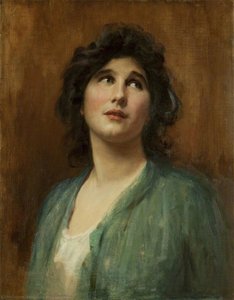
Adoration
 Oil
Oil- WallArt
- Social Realism
 19th Century
 61.0 x 45.0 cm
 Harris Museum - Art Gallery
 Read More
Hand Made Oil Reproduction
Hand-painted oil on canvas in your size and frame, made to order by our artists. ( Buy Print Buy Image)




P118B $10

P118H $10

P118W $10

P438Z $10

P508JH $12

P508YH $12

P805H $10

P805Z $10

P919BZ $10

P919G $10

P919XJ $10

P959ZH $10

P968JZ $12

W106C $8

W218G $10

W218JH $8

W218Y $10

W307PJ $10

W316G $10

W316PJ $8

W316Y $10

W398PJ $8

W4111J $10

W500HY $15

W500JH $15

W692G $12

W849H $8

W940BG $15

W953PJ $8




Pick from our preset sizes that match the artwork's original proportions.

You may enter your own dimensions to fit a specific frame or space. If your selected size does not match the original image's proportions, we will either crop the artwork or extend the painting with additional hand-painted elements. A digital mockup will be sent for your approval before production begins.
Please note that the on-screen preview does not reflect the actual cropping or extension. Only the mockup will accurately show the final composition.
While custom sizes are available, we recommend selecting a dimension from the predefined list to preserve the original proportions.
After order, ArtsDot.com team will email client for instructions and provide a mockup preview
Worldwide Delivery () in 3/4 weeks instead of standard 5 weeks. (18 August). No compromise on quality.

Free Worldwide Express Shipping

High-Quality Linen Canvas

Full Shipping Insurance

Customs Tax Refund Guarantee

True Color Matching Guarantee

60-Day Return Policy (Defects Only)

100% Money-Back Guarantee

Bulk Discount Offer
 Glass option is only available in size under 110 CM

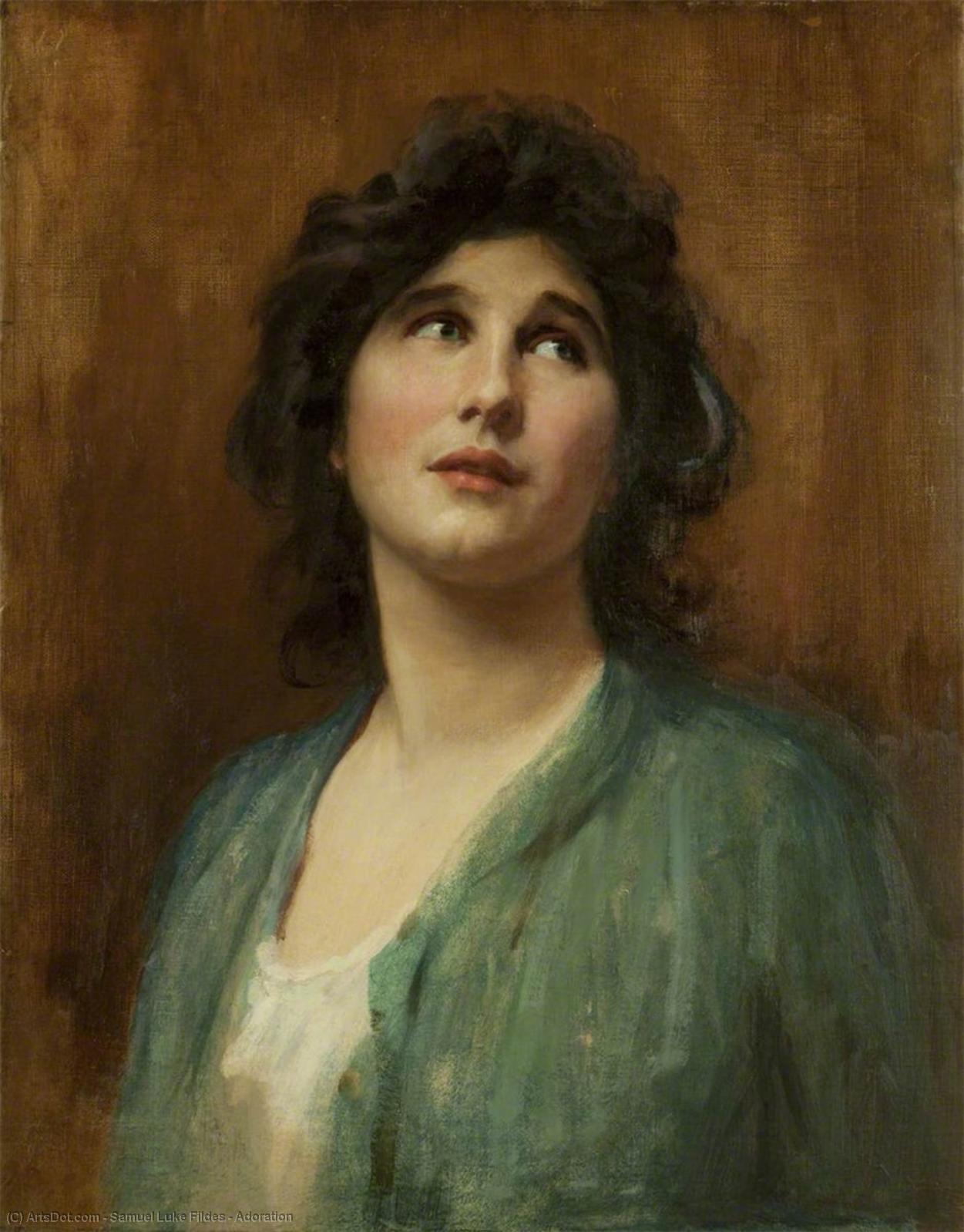
Adoration
Reproduction Medium
Reproduction Size
-


Total Price
$ 263
Artwork Description
A Moment Captured in Time: The Soul of Adoration
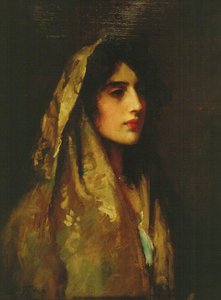
In the quiet intimacy of Adoration, we are invited into a private world where time seems to have momentarily suspended its forward march. This evocative portrait by the esteemed Victorian master Samuel Luke Fildes captures more than just a likeness; it captures a fleeting psychological state. The subject, a woman with expressive brown hair, gazes toward the viewer with an unmistakable sense of wonder. Her wide, luminous eyes and slightly parted lips suggest a sudden realization or a gentle surprise, creating a profound connection between the painted figure and the observer. It is this very vulnerability—the raw, unshielded curiosity of the human spirit—that makes the piece so deeply magnetic for those who appreciate art that speaks to the heart.
The composition is masterfully balanced, utilizing a soft, domestic setting to ground the subject's ethereal expression. Clad in a striking blue coat that serves as a vibrant anchor within the room's muted palette, the woman sits amidst the comforts of a lived-in space. The subtle presence of a couch and a chair in the background provides a sense of depth and narrative context, suggesting a quiet afternoon interrupted by a moment of profound thought. For the discerning collector or interior designer, this painting offers a sophisticated interplay of color and texture, where the cool tones of the blue garment contrast beautifully with the warm, ambient light of the domestic interior.
The Mastery of Social Realism and Technique
To understand the brilliance of Adoration, one must look to the lineage of its creator. Samuel Luke Fildes was a pivotal figure in the movement of Social Realism, a style characterized by its poignant, honest depiction of human emotion and social truth. While Fildes is often celebrated for his large-scale, dramatic narratives of Victorian life, it is in his smaller, more intimate portraits where his technical prowess truly shines. His training at the Royal Academy Schools allowed him to master the delicate handling of light and shadow, a technique used here to sculpt the woman's features and imbue her skin with a lifelike, porcelain quality.
The brushwork is deliberate yet fluid, guiding the eye from the intricate textures of her blue coat to the soft, searching gaze of her eyes. There is a rhythmic harmony in the way Fildes uses light to pull the subject forward from the shadows of the room, creating a three-dimensional presence that feels almost tangible. This level of craftsmanship ensures that a high-quality reproduction of this work retains its emotional weight and luminous character, making it an exquisite centerpiece for any curated collection or a sophisticated accent in a thoughtfully designed room.
An Enduring Legacy for Modern Spaces
Beyond its historical significance, Adoration possesses a timeless aesthetic appeal that transcends the Victorian era. In the context of modern interior design, the painting serves as a window into a more contemplative age. Its ability to evoke empathy and curiosity makes it an ideal choice for spaces intended for relaxation and reflection, such as libraries, study alcoves, or elegant sitting rooms. The piece does not merely decorate a wall; it breathes life into a room, providing a focal point that invites conversation and emotional resonance.
For those seeking to surround themselves with art that possesses both historical gravity and aesthetic grace, this work stands as a testament to the enduring power of portraiture. Whether you are an art historian drawn to Fildes' connection to the social realist tradition or a decorator looking for a piece that adds a layer of soulful sophistication to a contemporary setting, Adoration offers an unparalleled opportunity to own a fragment of much-loved history.
Related Artworks
Artist Biography
A Life Etched in Realism: The World of Samuel Luke Fildes
Born amidst the bustling port city of Liverpool in 1843, Samuel Luke Fildes emerged as a pivotal figure bridging Victorian illustration and painting. His lineage hinted at a life steeped in both artistry and social consciousness; he was the grandson of Mary Fildes, a dedicated political activist whose commitment to reform would subtly permeate his own artistic vision. Early experiences shaped young Luke’s path – a childhood spent observing the vibrant energy and underlying hardships of maritime Liverpool, followed by formal training that began at Warrington School of Art in 1860. This foundational period led him to South Kensington (later the Royal College of Art) and the prestigious Royal Academy Schools, where he forged lasting connections with fellow artists like Hubert von Herkomer and Frank Holl. However, it was the influence of Frederick Walker, a leading light of the social realist movement, that truly ignited Fildes’ artistic direction, instilling in him a desire to depict life as it *was*, not merely as it appeared to be. The young artist absorbed Walker’s commitment to portraying everyday struggles with honesty and empathy, a principle that would define much of his early work.
From Graphic Detail to Painted Narrative
Fildes initially found his voice – and an audience – through illustration. In 1869, he joined the staff of The Graphic, a groundbreaking illustrated newspaper edited by William Luson Thomas. This wasn’t merely a job; it was immersion in a world where art served as a powerful tool for social commentary. The Graphic's commitment to exposing societal ills resonated deeply with Fildes, and he quickly became known for his unflinching depictions of poverty and injustice. His work during this period wasn’t simply about documenting hardship; it was about humanizing those often rendered invisible by society. A pivotal moment arrived when Charles Dickens himself commissioned Fildes to illustrate the unfinished novel The Mystery of Edwin Drood, following a particularly poignant illustration of Dickens' empty chair after his death – an image that captured the nation’s grief and established Fildes’ reputation. This commission, alongside illustrations for other prominent periodicals like The Sunday Magazine, The Cornhill Magazine, and The Gentleman's Magazine, solidified his position as a leading illustrator of his time. The wood-engraving “Houseless and Hungry,” depicting the desperate plight of London’s homeless, brought him to Dickens’ attention and became emblematic of his early commitment to social realism. It was a stark reminder of the realities faced by many in Victorian England, and Fildes’ ability to convey this with such raw emotion set him apart.
A Shift in Medium: Embracing Oil and Expanding Vision
By 1870, Fildes felt a growing pull towards oil painting, a medium that allowed for greater nuance and depth than illustration. This transition marked a turning point in his career, as he began to establish himself not just as a skilled recorder of social realities but as a painter capable of capturing the complexities of human emotion and experience. He quickly rose through the ranks of the English art world, gaining recognition for works like The Casual Ward (1874), a stark portrayal of life within a workhouse; The Widower (1876), a deeply moving depiction of grief and loss; and The Village Wedding (1883), which offered a more optimistic, yet still grounded, view of rural life. His artistic horizons expanded beyond social commentary to encompass scenes of Venetian life – reflecting a growing fascination with light, color, and atmosphere – and an increasingly sought-after talent for portraiture. He became particularly renowned for his portraits commemorating the coronation of King Edward VII and Queen Alexandra, demonstrating his ability to capture both regal dignity and individual character. This period saw Fildes masterfully blending realism with a more refined aesthetic sensibility, showcasing his versatility as an artist.
Recognition, Legacy, and Lasting Influence
Fildes’ artistic achievements were met with increasing acclaim throughout his career. He was elected an Associate of the Royal Academy (A.R.A.) in 1879 and a full Royal Academician (R.A.) in 1887, solidifying his position within the established art world. In 1906, he received the honor of knighthood from King Edward VII, and later, in 1918, was appointed Knight Commander of the Royal Victorian Order (KCVO) by King George V. Beyond official recognition, Fildes also explored a lighter side to his artistry, producing caricatures under the pseudonym “Elf” for Vanity Fair. He became recognized as a leader of the Neo-Venetian school alongside Henry Woods, showcasing a shared passion for capturing the unique atmosphere and light of Venice. His personal life was equally fulfilling; he married Fanny Woods, sister to his friend Henry, in 1874, and together they had two sons, Philip and Sir Paul Fildes – the latter becoming an eminent scientist. Perhaps one of the most striking examples of his enduring influence is the inspiration his illustration of Dickens’ empty chair provided to Vincent van Gogh, leading to the creation of Van Gogh's iconic painting The Yellow Chair. Even in later years, his work continued to resonate – notably when his 1891 masterpiece, The Doctor, was used in a 1949 American Medical Association campaign, demonstrating the power of art to shape public discourse. Samuel Luke Fildes left behind a legacy not only as a gifted painter and illustrator but as an artist who dared to confront social realities while simultaneously celebrating the beauty and complexity of human life. His work continues to resonate with audiences today, offering a poignant glimpse into Victorian society and the enduring power of art to inspire empathy and understanding.
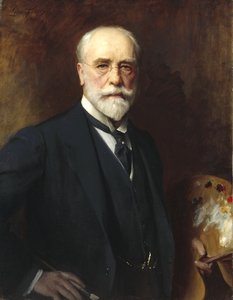
Samuel Luke Fildes
1843 - 1927 , United Kingdom
Quick Facts
- Artistic Movement Or Style: Social Realism
- Artists Or Movements Influenced By This Artist: ['Vincent van Gogh']
- Artists Who Influenced This Artist: ['Frederick Walker']
- Date Of Birth: 1843
- Date Of Death: 1927
- Full Name: Samuel Luke Fildes
- Nationality: British
- Notable Artworks:
- The Doctor
- The Casual Ward
- The Widower
- Houseless and Hungry
- Place Of Birth: Liverpool, UK
Related Articles

Slate Blue Masterpieces: 10 Iconic Paintings & Timeless Home Decor Ideas
Immerse yourself in the captivating world of slate blue! Explore 10 iconic paintings by Monet, Van Gogh & Renoir. Discover their stories, techniques & find museum-quality art reproductions for your home at .

The Allure of Azure: Exploring the Symbolic & Aesthetic Depths of Blue in Art History
Explore the rich history of blue in art! Discover its symbolism, from ancient pigments to modern masterpieces by Kandinsky & Seurat. Uncover the psychological impact and cultural meanings behind this captivating hue.

Romantic Realism's Finest: 10 Masterpieces for Your Home | ArtsDot
Explore 10 defining masterpieces of Romantic Realism! Discover Courbet, Millet & Daumier's powerful paintings—capturing emotion and social realities. Find museum-quality reproductions for your home at ArtsDot.com.
Dante Gabriel Rossetti's 25 Masterpieces: A Journey Through Victorian Art & Symbolism | ArtsDot
Explore 25 iconic artworks by Dante Gabriel Rossetti, a leading Pre-Raphaelite artist. Discover the stories behind masterpieces like 'Proserpine' & 'Beata Beatrix'. Find museum-quality art reproductions and elevate your home decor with ArtsDot.com.

The Gaze of a Changing World: Victorian Realism & Modern Life
Explore the captivating world of Victorian Realism! Discover genre painting's rise, social commentary in art, & masters like Fedotov and Wilkie. Expert analysis & high-quality reproductions at ArtsDot.