 Preview
 Send
Send Share
Share
 Details

 Download
 Similars
 X-Ray
X-Ray Diaporama
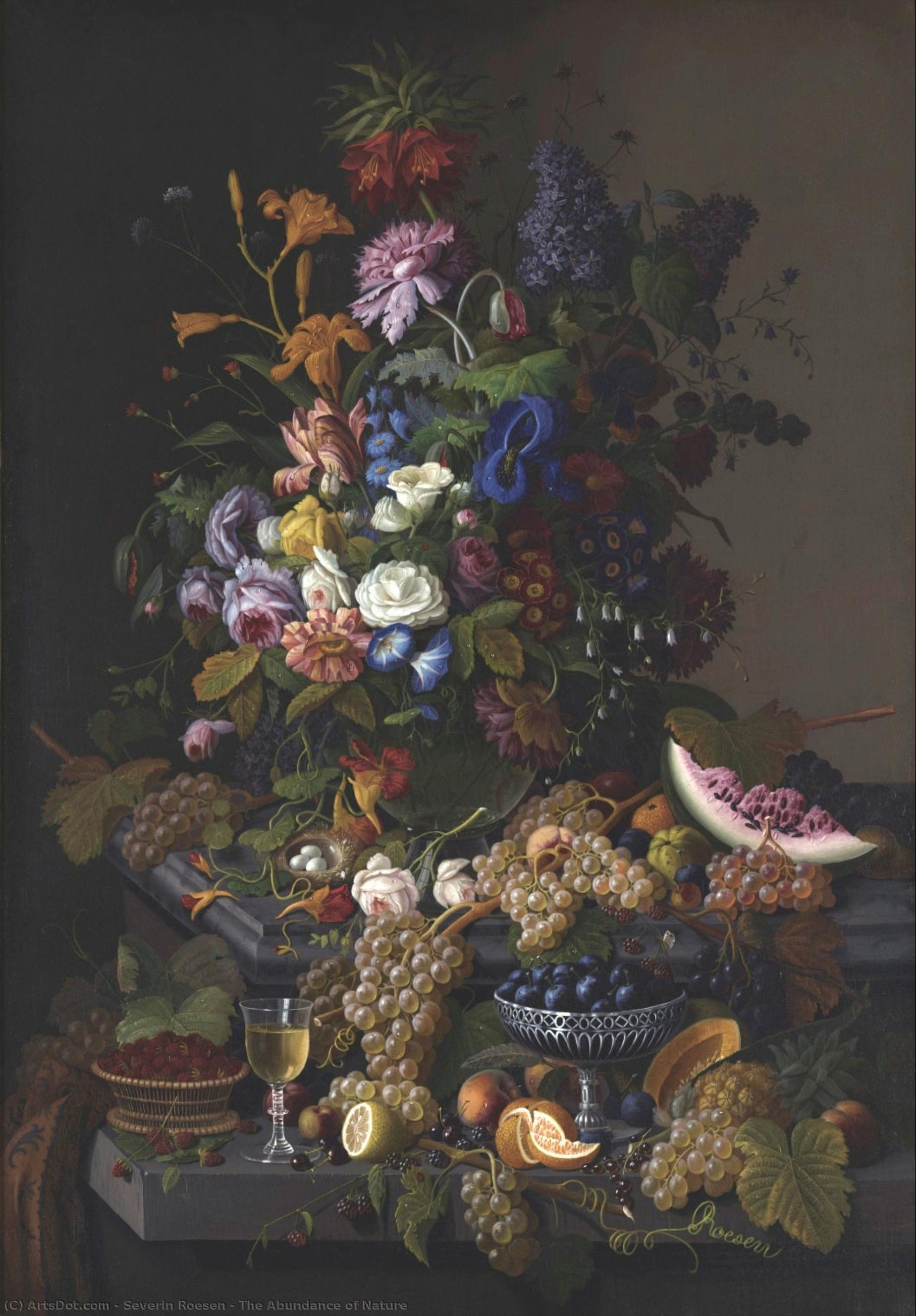
The Abundance of Nature


 Read More
Hand Made Oil Reproduction
Hand-painted oil on canvas in your size and frame, made to order by our artists. ( Buy Print Buy Image)




P118B $10

P118H $10

P118W $10

P438Z $10

P508JH $12

P508YH $12

P805H $10

P805Z $10

P919BZ $10

P919G $10

P919XJ $10

P959ZH $10

P968JZ $12

W106C $8

W218G $10

W218JH $8

W218Y $10

W307PJ $10

W316G $10

W316PJ $8

W316Y $10

W398PJ $8

W4111J $10

W500HY $15

W500JH $15

W692G $12

W849H $8

W940BG $15

W953PJ $8




Pick from our preset sizes that match the artwork's original proportions.

You may enter your own dimensions to fit a specific frame or space. If your selected size does not match the original image's proportions, we will either crop the artwork or extend the painting with additional hand-painted elements. A digital mockup will be sent for your approval before production begins.
Please note that the on-screen preview does not reflect the actual cropping or extension. Only the mockup will accurately show the final composition.
While custom sizes are available, we recommend selecting a dimension from the predefined list to preserve the original proportions.
After order, ArtsDot.com team will email client for instructions and provide a mockup preview
Worldwide Delivery () in 3/4 weeks instead of standard 5 weeks. (25 August). No compromise on quality.

Free Worldwide Express Shipping

High-Quality Linen Canvas

Full Shipping Insurance

Customs Tax Refund Guarantee

True Color Matching Guarantee

60-Day Return Policy (Defects Only)

100% Money-Back Guarantee

Bulk Discount Offer
 Glass option is only available in size under 110 CM

The Abundance of Nature
Reproduction Medium
Reproduction Size
-


Total Price
$ 263
Artwork Description
A Symphony of Color and Texture
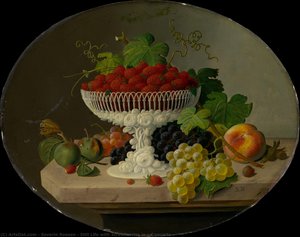
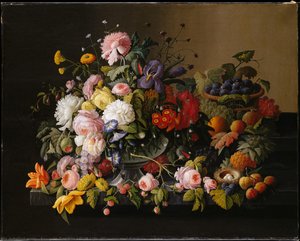
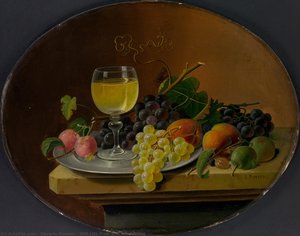
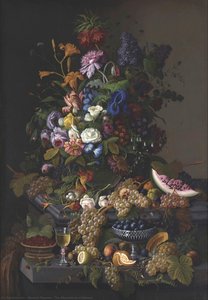
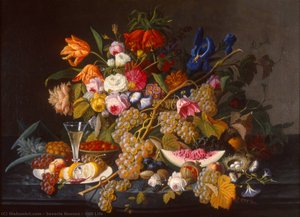
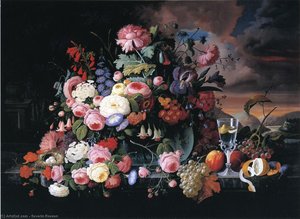
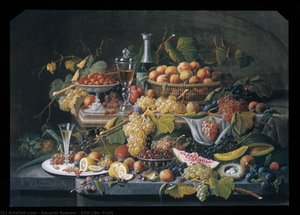
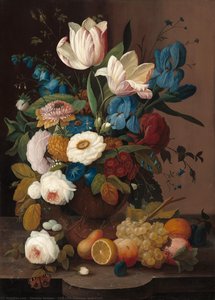
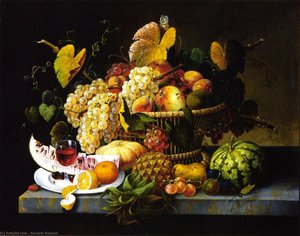
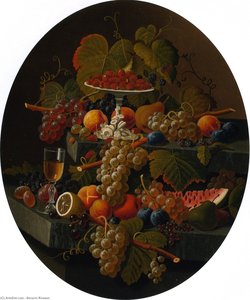
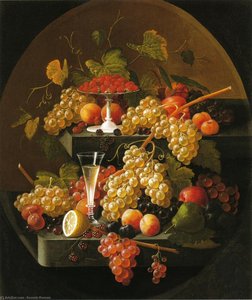
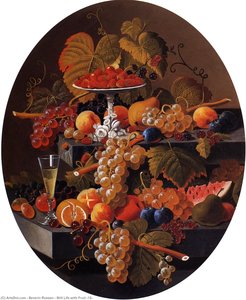
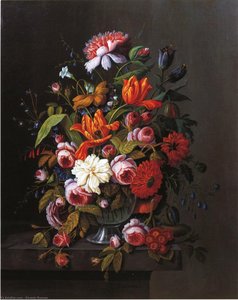
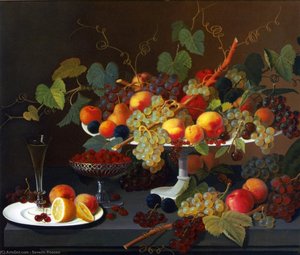
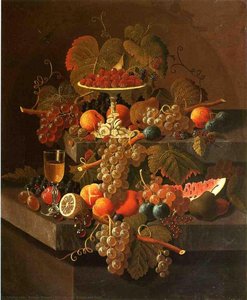
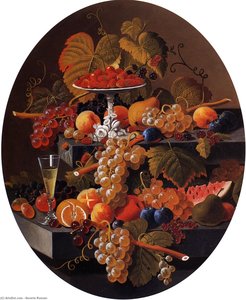
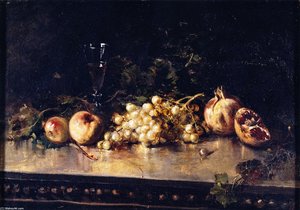
In the quiet, shadowed corners of nineteenth-century American art, few works radiate as much vitality and sensory richness as Severin Roesen’s “The Abundance of Nature.” This masterpiece is not merely a depiction of food; it is a breathtaking celebration of life's bountiful offerings. At first glance, the viewer is swept up in an overflowing arrangement where the delicate, velvety petals of roses and lilies dance alongside the heavy, sun-ripened weight of apples, peaches, and pears. Roesen, a German immigrant who brought the meticulous precision of his porcelain-painting training to the United States, creates a composition that feels both incredibly intimate and grandly operatic. The way the light catches the smooth skin of a pear or the reflective sheen of a wine glass invites the observer to reach out and touch the canvas, bridging the gap between the painted world and our own reality.
The brilliance of this work lies in its masterful use of contrast and light. Set against a dark, muted background that evokes the mysterious depths of a Dutch master’s studio, the fruits and flowers emerge with a luminous, almost supernatural glow. This technique, often achieved through careful layering and glazing, allows for a depth of color that feels truly three-dimensional. Deep crimsons, vibrant golds, and lush greens pop against the shadows, creating a visual rhythm that guides the eye across the asymmetrical yet perfectly balanced arrangement. For the discerning collector or interior designer, this painting offers a profound sense of luxury and warmth, making it an ideal centerpiece for spaces that demand a touch of classical elegance and organic splendor.
Symbolism and the Romantic Spirit
Beyond its surface beauty, “The Abundance of Nature” is steeped in the symbolic language of the Romantic era. During the mid-1800s, still life paintings often served as meditations on the fleeting nature of time and the eternal cycle of growth. The lushness of the fruit represents fertility and prosperity, a theme that would have resonated deeply with an expanding American nation seeking its own identity and wealth. Yet, there is a subtle tension within the piece; the very ripeness of the fruit hints at the inevitable passage of time, a concept known as vanitas. The inclusion of a glass of wine adds a layer of sensory indulgence, suggesting the pleasures of the present moment that must be cherished before they fade.
Roesen’s ability to weave these complex emotional threads into a single, cohesive image is what elevates this work from a mere botanical study to a profound piece of fine art. He captures not just the physical form of the objects, but the very essence of abundance itself—a feeling of overwhelming gratitude for the natural world. For those looking to adorn a home with art that inspires awe and contemplation, this reproduction serves as a constant reminder of the beauty and generosity found in nature's most delicate and robust forms.
Related Artworks
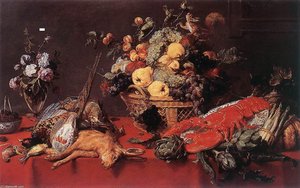
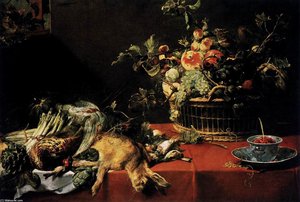
Artist Biography
The Painter of Fruitful Abundance
Severin Roesen remains one of the most enigmatic yet visually rewarding figures in nineteenth-century American art history. A German immigrant whose life story is as much a mystery as it is a testament to the American Dream, Roesen arrived on American shores during a period of profound transformation. Born around 1815 in Boppard, Prussia, his early years were shaped by the rich artistic traditions of his homeland. While the precise details of his formal education remain elusive, there is compelling evidence that he honed his meticulous eye as a porcelain painter in Cologne. This foundational experience in the decorative arts—a craft requiring extreme precision and an intimate understanding of color and texture—would later become the hallmark of his celebrated oil paintings.
His journey to America was marked by both ambition and personal upheaval. After marrying Sophia Jacobina Lambricht in 1847, Roesen traveled through England before arriving in New York in early 1848. This period coincided with a wave of German immigration driven by the political turbulence of the 1848 revolutions. In New York, Roesen quickly sought to establish his reputation, exhibiting eleven paintings with the prestigious American Art-Union between 1848 and 1852. However, the joys of his new life were tempered by tragedy; the death of his first wife in 1849 led him to a second marriage with Wilhelmine Ludwig, with whom he would eventually settle in Pennsylvania, finding a creative sanctuary in Williamsport around 1863.
A Legacy of Opulence and Realism
Roesen’s artistic output is defined by a breathtaking sense of abundance. He was a master of the still life, specifically a genre that drew deep inspiration from the Dutch Golden Age masters of the seventeenth century. His canvases serve as lush visual spectacles, where tropical fruits, vibrant blossoms, and delicate textures are arranged in compositions that feel both bountiful and meticulously ordered. He possessed a singular ability to evoke trompe-l'oeil realism—a technique designed to "fool the eye"—making the dew on a grape or the velvety skin of a peach appear almost tangible to the viewer.
Beyond mere decoration, Roesen’s work often carried deeper symbolic weight. His paintings frequently explored themes of:
- Nature's Bounty: The overwhelming variety of fruits and flowers served as a celebration of fertility and the richness of the natural world.
- Material Prosperity: In the context of mid-nineteenth-century America, these displays of plenty mirrored the growing economic optimism of a developing nation.
- Textural Mastery: His ability to contrast the hard surface of a porcelain bowl with the soft fragility of a flower petal showcased his technical evolution from a decorative craftsman to a fine art master.
Historical Significance and Enduring Influence
Though Roesen’s life ended in mystery—his last dated painting appears in 1872, after which all biographical records cease—his impact on American art remains undeniable. He was a pivotal figure in popularizing the still life genre in the United States, bridging the gap between European classical traditions and a burgeoning American aesthetic. His work provided a window into the national identity of a pre-Civil War America, capturing a sense of stability and prosperity through the lens of nature's generosity.
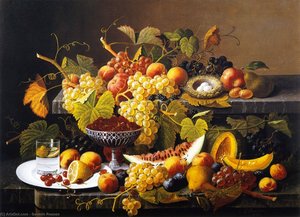
Today, Roesen is recognized as one of the most significant practitioners of nineteenth-century American realism. His ability to infuse abundance with elegance ensures that his works continue to captivate collectors and historians alike. Whether examining the delicate detail of a bird's nest tucked among fruit or the luminous glow of a wine glass, one finds in Roesen’s oeuvre a timeless celebration of life's most beautiful and fleeting moments.
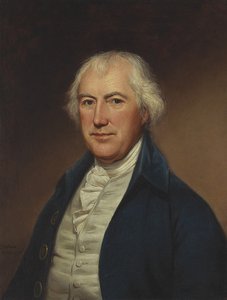
Severin Roesen
1815 - 1872 , Germany
Quick Facts
- Artistic Movement Or Style: Realism
- Artists Or Movements Influenced By This Artist: ['Dutch Still Life']
- Artists Who Influenced This Artist: ['Jan van Huysum']
- Date Of Death: c. 1872
- Full Name: Severin Roesen
- Nationality: German
- Notable Artworks:
- Still Life with Fruit
- Flower Still Life
- Place Of Birth: Boppard, Germany
Related Articles
Abraham Hendricksz van Beyeren: Pioneering Dutch Still Life & the Banquet Tradition
Explore the captivating world of Dutch Golden Age still life with Abraham van Beyeren. Discover his innovative techniques, symbolic banquet scenes & lasting influence on art history. Learn about collecting these masterpieces.

Dutch Baroque Masters: 10 Paintings That Shaped an Era | ArtsDot
Journey through the Golden Age with our guide to the Top 10 Dutch Baroque masterpieces! Explore iconic paintings by Rembrandt, Vermeer & Frans Hals. Find museum-quality art reproductions and elevate your home decor at ArtsDot.com.

Golden Age Reflections: Dutch Baroque Painting & Cultural Innovation
Explore the Dutch Golden Age of painting! Discover key artists like Vermeer & ter Borch, their innovative techniques, and the rich cultural context behind these Baroque masterpieces. Learn about collecting & appreciating this iconic art period.
Jan Jansz Wijnants: A Study in Dutch Golden Age Still Life & Floral Transience
Explore the captivating world of Jan Wijnants and Dutch Golden Age still life painting. Discover symbolism, masterful techniques & lasting influence on floral art history. Learn more!
The Enduring Appeal of Still Life: A Historical & Contemporary Exploration
Explore the rich history & symbolism of still life painting with ArtsDot. Discover masterpieces from the Dutch Golden Age, learn about vanitas art, and find expert guidance for collecting timeless artworks.