 Preview
 Send
Send Share
Share
 Details

 Download
 Similars
 X-Ray
X-Ray Diaporama
Album of Obscene Paintings


 Read More
Hand Made Oil Reproduction
Hand-painted oil on canvas in your size and frame, made to order by our artists. ( Buy Print Buy Image)




P118B $10

P118H $10

P118W $10

P438Z $10

P508JH $12

P508YH $12

P805H $10

P805Z $10

P919BZ $10

P919G $10

P919XJ $10

P959ZH $10

P968JZ $12

W106C $8

W218G $10

W218JH $8

W218Y $10

W307PJ $10

W316G $10

W316PJ $8

W316Y $10

W398PJ $8

W4111J $10

W500HY $15

W500JH $15

W692G $12

W849H $8

W940BG $15

W953PJ $8




Pick from our preset sizes that match the artwork's original proportions.

You may enter your own dimensions to fit a specific frame or space. If your selected size does not match the original image's proportions, we will either crop the artwork or extend the painting with additional hand-painted elements. A digital mockup will be sent for your approval before production begins.
Please note that the on-screen preview does not reflect the actual cropping or extension. Only the mockup will accurately show the final composition.
While custom sizes are available, we recommend selecting a dimension from the predefined list to preserve the original proportions.
After order, ArtsDot.com team will email client for instructions and provide a mockup preview
Worldwide Delivery () in 3/4 weeks instead of standard 5 weeks. (30 August). No compromise on quality.

Free Worldwide Express Shipping

High-Quality Linen Canvas

Full Shipping Insurance

Customs Tax Refund Guarantee

True Color Matching Guarantee

60-Day Return Policy (Defects Only)

100% Money-Back Guarantee

Bulk Discount Offer
 Glass option is only available in size under 110 CM

Album of Obscene Paintings
Reproduction Medium
Reproduction Size
-


Total Price
$ 263
A Window into Sensuality: Exploring Shin Yun-bok’s “Album of Obscene Paintings”
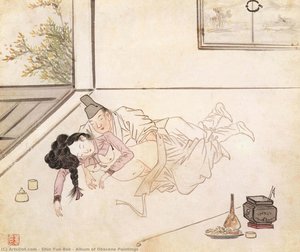
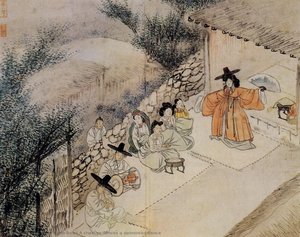
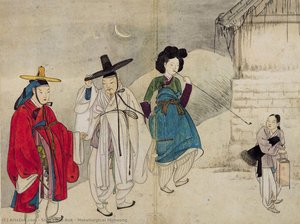
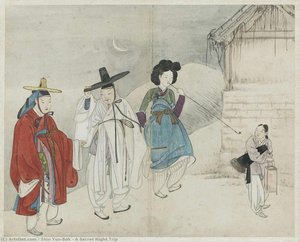
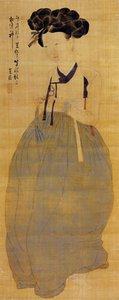
The artwork "Album of Obscene Paintings" by Shin Yun-bok (1758-1813), a Korean painter active during the Joseon Dynasty, presents a fascinating glimpse into artistic sensibilities and societal norms of its time. Produced sometime in the early 19th century, this painting transcends mere visual representation; it embodies a complex interplay of eroticism, cultural tradition, and masterful technique—elements that continue to intrigue art historians and collectors alike. The image itself depicts an intimate scene featuring two figures positioned within a modestly furnished room – a man reclining on the floor while a woman sits beside him. Accompanying details like a chair, bowl, cup, and subtle lighting contribute to creating an atmosphere of quiet contemplation and unspoken desire.Style and Technique: Vibrant Color Palette and Fluid Brushwork
Shin Yun-bok’s artistic style is characterized by a distinctive vibrancy achieved through the skillful application of color—a hallmark of Korean painting traditions. The palette utilizes rich hues, particularly reds and yellows, reflecting not only visual beauty but also symbolic significance within Joseon culture where colors held profound meanings related to status and auspiciousness. Furthermore, Yun-bok’s brushwork demonstrates remarkable fluidity and precision, demonstrating a mastery of traditional Korean painting techniques. Layers of translucent washes create depth and luminosity, capturing the subtle nuances of light and shadow—a technique that elevates the artwork beyond simple depiction into an emotive experience. The artist's meticulous attention to detail is evident in every stroke, reflecting the exacting standards prevalent during his era.Historical Context: Erotic Genre Painting in Joseon Korea
“Album of Obscene Paintings” belongs to a genre of Korean art known as Hyewon Pungsokhwacheop – “Three Wons’ Paintings.” This artistic tradition flourished during the late Joseon period (1797-1863) and was particularly favored by aristocratic patrons who sought to express desires and fantasies outside the confines of formal etiquette. Such paintings served as a form of visual indulgence, reflecting anxieties surrounding sexuality and marital fidelity—issues that were carefully navigated within the rigid social hierarchy of the time. The depiction itself aligns with prevailing artistic conventions of the period, where artists skillfully employed symbolism to convey emotions and ideas subtly yet powerfully.Symbolism: Color and Gesture – Expressions of Hidden Longing
The deliberate use of color is paramount in conveying symbolic meaning. Red, frequently associated with passion and vitality, dominates the composition, highlighting the central figures' desire. Similarly, yellow represents prosperity and nobility—elements that underscore the social status of those involved. Beyond color, Yun-bok’s artistic gesture – the positioning of the figures and their gaze – contributes to creating an atmosphere of unspoken longing. The posture of the reclining man embodies vulnerability and receptiveness, while the woman's gaze conveys a quiet confidence and invitation. These subtle movements communicate emotions that transcend literal representation, inviting viewers to contemplate themes of intimacy and desire.Emotional Impact: Capturing Transient Moments of Sensuality
Ultimately, “Album of Obscene Paintings” succeeds in capturing a fleeting moment of sensual contemplation—a testament to Shin Yun-bok’s artistic vision. The painting evokes feelings of warmth, vulnerability, and unspoken connection, transporting the viewer back to a time when art served as a conduit for expressing desires and fantasies. Its enduring appeal lies not only in its aesthetic beauty but also in its ability to resonate with audiences across cultures and eras—a remarkable achievement considering its origins within a specific cultural context. This artwork stands as an exceptional example of Korean artistic heritage, inviting contemplation on themes of desire, intimacy, and the complexities of human emotion.Related Artworks
Artist Biography
The Delicate Hand of Alexander Nasmyth: A Portraitist of Georgian England
Alexander Nasmyth, born in Edinburgh on September 9th, 1758, and passing away on April 10th, 1840, was a pivotal figure in the landscape of late 18th and early 19th-century British art. More than simply a painter, he embodied a confluence of artistic influences – from the formal training under Allan Ramsay to the burgeoning fascination with scientific illustration and the evolving tastes of the Georgian elite. His career, marked by both portrait commissions and a significant shift towards landscape painting, reveals a man deeply attuned to his time and a keen observer of its social and aesthetic currents. Nasmyth’s early artistic development was firmly rooted in the traditions of portraiture. He began his apprenticeship with Allan Ramsay, a renowned Scottish painter known for his dramatic and emotionally charged portraits. This foundational training instilled in him a meticulous attention to detail, an understanding of classical composition, and a sensitivity to capturing the individual character of his subjects. However, Nasmyth’s artistic journey wasn't confined solely to the realm of formal portraiture. He possessed a deep appreciation for the natural world, nurtured by extensive travels throughout Europe, particularly Italy, where he spent several years immersing himself in the art and culture of the Renaissance. This exposure profoundly shaped his later work, influencing his choice of subject matter and his approach to depicting landscapes.Early Career & The Rise of the Kupferstich- und Zeichnungskabinett
Returning to Edinburgh in 1782, Nasmyth established himself as a portrait painter, catering to a clientele that included prominent figures within Scottish society. His portraits were characterized by their elegance and refinement, reflecting the prevailing aesthetic sensibilities of the era. Crucially, his career took an unexpected turn with the establishment of Charles Theodore, Elector of Bavaria’s *Kupferstich- und Zeichnungskabinett* (Engraving and Drawing Cabinet) at Mannheim Palace in 1758 – a pivotal moment that significantly impacted the development of printmaking and drawing techniques. Nasmyth's involvement in this groundbreaking institution provided him with invaluable experience in producing accurate and detailed illustrations, skills he would later apply to his landscape paintings. This period marked a shift from purely representational portraiture towards a more observational approach, laying the groundwork for his future artistic explorations.A Shift Towards Landscape: Influences & Techniques
Around 1792, Nasmyth made a decisive break from portraiture and dedicated himself primarily to landscape painting. This transition wasn’t arbitrary; it reflected a broader cultural shift towards valuing the beauty of nature and embracing the ideals of the Romantic movement, which was beginning to emerge in England. His landscapes were informed by several key influences: his Italian sojourn, where he studied the works of Claude Lorrain and other masters of landscape painting; his interest in architecture, evident in his depictions of buildings integrated seamlessly into natural settings; and a growing fascination with engineering and design. Nasmyth’s technique was characterized by its precision and meticulousness. He meticulously observed and rendered details – trees, rocks, water features – with remarkable accuracy. His compositions often featured carefully arranged elements, creating a sense of balance and harmony. Unlike some of his contemporaries who favored looser brushwork and expressive handling of paint, Nasmyth prioritized clarity and detail, striving to capture the essence of each scene with unwavering fidelity.Notable Works & Legacy
Among Nasmyth’s most celebrated works are his portraits of Robert Burns, a beloved figure in Scottish literature and culture, now housed at the National Gallery of Scotland; and his depictions of Inverary from the Sea, commissioned by the Duke of Argyll to illustrate the proposed location for a lighthouse. These paintings demonstrate his ability to capture both the subject matter and the spirit of the era. His work also includes numerous architectural studies and illustrations, showcasing his versatility as an artist. Alexander Nasmyth’s legacy extends beyond his individual artistic achievements. He played a crucial role in shaping the development of landscape painting in Britain, demonstrating the importance of observation, technical skill, and a deep appreciation for the natural world. His career exemplifies the dynamic interplay between tradition and innovation within the art world, bridging the gap between formal portraiture and the emerging ideals of the Romantic era. He remains an important figure in British art history, remembered as a skilled painter who skillfully captured the beauty and complexity of his time.Further Research

shin yun-bok
1758 - 1813 , South Korea
Quick Facts
- Artistic Movement Or Style: Portrait & Landscape
- Artists Or Movements Influenced By This Artist:
- Portraiture
- Landscape Art
- Artists Who Influenced This Artist: ['Allan Ramsay']
- Date Of Birth: September 9, 1758
- Date Of Death: April 10, 1840
- Full Name: Alexander Nasmyth
- Nationality: Scottish
- Notable Artworks:
- Conversation Pieces
- Inverary from the Sea
- Place Of Birth: Edinburgh, Scotland
Related Articles
Scenes of Daily Life: A Comprehensive Exploration of Genre Painting Through History
Explore the rich history of genre painting! Discover Dutch Masters & European artists who captured everyday life with stunning realism. Learn about symbolism, techniques & lasting influence.
Yi Eungro: Bridging East & West in the Landscape of Korean Modernism
Explore the captivating world of Yi Eungro (Lee Ungno), a pivotal figure in Korean modernism. Discover his unique fusion of Eastern and Western artistic traditions, abstract masterpieces, and lasting legacy. A must-read for discerning art collectors.
Echoes of Daily Life: Genre Painting & Societal Values Through the Ages
Explore the captivating world of genre painting! Discover Dutch Masters like Ostade & de Hooch, hidden symbolism, and social commentary in art history. Shop museum-quality reproductions at ArtsDot.
Thomas George Webster: Navigating Genre Boundaries & American Identity in 19th-Century Landscape Painting
Explore the captivating genre scenes of Thomas George Webster, a Victorian painter bridging British traditions with American themes. Discover his style, influences & legacy in 19th-century art history.
The Poetics of the Mundane: Everyday Life in Art History
Explore the captivating world of genre painting! Discover how artists throughout history have found beauty & meaning in everyday life. Learn about Dutch Masters, key characteristics, and its lasting influence on art.