 Preview
 Send
Send Share
Share
 Details

 Download
 Similars
 X-Ray
X-Ray Diaporama
 Stats
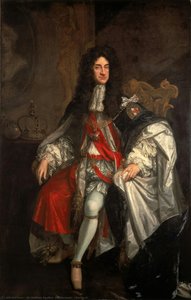
StatsCharles II
 Oil On Canvas
- WallArt
- Baroque
 1685
1685- Early Modern
 244.0 x 144.0 cm
 National Museums Liverpool
 Read More
Hand Made Oil Reproduction
Hand-painted oil on canvas in your size and frame, made to order by our artists. ( Switch to Print Switch to Digital Image)




P118B $10

P118H $10

P118W $10

P438Z $10

P508JH $12

P508YH $12

P805H $10

P805Z $10

P919BZ $10

P919G $10

P919XJ $10

P959ZH $10

P968JZ $12

W106C $8

W218G $10

W218JH $8

W218Y $10

W307PJ $10

W316G $10

W316PJ $8

W316Y $10

W398PJ $8

W4111J $10

W500HY $15

W500JH $15

W692G $12

W849H $8

W940BG $15

W953PJ $8




Pick from our preset sizes that match the artwork's original proportions.

You may enter your own dimensions to fit a specific frame or space. If your selected size does not match the original image's proportions, we will either crop the artwork or extend the painting with additional hand-painted elements. A digital mockup will be sent for your approval before production begins.
Please note that the on-screen preview does not reflect the actual cropping or extension. Only the mockup will accurately show the final composition.
While custom sizes are available, we recommend selecting a dimension from the predefined list to preserve the original proportions.
After order, ArtsDot.com team will email client for instructions and provide a mockup preview
Worldwide Delivery () in 3/4 weeks instead of standard 5 weeks. (13 September). No compromise on quality.

Free Worldwide Express Shipping

High-Quality Linen Canvas

Full Shipping Insurance

Customs Tax Refund Guarantee

True Color Matching Guarantee

100-Day Return Policy (Defects Only)

100% Money-Back Guarantee

Bulk Discount Offer
 Glass option is only available in size under 110 CM

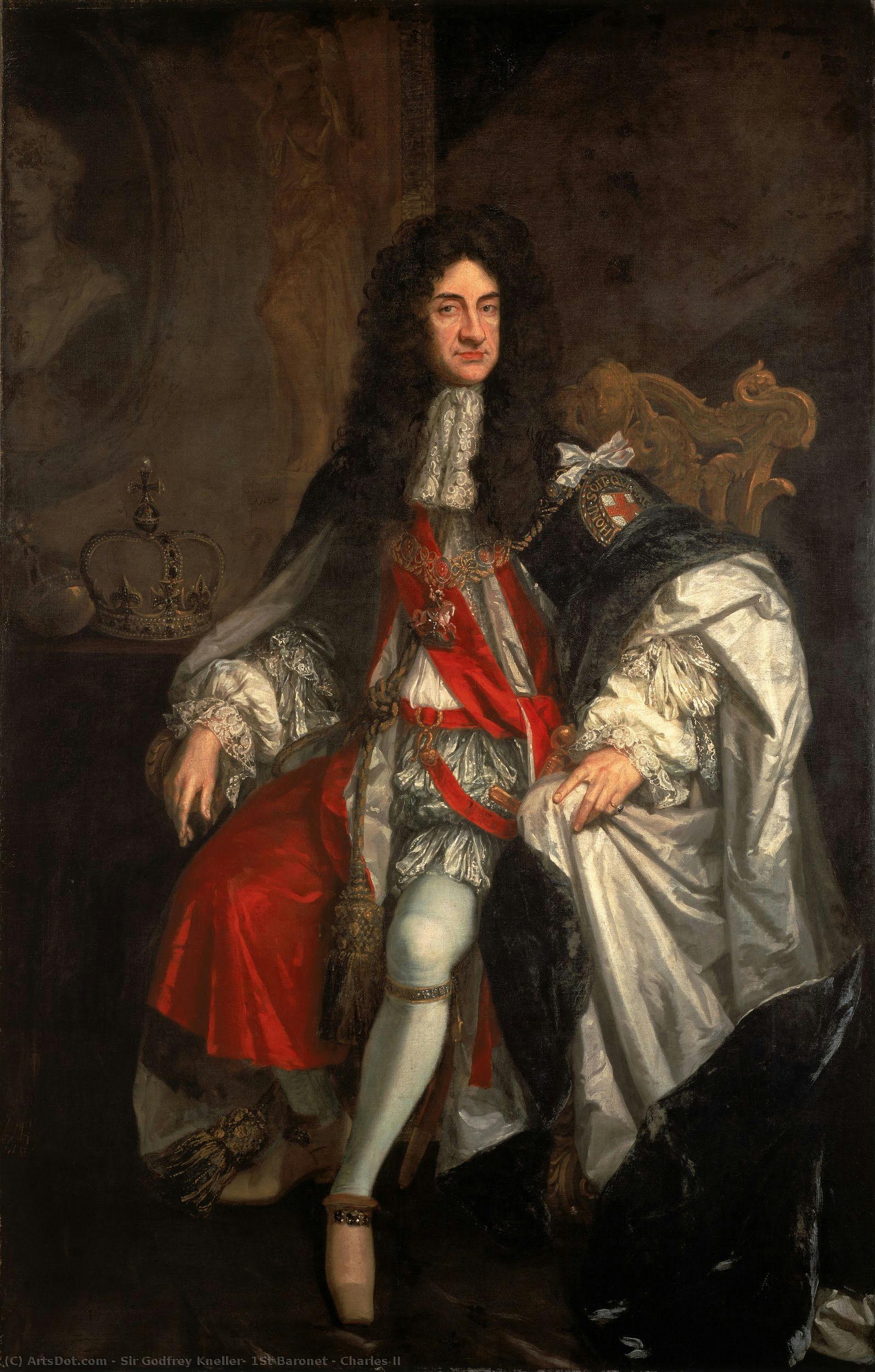
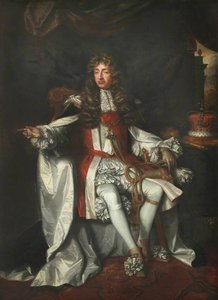
Charles II
Reproduction Medium
Reproduction Size
-


Total Price
$ 263
A Vision of Sovereignty: The Majesty of Charles II
In the grand tapestry of English Baroque art, few portraits command the room with as much authoritative grace as Sir Godfrey Kneller’s 1685 depiction of King Charles II. This is not merely a likeness of a monarch; it is a carefully orchestrated manifesto of power and stability. Painted during the twilight of the Restoration period, the work captures a moment when England was yearning for the permanence of the Crown after the turbulent, austere years of Cromwell’s Commonwealth. Through Kneller's masterful lens, we see a king who embodies the very essence of his era—a figure of profound dignity emerging from the shadows of political upheaval to reclaim his rightful place at the center of the world.
The emotional resonance of the piece lies in its ability to evoke both awe and intimacy. As one gazes upon the canvas, the viewer is drawn into a richly ornamented interior that feels both palatial and profoundly personal. There is a palpable sense of weight and history in the atmosphere, an invitation to step back into a time of courtly elegance and high stakes diplomacy. For the discerning collector or interior designer, this portrait offers more than just visual splendor; it provides a focal point of historical gravity, capable of anchoring a room with its sophisticated and commanding presence.
The Master’s Touch: Technique and Composition
Sir Godfrey Kneller, a titan of the London art scene, brings his rigorous training from the Dutch masters to this monumental work. Utilizing the dramatic chiaroscuro technique, Kneller orchestrates a breathtaking interplay between light and shadow. This method does more than just illuminate the subject; it sculpts the King’s figure, lending a three-dimensional muscularity and a lifelike texture to his skin and the heavy folds of his royal drapery. The subtle gradations of tone create a sense of depth that makes the monarch appear almost tangible, as if he might step forward from the canvas.
The composition is a triumph of Baroque balance. By positioning Charles II centrally within a meticulously detailed setting, Kneller ensures that all visual paths lead back to the sovereign. The arrangement is deliberate and rhythmic, guiding the eye from the brilliant highlights of the King's attire to the more muted, atmospheric details of the background. This structural harmony reinforces the theme of order and stability, mirroring the political aspirations of the Restoration itself. Every brushstroke serves the greater purpose of reinforcing the legitimacy and the unshakeable nature of the royal lineage.
Symbolism and the Language of Royalty
Every element within this portrait is steeped in symbolic meaning, designed to communicate status to a contemporary audience. The King is draped in the prestigious robes of the Order of the Garter, the highest order of chivalry in England. This sartorial choice is a profound statement of honor and loyalty, signaling Charles II's role as the protector of traditional English values. Beside him, the presence of Prince George of Denmark serves as a poignant reminder of the importance of dynastic alliances and the continuity of the bloodline, essential for securing the future of the realm.
Even the smallest details contribute to the painting's narrative depth. A clock visible on the wall acts as a memento mori, a subtle, sophisticated commentary on the fleeting nature of time and the ephemeral quality of even the most powerful lives. This layer of philosophical reflection elevates the work from a standard royal portrait to a complex meditation on legacy. For those seeking to adorn their spaces with art that speaks of depth and intellect, this reproduction offers a window into a world where every ornament, every shadow, and every garment tells a story of enduring importance.
Related Artworks
Artist Biography
Sir Godfrey Kneller: A Life in Portraiture
- Born: August 8, 1646, Lübeck, Germany
- Died: October 19, 1723, London, England
- Known for: Baroque portrait painting, Court Painter to English Monarchs, Kit-Cat Portraits
Early Life and Training
- Kneller was born into a family of artists; his father, Zacharias Kniller, was a portrait painter in Lübeck.
- He received early artistic training in Leiden before becoming a pupil of Ferdinand Bol and Rembrandt Harmenszoon van Rijn in Amsterdam. This period significantly shaped his style, exposing him to the Dutch Baroque tradition.
- Travels with his brother, John Zacharias Kneller, took him to Rome and Venice where he painted historical subjects and portraits under Carlo Maratti, further refining his skills and broadening his artistic influences.
Career in England: Royal Portraitist
- Kneller arrived in England in 1676 and quickly gained patronage, including from the Duke of Monmouth.
- He became a leading portrait artist, succeeding Peter Lely as Principal Painter in Ordinary to the Crown under Charles II. This appointment marked the beginning of his long and successful career as court painter.
- Kneller served successive monarchs, including James II, William III & Mary, and George I, solidifying his position as the most sought-after portraitist in England.
- He was knighted in 1691 and created a Baronet in 1715, further demonstrating his elevated status within English society.
Major Works and Artistic Style
- Kit-Cat Portraits: These are perhaps Kneller’s most famous works – a series of half-length portraits of members of the Kit-Cat Club, a prominent political and literary association. They are characterized by their standardized size (36 x 28 inches) and focus on capturing the likeness and personality of the sitters.
- The Hampton Court Beauties: A series commissioned by William III to depict fashionable women of the court.
- Portraits of Royalty: Kneller painted numerous portraits of monarchs, including Charles II, James II, William III & Mary, and George I, showcasing his ability to capture regal dignity and power.
- Artistic Style: Kneller’s style was broadly Baroque, characterized by a sense of grandeur, dramatic lighting, and rich colors. While sometimes criticized for being formulaic, he possessed a keen eye for characterization and an ability to create compelling likenesses. He often employed studio assistants to complete portions of his paintings, particularly draperies and backgrounds.
Legacy and Historical Significance
- Kneller’s influence on English portraiture was significant. He established a highly successful studio that produced portraits for the elite, shaping tastes and setting standards for artistic excellence.
- He played a crucial role in transitioning English art from its earlier influences to a more distinctly Baroque style.
- His work helped to popularize portraiture among the upper classes, contributing to a culture of self-representation and social display.
- Kneller is commemorated at Westminster Abbey with a marble memorial by John M. Rysbrack, recognizing his lasting contribution to British art.
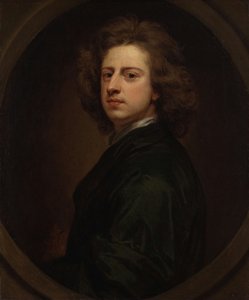
sir godfrey kneller, 1st baronet
1646 - 1723 , Germany
Quick Facts
- Artistic Movement Or Style: Baroque portraiture
- Artists Who Influenced This Artist:
- Ferdinand Bol
- Rembrandt Harmenszoon van Rijn
- Carlo Maratti
- Date Of Birth: August 8, 1646
- Date Of Death: October 19, 1723
- Full Name: Sir Godfrey Kneller, 1st Baronet
- Nationality: German-British
- Notable Artworks:
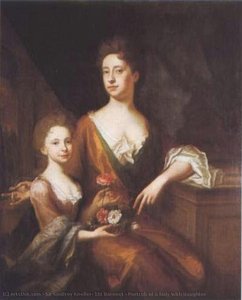
- Portrait of a Lady with Daughter
- Charles II
- Portrait of Marcello Durazzo
- Place Of Birth: Lübeck, Germany
Related Articles
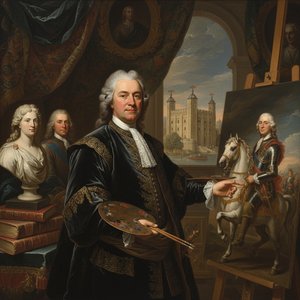
Sir Godfrey Kneller: Portraiture, Power & Artistic Identity in Restoration England
Explore the life & work of Sir Godfrey Kneller, leading portraitist of Restoration England. Discover his Baroque style, influence on aristocratic society, and lasting legacy in English art history. Learn about Kit-Cat portraits & more!
Sir Alfred Munnings' Masterpieces: 25 Paintings That Define Equine Art | ArtsDot
Explore 25 iconic Sir Alfred Munnings paintings! Discover the beauty of British Impressionism, equine art & rural England. Find museum-quality reproductions and elevate your home decor with ArtsDot. Explore the full collection online.

Baroque Classicism: Reconciling Drama & Order in 17th-Century Art
Explore the captivating world of Baroque Classicism! Discover its history, key artists like Caravaggio & Rubens, and defining characteristics. Expert insights & high-quality reproductions at ArtsDot.

Decoding Baroque Grandeur: A Guide to the Drama and Emotion of 17th-Century Art
Explore the breathtaking drama of 17th-century Baroque art. Our expert guide decodes the use of chiaroscuro, emotional intensity, and historical grandeur to help you appreciate and curate timeless masterpieces for your collection.
Sir Joshua Reynolds' Masterpieces: 25 Portraits of Power & Refinement | ArtsDot
Explore 25 captivating portraits by Sir Joshua Reynolds, a master of British art. Discover stories behind his iconic paintings, elegant style & historical influence. Find museum-quality reproductions and elevate your home decor on ArtsDot.com.