 Preview
 Send
Send Share
Share
 Details

 Download
 Similars
 X-Ray
X-Ray Diaporama
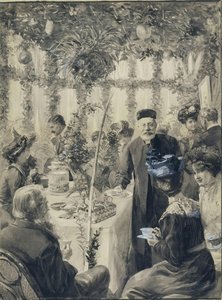
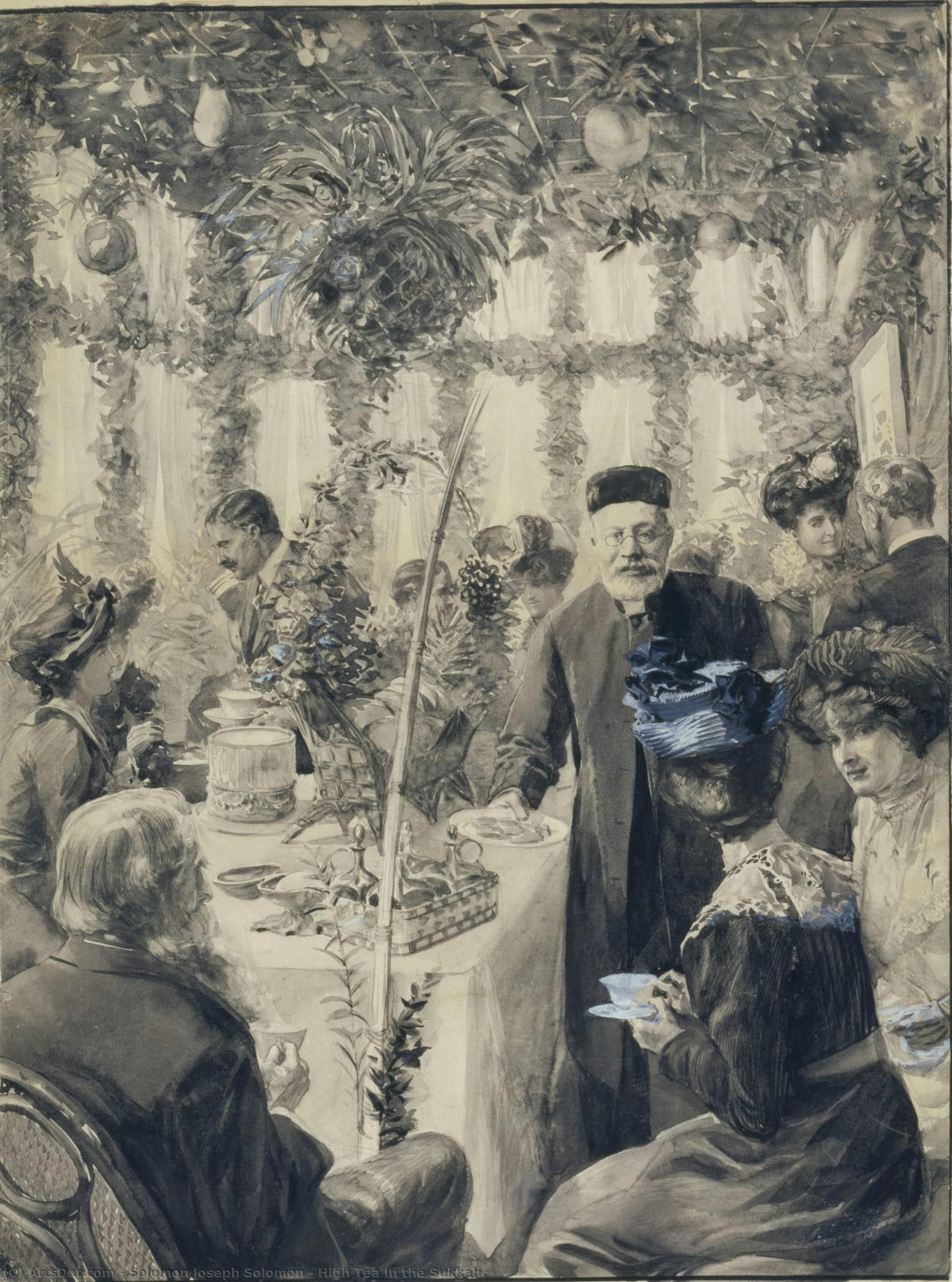
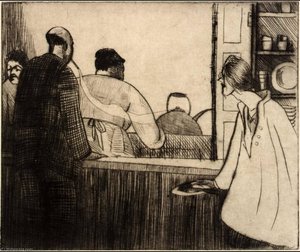
High Tea in the Sukkah
 Drawing
- WallArt
- Academic Realism
 1906
1906- 19th Century
 41.0 x 30.0 cm
 The Jewish Museum
 Read More
Hand Made Oil Reproduction
Hand-painted oil on canvas in your size and frame, made to order by our artists. ( Buy Print Buy Image)




P118B $10

P118H $10

P118W $10

P438Z $10

P508JH $12

P508YH $12

P805H $10

P805Z $10

P919BZ $10

P919G $10

P919XJ $10

P959ZH $10

P968JZ $12

W106C $8

W218G $10

W218JH $8

W218Y $10

W307PJ $10

W316G $10

W316PJ $8

W316Y $10

W398PJ $8

W4111J $10

W500HY $15

W500JH $15

W692G $12

W849H $8

W940BG $15

W953PJ $8




Pick from our preset sizes that match the artwork's original proportions.

You may enter your own dimensions to fit a specific frame or space. If your selected size does not match the original image's proportions, we will either crop the artwork or extend the painting with additional hand-painted elements. A digital mockup will be sent for your approval before production begins.
Please note that the on-screen preview does not reflect the actual cropping or extension. Only the mockup will accurately show the final composition.
While custom sizes are available, we recommend selecting a dimension from the predefined list to preserve the original proportions.
After order, ArtsDot.com team will email client for instructions and provide a mockup preview
Worldwide Delivery () in 3/4 weeks instead of standard 5 weeks. (17 August). No compromise on quality.

Free Worldwide Express Shipping

High-Quality Linen Canvas

Full Shipping Insurance

Customs Tax Refund Guarantee

True Color Matching Guarantee

60-Day Return Policy (Defects Only)

100% Money-Back Guarantee

Bulk Discount Offer
 Glass option is only available in size under 110 CM

High Tea in the Sukkah
Reproduction Medium
Reproduction Size
-


Total Price
$ 263
Artwork Description
A Moment Frozen in Time: The Elegance of High Tea in the Sukkah
In the delicate lines of Solomon J. Solomon’s 1906 drawing, High Tea in the Sukkah, we are invited into a private, sacred moment that bridges two worlds. This exquisite work captures Dr. Hermann Adler, the Chief Rabbi of Great Britain, surrounded by his community within the intimate confines of a sukkah. The scene is far more than a mere depiction of a meal; it is a profound visual narrative of acculturation. Through Solomon’s masterful hand, we witness the seamless blending of venerable Jewish tradition with the refined customs of Edwardian England. The artist captures the essence of the Sukkot festival—a time of harvest and remembrance—by situating the ancient ritual of dwelling in a temporary booth within the sophisticated social framework of a British high tea.
The composition breathes with a sense of communal warmth and quiet dignity. As we gaze upon the gathering, the eye is drawn to the meticulously rendered table, laden with the symbols of hospitality: delicate cups, polished bowls, and sweet cakes that suggest both abundance and celebration. The presence of at least twelve figures, some engaged in deep conversation while others stand poised in attentive grace, creates a rhythmic vitality within the frame. Solomon utilizes the interplay of light and shadow to lend depth to the room, where potted greenery peeking through the structure serves as a poignant reminder of the natural world and the seasonal significance of the holiday. The atmosphere is one of serene togetherness, making it an ideal piece for those who wish to bring a sense of peace and historical continuity into their living spaces.
Mastery of Line and Historical Resonance
Technically, this work showcases Solomon’s exceptional ability to convey texture and emotion through monochromatic precision. The artist’s training at the prestigious Royal Academy and the Munich Academy is evident in the way he handles the weight of the fabrics and the reflective surfaces of the tea service. Every stroke contributes to a sense of realism that allows the viewer to almost hear the soft clink of silverware and the low murmur of scholarly debate. For the discerning collector, this drawing represents a rare window into the late nineteenth and early twentieth-century Jewish experience in Britain—a period marked by significant immigration and the beautiful tension between maintaining ancestral identity and embracing new national customs.
For interior designers and art enthusiasts alike, High Tea in the Sukkah offers a sophisticated focal point that transcends simple decoration. It is a conversation piece that speaks of heritage, intellect, and the enduring strength of community. Whether placed in a formal study, a dining room, or a curated gallery wall, a high-quality reproduction of this piece serves as an evocative reminder of the beauty found in tradition. It invites the observer to reflect on their own roots and the ways in which we create sacred spaces within our modern lives, making it a timeless addition to any collection focused on historical narrative and emotional depth.
Related Artworks
Artist Biography
solomon's family was jewish, and his sister, lily delissa joseph (née solomon), was also a painter. he made an important contribution to the development of camouflage in the first world war, working in particular on tree observation posts and arguing tirelessly for camouflage netting.
born in london in 1860, solomon studied at various art schools, sequentially, heatherley school of fine art, the royal academy schools, the munich academy, and école des beaux-arts (under alexandre cabanel). solomon also studied separately under rev. s. singer. he exhibited his first works as early as 1881, and showed at the royal academy, the new gallery, and the society of british artists. in 1886, he became one of the founding members of the new english art club. in 1896, he became an associate of the royal academy, with full membership following in 1906, one of the few jewish painters to do so. he joined, and became president of, the royal society of british artists in 1919. in 1921 "col. s.j. solomon, r.a., p.r.b.a." was listed as one of the early members of the newly-formed society of graphic art.
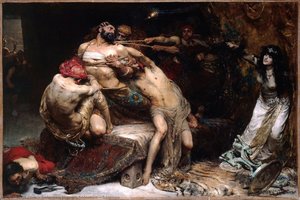
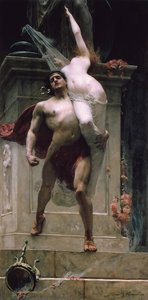
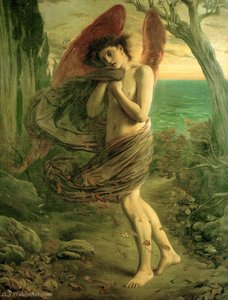
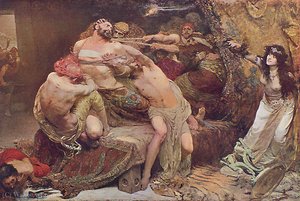
solomon's painting was grounded in his influence from his teacher alexandre cabanel, but was also influenced by frederic leighton and lawrence alma-tadema. solomon painted mainly portraits to earn a living, but also painted dramatic, theatrical scenes from mythology and the bible on large canvasses. these scenes include some of his more popular paintings. in 1897 he painted a mural for the royal exchange, london charles i demanding the five members at the guildhall, 1641–42. one of solomon's most popular works was samson (1887), depicting a scene from the biblical story of samson and delilah. this painting was praised for its use of multiple male nudes in active poses. samson is one of few solomon paintings on regular display, at the walker art gallery in liverpool. some other solomon paintings that have received significant attention include ajax and cassandra (1886, illustration, right) and the birth of love (1896).
solomon became well known as an innovative portrait artist by the time he painted mrs patrick campbell as 'paula tanqueray' ara (1894), her role in arthur wing pinero's the second mrs tanqueray, and went on to paint a number of portraits of well-known people, including the architect sir aston webb, and later in life, the royals king george v, queen mary, and prince edward (later king edward viii). solomon was also in demand as a book illustrator, particularly adventure books. in 1914, solomon authored the practice of oil painting and drawing.
during world war i, solomon was a pioneer of camouflage techniques. having originally signed-up at the start of the war as a private in the artists rifles, a home defence corps, he promoted his ideas on camouflage, initially in the press and then directly to senior army officers.
in december 1915, general herbert plumer arranged for solomon to visit the front lines and investigate techniques in use by the french. his ideas were accepted, and he was asked to set up a team to start the production of camouflage materials in france. on 31 december 1915, general haig, commander-in-chief of the british forces in france, instructed that solomon be given the temporary rank of lieutenant-colonel to enable him to carry out his new duties.
the new unit's first task was the design of armoured observation posts disguised as trees, following the pioneering work of the french section de camouflage led by lucien-victor guirand de scévola. the first british tree observation post was put up on 22 march 1916. solomon was effective at the artistic and technical tasks of designing trees and nets, but not as a commander. he was replaced in march 1916, instead becoming a technical advisor, a role that suited him better. in may 1916, he was sent to england to help develop tank camouflage. solomon doubted that tanks could be effectively camouflaged since they cast a large shadow. instead, he argued for the use of camouflage netting, with which he gradually became obsessed, claiming that the germans were hiding huge armies under immense nets. camouflage netting was at first considered unimportant by the army; it was not manufactured in large quantities until 1917. eventually, in 1920, he published a book, strategic camouflage, arguing this case, to critical derision in england but with some support from german newspapers.
in december 1916, solomon established a camouflage school in hyde park which was eventually taken over by the army.
solomon's daughter, iris, was married to ewen montagu, one of the "brains" behind operation mincemeat in world war two. solomon was an uncle of the american playwright moss hart.
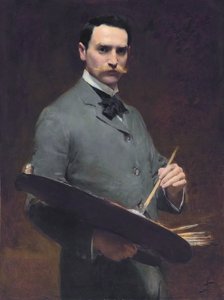
solomon joseph solomon
1840 - 1905
Related Articles

Dark Masterpieces: 10 Iconic Paintings Dominated by Black Tones |
Explore 10 iconic paintings dominated by black tones, from Rembrandt’s chiaroscuro to Goya's dark expressions. Discover the stories behind these masterpieces & find museum-quality art reproductions for your home at .
Mars Black Masterpieces: 10 Iconic Paintings & Timeless Art Decor Ideas
Delve into the power of 'Mars Black' with 10 iconic paintings by masters like Rembrandt & Caravaggio. Explore dramatic chiaroscuro, gothic art, and timeless beauty. Find museum-quality reproductions & elevate your home decor on .
Lamp Black & Masterpieces: 10 Paintings That Define Shadow & Light |
Delve into the captivating world of 'Lamp Black' tones with 10 iconic paintings by masters like Rembrandt & Caravaggio. Explore Baroque chiaroscuro, dramatic lighting & shadow in art history. Find museum-quality reproductions at
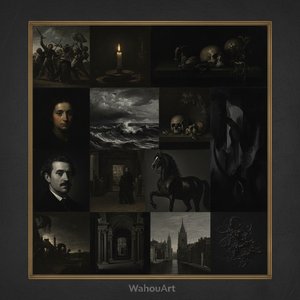
Ivory Black Masters: 10 Paintings That Define Dramatic Art |
Delve into the power of 'Ivory Black' with 10 iconic paintings by masters like Rembrandt & Caravaggio. Explore dramatic chiaroscuro, gothic moods & timeless art history. Find museum-quality reproductions and elevate your home decor at

Monochrome Visions: Exploring the Aesthetic & Historical Significance of Black & White Photography
Explore the rich history & artistic power of black and white photography. From early techniques to iconic masters like Ansel Adams, discover why monochrome continues to captivate art lovers today. Expert insights for collectors.