 Preview
 Send
Send Share
Share
 Details

 Download
 Similars
 X-Ray
X-Ray Diaporama
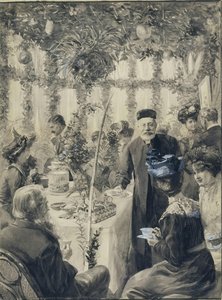
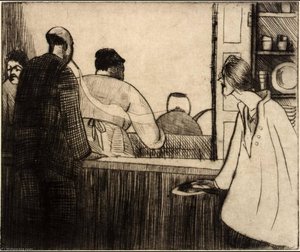
High Tea in the Sukkah
 Drawing
- WallArt
- Academic Realism
 1906
1906- 19th Century
 41.0 x 30.0 cm
 The Jewish Museum
 Read More
Hand Made Oil Reproduction
Hand-painted oil on canvas in your size and frame, made to order by our artists. ( Buy Print Buy Image)




P118B $10

P118H $10

P118W $10

P438Z $10

P508JH $12

P508YH $12

P805H $10

P805Z $10

P919BZ $10

P919G $10

P919XJ $10

P959ZH $10

P968JZ $12

W106C $8

W218G $10

W218JH $8

W218Y $10

W307PJ $10

W316G $10

W316PJ $8

W316Y $10

W398PJ $8

W4111J $10

W500HY $15

W500JH $15

W692G $12

W849H $8

W940BG $15

W953PJ $8




Pick from our preset sizes that match the artwork's original proportions.

You may enter your own dimensions to fit a specific frame or space. If your selected size does not match the original image's proportions, we will either crop the artwork or extend the painting with additional hand-painted elements. A digital mockup will be sent for your approval before production begins.
Please note that the on-screen preview does not reflect the actual cropping or extension. Only the mockup will accurately show the final composition.
While custom sizes are available, we recommend selecting a dimension from the predefined list to preserve the original proportions.
After order, ArtsDot.com team will email client for instructions and provide a mockup preview
Worldwide Delivery () in 3/4 weeks instead of standard 5 weeks. (26 August). No compromise on quality.

Free Worldwide Express Shipping

High-Quality Linen Canvas

Full Shipping Insurance

Customs Tax Refund Guarantee

True Color Matching Guarantee

60-Day Return Policy (Defects Only)

100% Money-Back Guarantee

Bulk Discount Offer
 Glass option is only available in size under 110 CM

High Tea in the Sukkah
Reproduction Medium
Reproduction Size
-


Total Price
$ 263
Artwork Description
A Moment Frozen in Time: The Elegance of High Tea in the Sukkah
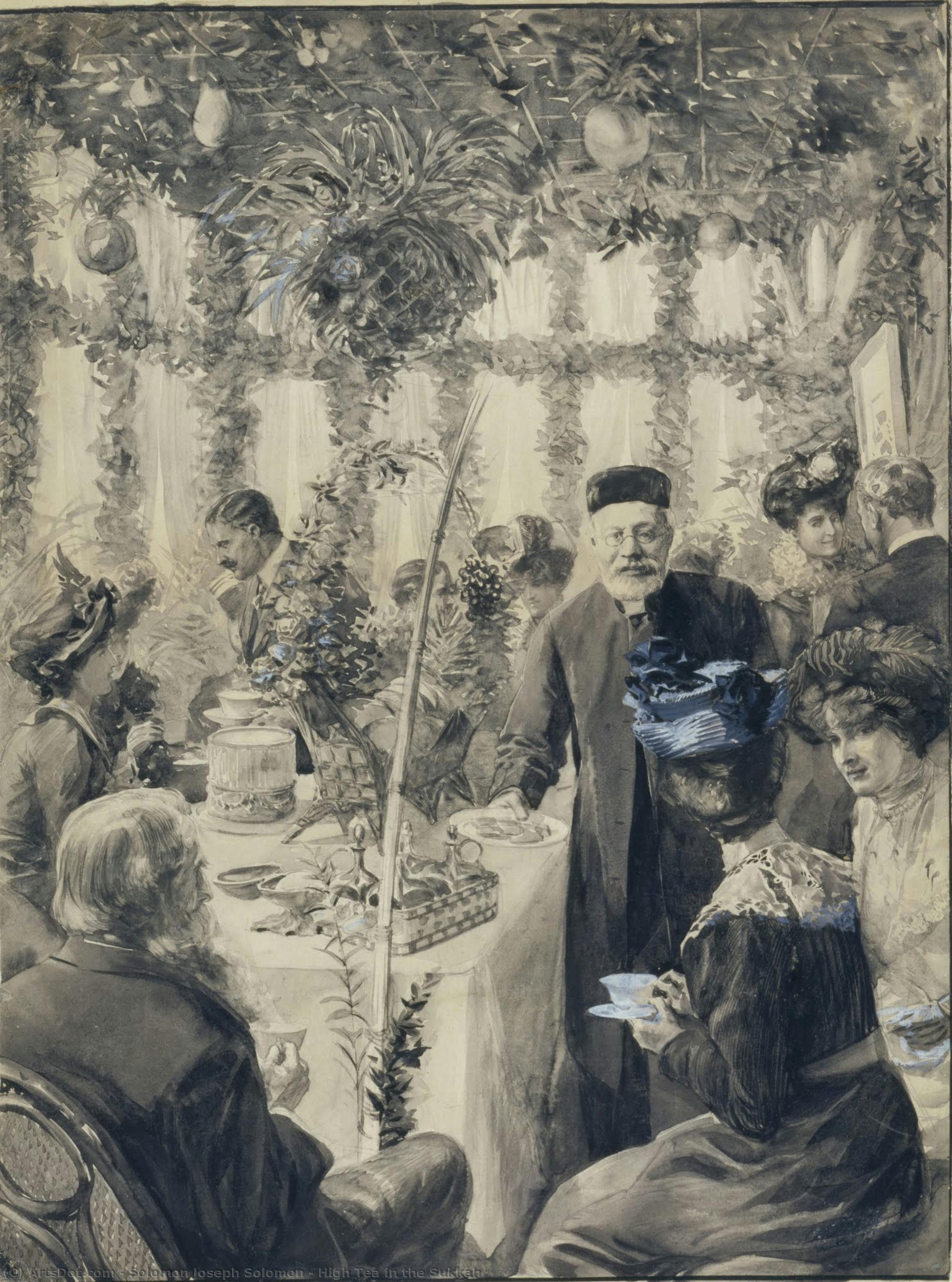
In the delicate lines of Solomon J. Solomon’s 1906 drawing, High Tea in the Sukkah, we are invited into a private, sacred moment that bridges two worlds. This exquisite work captures Dr. Hermann Adler, the Chief Rabbi of Great Britain, surrounded by his community within the intimate confines of a sukkah. The scene is far more than a mere depiction of a meal; it is a profound visual narrative of acculturation. Through Solomon’s masterful hand, we witness the seamless blending of venerable Jewish tradition with the refined customs of Edwardian England. The artist captures the essence of the Sukkot festival—a time of harvest and remembrance—by situating the ancient ritual of dwelling in a temporary booth within the sophisticated social framework of a British high tea.
The composition breathes with a sense of communal warmth and quiet dignity. As we gaze upon the gathering, the eye is drawn to the meticulously rendered table, laden with the symbols of hospitality: delicate cups, polished bowls, and sweet cakes that suggest both abundance and celebration. The presence of at least twelve figures, some engaged in deep conversation while others stand poised in attentive grace, creates a rhythmic vitality within the frame. Solomon utilizes the interplay of light and shadow to lend depth to the room, where potted greenery peeking through the structure serves as a poignant reminder of the natural world and the seasonal significance of the holiday. The atmosphere is one of serene togetherness, making it an ideal piece for those who wish to bring a sense of peace and historical continuity into their living spaces.
Mastery of Line and Historical Resonance
Technically, this work showcases Solomon’s exceptional ability to convey texture and emotion through monochromatic precision. The artist’s training at the prestigious Royal Academy and the Munich Academy is evident in the way he handles the weight of the fabrics and the reflective surfaces of the tea service. Every stroke contributes to a sense of realism that allows the viewer to almost hear the soft clink of silverware and the low murmur of scholarly debate. For the discerning collector, this drawing represents a rare window into the late nineteenth and early twentieth-century Jewish experience in Britain—a period marked by significant immigration and the beautiful tension between maintaining ancestral identity and embracing new national customs.
For interior designers and art enthusiasts alike, High Tea in the Sukkah offers a sophisticated focal point that transcends simple decoration. It is a conversation piece that speaks of heritage, intellect, and the enduring strength of community. Whether placed in a formal study, a dining room, or a curated gallery wall, a high-quality reproduction of this piece serves as an evocative reminder of the beauty found in tradition. It invites the observer to reflect on their own roots and the ways in which we create sacred spaces within our modern lives, making it a timeless addition to any collection focused on historical narrative and emotional depth.
Related Artworks
Artist Biography
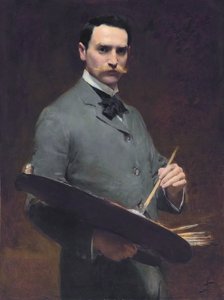
The Master of Drama and Light: The Life of Solomon Joseph Solomon
In the grand tapestry of late Victorian and Edwardian art, few figures command as much presence through both their brushwork and their historical contributions as Solomon Joseph Solomon. A man of profound versatility, Solomon was not merely a painter of exquisite skill but a pivotal figure in the British art establishment. Born into a Jewish family in London, his journey through the prestigious halls of the Heatherley School of Fine Art, the Royal Academy Schools, and eventually the esteemed Munich Academy and the École des Beaux-Arts under Alexandre Cabanel, shaped a style that was both classically grounded and vibrantly modern. His education allowed him to weave together the academic rigor of the French tradition with a uniquely British sensibility, creating works that felt both timeless and immediate.
Solomon’s artistic evolution was deeply influenced by the masters of his era, most notably Alexandre Cabanel, whose influence provided a foundation of anatomical precision and elegance. This, combined with the classical grandeur of Frederic Leighton and the meticulous, opulent detail of Lawrence Alma-Tadema, allowed Solomon to master the art of the large-scale narrative. While he maintained a steady practice of portraiture to sustain his livelihood, it was in the sweeping, theatrical realms of mythology and biblical epic that his soul truly found expression. His canvases became stages where ancient legends were brought to life with a palpable sense of movement and human emotion.
A Legacy of Narrative and Grandeur
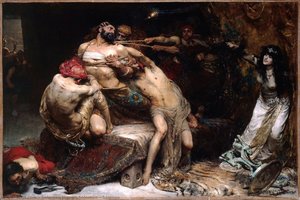
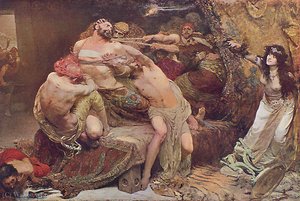
The true brilliance of Solomon’s work lies in his ability to capture the tension of a single, decisive moment. He possessed a rare talent for composing complex scenes that utilized the human form as a vehicle for drama. One of his most celebrated triumphs, Samson (1887), remains a landmark of his career. In this piece, he masterfully depicted the biblical struggle between Samson and Delilah, earning widespread acclaim for his daring use of multiple male nudes in dynamic, active poses. This work demonstrated not only his technical command over musculature and light but also his ability to push the boundaries of what was acceptable in the academic circles of his time.
Beyond the intimate drama of his biblical scenes, Solomon contributed to the very architecture of London’s history. His mural for the Royal Exchange, Charles I Demanding the Five Members at the Guildhall, stands as a testament to his ability to handle historical gravity and monumental scale. His career was marked by significant institutional achievements, including:
- Founding Member: He played a crucial role in the establishment of the New English Art Club, fostering a space for fresh, contemporary perspectives.
- Royal Academy Recognition: His ascent through the ranks of the Royal Academy, from Associate to full member, signaled his acceptance into the highest echelon of British art.
- Leadership: Serving as the President of the Royal Society of British Artists, he helped shape the direction of the British art scene during a period of immense transition.
Innovation Beyond the Canvas
Perhaps the most unexpected chapter of Solomon’s life occurred far from the quiet sanctity of his studio. During the First World War, the artist applied his keen eye for observation and texture to a much more practical, albeit grim, necessity: the development of camouflage. Recognizing the lethal importance of concealment in modern warfare, he worked tirelessly on the design of tree observation posts and advocated passionately for the implementation of camouflage netting. This period of his life reveals a man whose intellect and observational skills were not confined to the aesthetic, but were deeply engaged with the pressing realities of his age.
Solomon Joseph Solomon’s significance extends far beyond the borders of the frame. He was an artist who bridged the gap between the classical traditions of the 19th century and the burgeoning complexities of the 20th. Through his portraits, his epic mythological canvases, and his unexpected contributions to military science, he left an indelible mark on the history of British art, proving that a true master is one who can find beauty in the divine and utility in the shadows.
solomon joseph solomon
1840 - 1905
Quick Facts
- Artistic Movement Or Style: Academicism, Mythological, Biblical
- Artists Who Influenced This Artist:
- Alexandre Cabanel
- Frederic Leighton
- Lawrence Alma-Tadema
- Date Of Birth: 1840
- Date Of Death: 1905
- Full Name: Solomon Joseph Solomon
- Nationality: British
- Notable Artworks:
- Samson
- Charles I demanding the five members
- Place Of Birth: London, United Kingdom
Related Articles

Dark Masterpieces: 10 Iconic Paintings Dominated by Black Tones |
Explore 10 iconic paintings dominated by black tones, from Rembrandt’s chiaroscuro to Goya's dark expressions. Discover the stories behind these masterpieces & find museum-quality art reproductions for your home at .
Mars Black Masterpieces: 10 Iconic Paintings & Timeless Art Decor Ideas
Delve into the power of 'Mars Black' with 10 iconic paintings by masters like Rembrandt & Caravaggio. Explore dramatic chiaroscuro, gothic art, and timeless beauty. Find museum-quality reproductions & elevate your home decor on .
Lamp Black & Masterpieces: 10 Paintings That Define Shadow & Light |
Delve into the captivating world of 'Lamp Black' tones with 10 iconic paintings by masters like Rembrandt & Caravaggio. Explore Baroque chiaroscuro, dramatic lighting & shadow in art history. Find museum-quality reproductions at

Ivory Black Masters: 10 Paintings That Define Dramatic Art |
Delve into the power of 'Ivory Black' with 10 iconic paintings by masters like Rembrandt & Caravaggio. Explore dramatic chiaroscuro, gothic moods & timeless art history. Find museum-quality reproductions and elevate your home decor at

Monochrome Visions: Exploring the Aesthetic & Historical Significance of Black & White Photography
Explore the rich history & artistic power of black and white photography. From early techniques to iconic masters like Ansel Adams, discover why monochrome continues to captivate art lovers today. Expert insights for collectors.