 Preview
 Send
Send Share
Share
 Details

 Download
 Similars
 X-Ray
X-Ray Diaporama
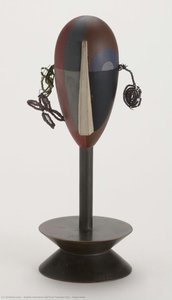
Dada Head


 Read More
Hand Made Oil Reproduction
Hand-painted oil on canvas in your size and frame, made to order by our artists. ( Buy Print Buy Image)




P118B $10

P118H $10

P118W $10

P438Z $10

P508JH $12

P508YH $12

P805H $10

P805Z $10

P919BZ $10

P919G $10

P919XJ $10

P959ZH $10

P968JZ $12

W106C $8

W218G $10

W218JH $8

W218Y $10

W307PJ $10

W316G $10

W316PJ $8

W316Y $10

W398PJ $8

W4111J $10

W500HY $15

W500JH $15

W692G $12

W849H $8

W940BG $15

W953PJ $8




Pick from our preset sizes that match the artwork's original proportions.

You may enter your own dimensions to fit a specific frame or space. If your selected size does not match the original image's proportions, we will either crop the artwork or extend the painting with additional hand-painted elements. A digital mockup will be sent for your approval before production begins.
Please note that the on-screen preview does not reflect the actual cropping or extension. Only the mockup will accurately show the final composition.
While custom sizes are available, we recommend selecting a dimension from the predefined list to preserve the original proportions.
After order, ArtsDot.com team will email client for instructions and provide a mockup preview
Worldwide Delivery () in 3/4 weeks instead of standard 5 weeks. (17 August). No compromise on quality.

Free Worldwide Express Shipping

High-Quality Linen Canvas

Full Shipping Insurance

Customs Tax Refund Guarantee

True Color Matching Guarantee

60-Day Return Policy (Defects Only)

100% Money-Back Guarantee

Bulk Discount Offer
 Glass option is only available in size under 110 CM

Dada Head
Reproduction Medium
Reproduction Size
-


Total Price
$ 263
Artwork Description
Sophie Taeuber-Arp’s ‘Dada Head’: A Fragmented Portrait of Disruption
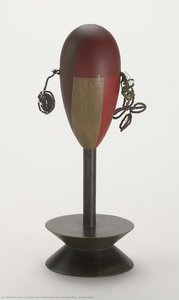
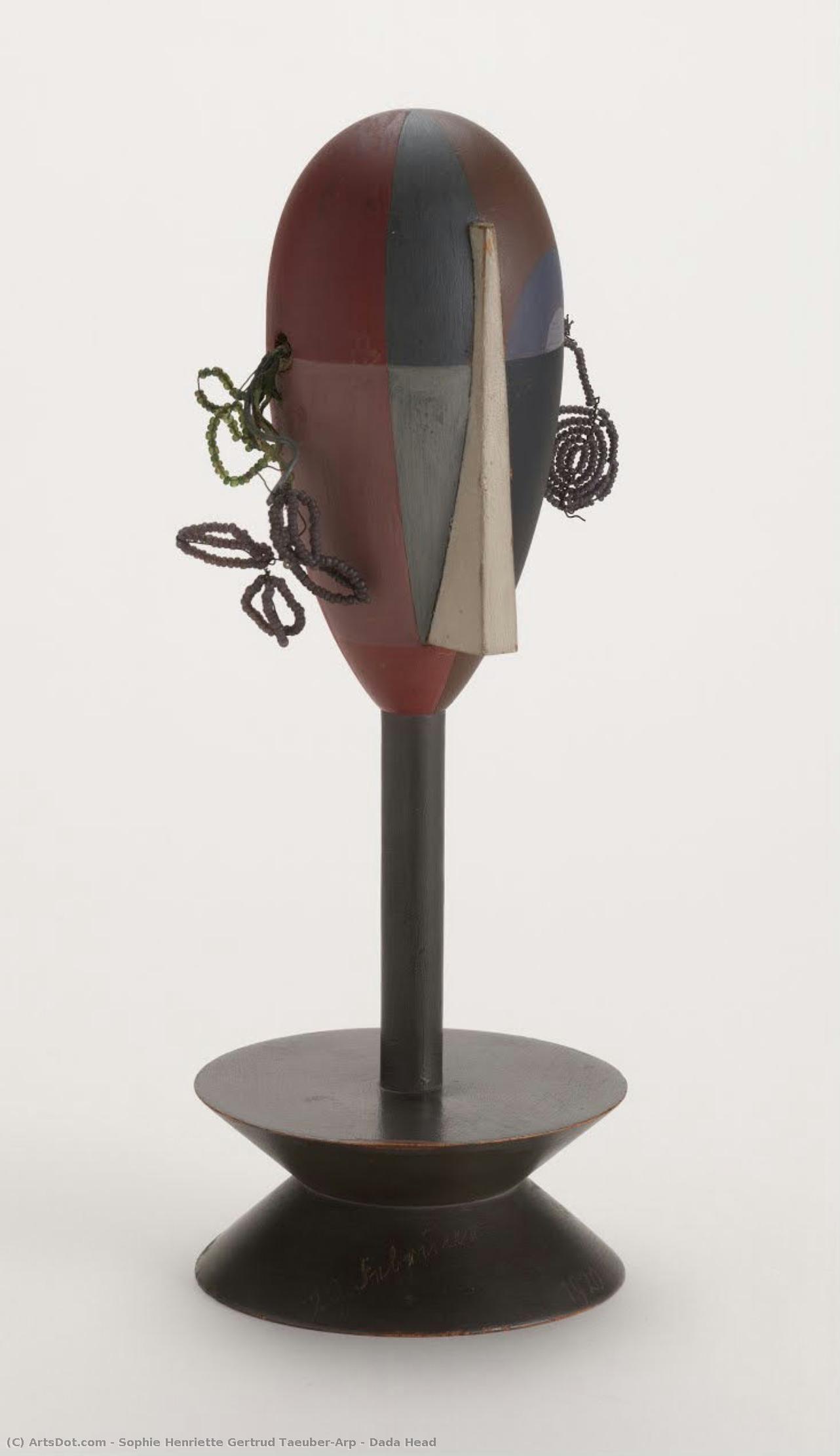
Sophie Taeuber-Arp's “Dada Head,” created in 1920, isn’t merely a sculpture; it’s a carefully orchestrated explosion of geometric abstraction and playful rebellion. Born from the turbulent heart of Zurich’s Dada movement, this striking piece transcends simple representation, offering instead a potent visual distillation of the era’s anxieties and its radical rejection of established artistic norms. Crafted primarily from turned wood—a material often associated with domestic crafts—and adorned with meticulously placed glass beads, the head possesses an unexpected elegance amidst its deliberately fractured form.
The sculpture immediately commands attention through its unconventional composition. The head itself is a simplified, almost childlike representation, constructed from sharp angles and flat planes. It’s not a portrait in the traditional sense; rather, it's a deconstructed mask, an embodiment of the Dadaist fascination with anonymity and the dismantling of recognizable forms. The use of contrasting colors—primarily reds, blues, browns, and creams—further emphasizes this fragmentation, preventing any single element from dominating the visual field. The deliberate lack of blending or shading reinforces the piece’s two-dimensional quality, pushing it away from illusionistic depth and firmly grounding it in the realm of pure abstraction.
A Reflection of Dadaist Principles
“Dada Head” is deeply rooted in the principles of the Zurich Dada movement. Emerging from the aftermath of World War I, Dada was a visceral reaction against the perceived failures of reason, logic, and societal structures. Artists sought to dismantle conventional aesthetics, embracing chance, absurdity, and irony as tools for critique. Taeuber-Arp’s sculpture perfectly embodies this spirit—a deliberate provocation that challenges our expectations of what art should be. The use of found materials – turned wood, a readily available craft material – further underscores the movement's rejection of traditional artistic hierarchies.
Interestingly, the piece shares striking similarities with another work by Taeuber-Arp, “Study for a Marionette (Portrait of H.A.)” from 1918. Both sculptures feature a bobbin-shaped base, trapezoidal noses, oval heads, and cylindrical necks, suggesting a deliberate pairing and highlighting the artist’s exploration of geometric forms and their potential for expressive communication. This connection hints at a deeper investigation into self-representation—or perhaps, more accurately, the deconstruction of it.
Symbolism and Emotional Resonance
The fragmented nature of “Dada Head” evokes a complex range of emotions. The disjointed composition can be unsettling, creating a sense of disorientation or even anxiety – mirroring the widespread disillusionment felt in Europe after the war. However, there’s also an undeniable playfulness to the piece, stemming from its bold colors and unconventional arrangement. The use of glass beads adds a subtle shimmer and texture, hinting at a hidden complexity beneath the surface.
Beyond its immediate visual impact, “Dada Head” speaks to broader themes of identity, representation, and the role of art in challenging societal norms. It’s a testament to Taeuber-Arp's innovative spirit and her ability to translate abstract concepts into tangible forms. The sculpture remains a powerful reminder of Dada’s legacy—a movement that continues to inspire artists and thinkers today.
Technical Details & Historical Context
Crafted primarily from wood, the surface of “Dada Head” is remarkably smooth and uniform, suggesting a meticulous application of enamel or another durable coating. The technique involves applying flat planes of color directly onto the surface, without any attempt at blending or shading – a deliberate choice that reinforces the sculpture’s abstract qualities. The piece was created during a period of significant artistic experimentation, as artists sought to break free from traditional conventions and explore new modes of expression. Taeuber-Arp's work exemplifies this spirit of innovation, pushing the boundaries of art and design.
Born in 1889 in Davos, Switzerland, Sophie Taeuber-Arp (1889 – 1943) was a Swiss artist whose groundbreaking work spanned painting, sculpture, textile design, furniture creation, architectural collaborations, and dance performances. Her distinctive style blended organic forms with geometric precision, reflecting her fascination with chance and intuition alongside meticulous craftsmanship. She attended a trade school in St. Gallen, Switzerland, honing skills in crafts and design before furthering her studies at art schools in Germany—particularly Bauhaus.
Related Artworks




Artist Biography
The Architect of Abstraction: The Life and Legacy of Sophie Taeuber-Arp
In the turbulent landscape of early 20th-century modernism, few figures possessed the multidisciplinary vision of Sophie Henriette Gertrud Taeuber-Arp. Born in 1889 in the serene Swiss town of Davos, her journey would eventually lead her to the very heart of the avant-garde revolution. She was not merely a painter or a sculptor; she was a weaver of worlds, an artist who dissolved the boundaries between fine art and functional design. Her life’s work stands as a testament to the power of geometric precision married to the spontaneous energy of the human spirit, creating a visual language that remains strikingly contemporary.
Taeuber-Arp’s artistic foundation was built upon a rigorous dedication to craft. Her early education at the Gewerbeschule in St. Gallen provided her with a profound understanding of textiles and design, a skill set that would later become a cornerstone of her abstract vocabulary. This technical mastery was further refined through her studies at influential German art schools, most notably the Bauhaus. It was here that she absorbed the revolutionary principles of modernism—the idea that art should be integrated into the fabric of daily life. Her marriage to the renowned artist Jean Arp in 1922 did more than unite two souls; it forged a creative partnership that would propel her into the epicenter of the Dada movement.
A Rebellion in Form: Dada and the Geometric Spirit
When the shadows of World War I descended upon Europe, Taeuber-Arp found herself part of the radical Dadaist circle in Cologne. While many associated Dada with chaos and nihilism, Sophie brought a unique structural discipline to its rebellion. She embraced the movement's anti-rationalist ethos, yet she infused it with a meticulous sense of composition. Her iconic “Dada Head” serves as a breathtaking example of this duality; by utilizing assemblage techniques involving geometric shapes and textile fragments, she rejected traditional sculptural norms in favor of a new, fragmented reality that mirrored the fractured world around her.
As her career progressed, her work transitioned from the provocative spontaneity of Dada toward the structured elegance of Constructivism and Concrete Art. This evolution is beautifully captured in her various masterpieces:
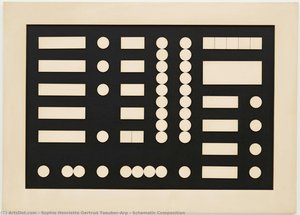
- Schematic Composition (1933): A vibrant oil on board that demonstrates her ability to use color and geometry to create a sense of playful, rhythmic movement.
- Composition of Circles and Overlapping Angles (1930): An iconic exploration of how geometric precision can evoke organic, fluid energy within a Constructivist framework.
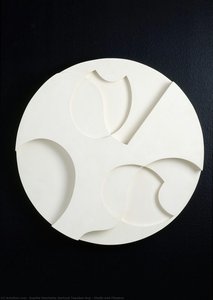
- Shells and Flowers (1938): A delicate paper cut that showcases her mastery of minimalism, using radial design and stark contrast to find beauty in the simplest of forms.
The Enduring Resonance of a Visionary
The historical significance of Sophie Taeuber-Arp lies in her refusal to be confined by medium or label. She moved seamlessly between the tactile world of textile design, the structural demands of furniture creation, and the ethereal realms of dance and painting. Her ability to blend organic forms with mathematical precision allowed her to bridge the gap between the natural world and the industrial age. She did not just observe the changing tides of modernism; she helped direct them.
Though her life was tragically cut short in 1943, her influence continues to ripple through the history of abstract art. Today, we recognize her as a pioneer who saw the potential for profound beauty in the grid, the circle, and the line. Her legacy is found in every modern design that seeks harmony between function and aesthetic, reminding us that true innovation often requires the courage to break old forms to build entirely new ones.

sophie henriette gertrud taeuber-arp
1889 - 1943 , Switzerland
Quick Facts
- Artistic Movement Or Style: Dada, Constructivism & Concrete Art
- Artists Or Movements Influenced By This Artist: ['Vienna Exhibition']
- Artists Who Influenced This Artist: ['Jean Arp']
- Date Of Birth: 19 January 1889
- Date Of Death: 13 January 1943
- Full Name: Sophie Henriette Gertrud Taeuber-Arp
- Nationality: Swiss
- Notable Artworks:
- Dada Head
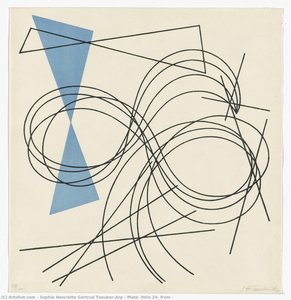
- Plate (folio 24)
- Sophie Taeuber-Arp
- Place Of Birth: Davos, Switzerland
Related Articles

Geometric Abstraction's 10 Defining Masterpieces | Art for Your Home - ArtsDot
Explore 10 defining masterpieces of Geometric Abstraction! Discover Kandinsky, Mondrian & Malevich’s iconic works. Find museum-quality art reproductions and curated decor ideas to elevate your home at ArtsDot.com.
Beyond Form: Exploring Geometric Abstraction's Enduring Legacy in Art History
Explore the captivating world of geometric abstraction! Discover its origins, key artists like Kandinsky & Mondrian, and why this movement remains highly valued by art collectors today. Expert insights at ArtsDot.

Dada: A Revolution of Anti-Art & the Rejection of Reason in Early 20th Century Aesthetics
Explore the revolutionary Dada art movement! Discover its origins, key artists like Duchamp & Arp, and lasting impact on modern art. A deep dive into anti-art & challenging conventions.

Dadaism: A Rebellion Against Reason – Exploring the Origins, Characteristics, and Enduring Legacy of an Anti-Art Movement
Explore the revolutionary Dada art movement! Discover its origins in WWI, key artists like Duchamp & Höch, core principles, and lasting impact on modern and contemporary art. A comprehensive guide for enthusiasts.

Geometric Design in Art: A Historical Survey & Contemporary Appeal for Collectors
Explore the enduring legacy of geometric abstraction! Discover key artists, historical movements & investment insights for discerning art collectors. Expert guidance from ArtsDot.