 Preview
 Send
Send Share
Share
 Details

 Download
 Similars
 X-Ray
X-Ray Diaporama
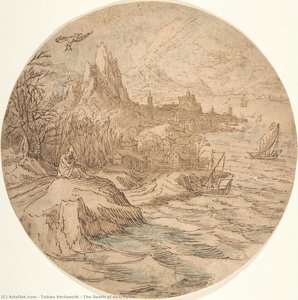
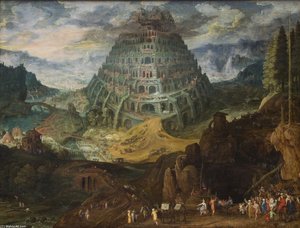
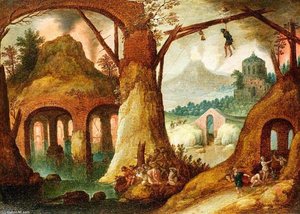
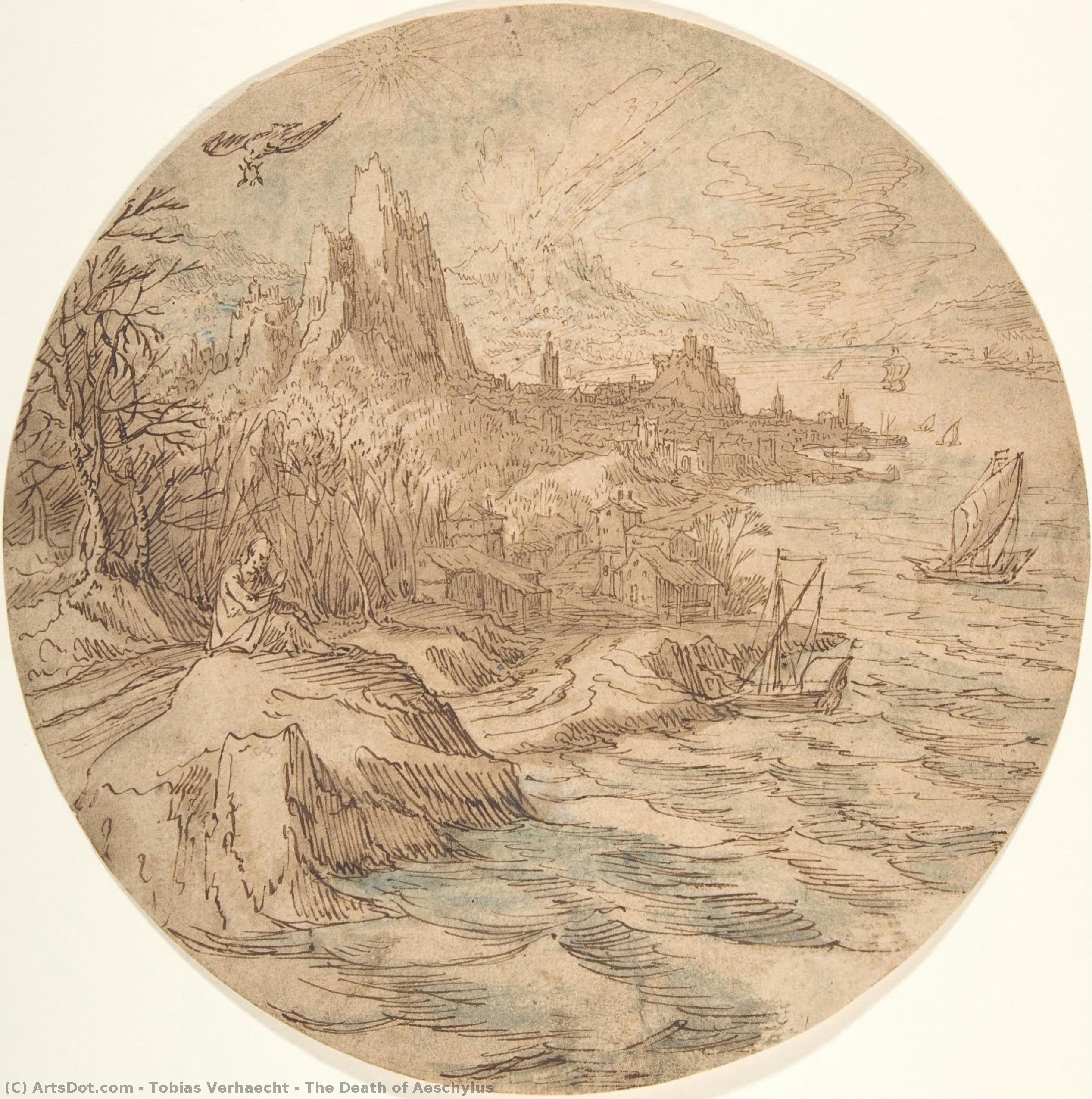
The Death of Aeschylus


 Read More
Hand Made Oil Reproduction
Hand-painted oil on canvas in your size and frame, made to order by our artists. ( Buy Print Buy Image)




P118B $10

P118H $10

P118W $10

P438Z $10

P508JH $12

P508YH $12

P805H $10

P805Z $10

P919BZ $10

P919G $10

P919XJ $10

P959ZH $10

P968JZ $12

W106C $8

W218G $10

W218JH $8

W218Y $10

W307PJ $10

W316G $10

W316PJ $8

W316Y $10

W398PJ $8

W4111J $10

W500HY $15

W500JH $15

W692G $12

W849H $8

W940BG $15

W953PJ $8




Pick from our preset sizes that match the artwork's original proportions.

You may enter your own dimensions to fit a specific frame or space. If your selected size does not match the original image's proportions, we will either crop the artwork or extend the painting with additional hand-painted elements. A digital mockup will be sent for your approval before production begins.
Please note that the on-screen preview does not reflect the actual cropping or extension. Only the mockup will accurately show the final composition.
While custom sizes are available, we recommend selecting a dimension from the predefined list to preserve the original proportions.
After order, ArtsDot.com team will email client for instructions and provide a mockup preview
Worldwide Delivery () in 3/4 weeks instead of standard 5 weeks. (28 August). No compromise on quality.

Free Worldwide Express Shipping

High-Quality Linen Canvas

Full Shipping Insurance

Customs Tax Refund Guarantee

True Color Matching Guarantee

60-Day Return Policy (Defects Only)

100% Money-Back Guarantee

Bulk Discount Offer
 Glass option is only available in size under 110 CM

The Death of Aeschylus
Reproduction Medium
Reproduction Size
-


Total Price
$ 263
The Death of Aeschylus: A Flemish Masterpiece of Tragedy and Landscape
Tobias Verhaecht’s “The Death of Aeschylus,” painted in 1606, is more than just a depiction of a gruesome legend; it's a meticulously crafted meditation on mortality, fate, and the sublime beauty of the natural world. The painting, now housed within the Metropolitan Museum of Art, immediately draws the eye with its expansive composition – a panoramic landscape dominating the canvas, subtly framing the tragic event at its heart. It’s a work that speaks volumes through restraint, relying heavily on atmospheric perspective and a masterful understanding of light to convey both the drama of the scene and the quiet grandeur of the surrounding wilderness. Verhaecht, a key figure in the Flemish landscape tradition, expertly blends elements of Mannerism with the burgeoning realism of his time, creating an image that is simultaneously elegant and profoundly unsettling.A Legend Brought to Life: The Story Behind the Canvas
The narrative depicted – the tale of Aeschylus, the renowned Greek playwright, being killed by an eagle mistaking his bald head for a shiny rock – is a chilling one, recounted in detail within the painting itself. This bizarre event, as legend has it, served as a potent metaphor for the fragility of life and the capricious nature of fate. The story’s resonance with Verhaecht's audience would have been heightened by its connection to classical mythology and the enduring themes of heroism, hubris, and divine retribution. Interestingly, the painting wasn’t merely a straightforward illustration; it was likely conceived as a design for a stained-glass window, evidenced by the circular format and the artist’s meticulous attention to detail – elements typically associated with ecclesiastical art. The inclusion of the surrounding landscape suggests a deliberate attempt to elevate the tragic event beyond a simple anecdote, transforming it into a broader commentary on humanity's place within the vastness of creation.Technique and Style: A Masterclass in Atmospheric Perspective
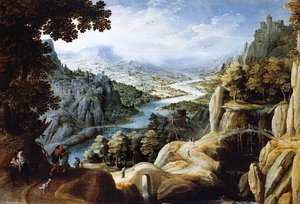
Verhaecht’s skill as a painter is immediately apparent in his masterful use of technique. The composition employs a sophisticated system of aerial perspective, with distant mountains rendered in hazy blues and purples, gradually fading into lighter tones as they recede into the background. This creates a convincing illusion of depth, drawing the viewer's eye into the scene and emphasizing the immense scale of the landscape. The artist’s use of pen and brown ink, combined with washes of blue and body color, produces a remarkably detailed surface texture – each rock formation, each blade of grass, is rendered with painstaking precision. The broad, expressive strokes in the foreground contrast sharply with the delicate lines used to depict the distant mountains, further enhancing the sense of depth and spatial recession. The painting’s overall effect is one of quiet intensity, a testament to Verhaecht's ability to capture both the beauty and the terror of the natural world.Symbolism and Emotional Resonance: More Than Meets the Eye
Beyond the literal depiction of the event, “The Death of Aeschylus” is rich in symbolic meaning. The eagle itself can be interpreted as a symbol of divine judgment or the relentless forces of nature. Aeschylus’s bald head, vulnerable and exposed, represents human mortality and vulnerability in the face of overwhelming power. The surrounding landscape, with its towering mountains and turbulent waters, serves as a metaphor for the unpredictable and often hostile environment of life. The painting evokes a profound sense of melancholy and contemplation, prompting viewers to consider their own mortality and the fleeting nature of existence. The inclusion of a small boat on the water adds another layer of complexity, suggesting themes of journey, loss, and the search for meaning in a world filled with uncertainty. It’s a work that lingers in the mind long after it has been viewed, prompting reflection on timeless questions about life, death, and the human condition.Related Artworks


Artist Biography
The Architect of the World Landscape
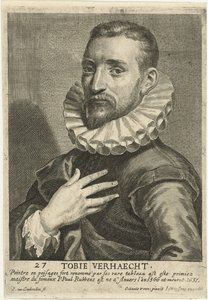
In the vibrant, bustling heart of Antwerp during the late sixteenth century, a master was at work, weaving together the rugged textures of mountains and the ethereal light of distant horizons. Tobias Verhaecht, born in 1561, emerged as a pivotal figure in the Flemish tradition, a painter whose brush captured the vastness of the "world landscape." His artistry was deeply rooted in the Mannerist traditions established by legends such as Joachim Patinir and Pieter Bruegel the Elder. Verhaecht did not merely paint scenery; he constructed entire universes on canvas, where panoramic vistas stretched toward infinite, hazy peaks, inviting the viewer to lose themselves in a meticulously detailed topography of the imagination.
The trajectory of Verhaecht’s life was as expansive as his landscapes. As the son of Cornelis van Haecht, he was born into the prestigious lineage of the Antwerp Guild of St. Luke, gaining entry to the guild as the son of a master. This early immersion in the professional artistic community provided him with a foundation that would eventually lead him far beyond the borders of Flanders. Before 1590, Verhaecht embarked on a transformative journey through Italy, a period that would profoundly refine his aesthetic sensibilities. In Florence, he found himself under the esteemed patronage of Francesco I de' Medici, Grand Duke of Tuscany, an honor that speaks to the high regard in which his talent was held. His travels continued to Rome, where he applied his skill to the grand medium of fresco painting, capturing the monumental scale of classical landscapes within the architectural splendor of Italian interiors.
A Legacy of Mentorship and Mastery
Upon his return to Antwerp, Verhaecht transitioned from a wandering traveler to a pillar of the local art scene. Having achieved the status of master in the Guild of St. Luke around 1590–91, he became a central figure in the city's cultural fabric. Perhaps his most enduring historical significance lies in his role as a teacher; it was Verhaemt who first instructed the legendary Pieter Paul Rubens. While the young Rubens would eventually depart Verhaecht’s studio to pursue the grander scale of history painting, the foundational lessons in landscape and composition learned under Verhaecht remained a vital part of his artistic DNA. The lineage of Verhaecht’s influence extended through many pupils, including Willem van Haecht, Jacques Backereel, and Martin Ryckaert, ensuring that his stylistic fingerprints were pressed upon the next generation of Flemish masters.
Beyond the studio, Verhaecht’s life was a complex tapestry of personal triumph and profound sorrow. His domestic life was marked by significant shifts; he married Suzanna van Mockenborch, a connection that linked him to the family of Rubens' stepfather, but her untimely death in 1595 plunged him into a period of both financial hardship and personal grief. He later found companionship again with Esther Pamphi, yet his later years were shadowed by the loss of his children, Cornelis and Suzanna. Despite these tribulations, Verhaecht remained an active participant in the intellectual life of Antwerp, joining the violieren, a local chamber of rhetoric, even composing a comedy in 1620. His life was a testament to the resilience of the creative spirit, standing as a bridge between the structured Mannerism of the sixteenth century and the burgeoning Baroque era that would soon redefine European art.
tobias verhaecht
1561 - 1631 , Belgium
Quick Facts
- Artistic Movement Or Style: Mannerist world landscape
- Artists Or Movements Influenced By This Artist:
- Peter Paul Rubens
- Willem van Haecht
- Martin Ryckaert
- Artists Who Influenced This Artist:
- Joachim Patinir
- Pieter Bruegel the Elder
- Date Of Birth: 1561
- Date Of Death: 1631
- Full Name: Tobias Verhaecht
- Nationality: Flemish
- Place Of Birth: Antwerp, Belgium
Related Articles

Romantic Landscapes: 10 Masterpieces for Your Home | ArtsDot
Journey through 10 Romantic landscape masterpieces by Friedrich, Turner & Cole. Explore emotional art, sublime nature scenes & iconic 19th-century paintings. Find museum-quality reproductions for your home at ArtsDot.com – discover the full collection online!

Evocations of Place: A Historical Journey Through Landscape Art
Explore the rich history of landscape art with ArtsDot. Discover renowned artists, movements like Impressionism & Romanticism, and expert guidance for collecting timeless pieces. Find your perfect serene escape today!

John Constable's Masterpieces: Explore 25 Iconic Landscapes for Your Home
Journey through John Constable's 25 most celebrated landscapes. Explore Romanticism, Dedham Vale & his masterful use of light in iconic paintings like 'Hay Wain'. Find museum-quality art reproductions and elevate your home decor on ArtsDot.com.
Evocations of Place: A Historical Journey Through Landscape Art
Explore the rich history of landscape art with ArtsDot. Discover renowned artists, movements like Impressionism & tonalism, and expert guidance for collecting timeless pieces. Find your perfect serene escape today!
Evoking Nature's Sublime: A Comprehensive Exploration of 19th-Century Landscape Painting
Explore the captivating world of 19th-century landscape painting! Discover renowned artists like Friedrich & Monet, key movements, and find the perfect artwork to bring nature's serenity into your home. Expert insights at ArtsDot.