 Preview
 Send
Send Share
Share
 Details

 Download
 Similars
 X-Ray
X-Ray Diaporama
Factory Foltzer


 Read More
Hand Made Oil Reproduction
Hand-painted oil on canvas in your size and frame, made to order by our artists. ( Buy Print Buy Image)




P118B $10

P118H $10

P118W $10

P438Z $10

P508JH $12

P508YH $12

P805H $10

P805Z $10

P919BZ $10

P919G $10

P919XJ $10

P959ZH $10

P968JZ $12

W106C $8

W218G $10

W218JH $8

W218Y $10

W307PJ $10

W316G $10

W316PJ $8

W316Y $10

W398PJ $8

W4111J $10

W500HY $15

W500JH $15

W692G $12

W849H $8

W940BG $15

W953PJ $8




Pick from our preset sizes that match the artwork's original proportions.

You may enter your own dimensions to fit a specific frame or space. If your selected size does not match the original image's proportions, we will either crop the artwork or extend the painting with additional hand-painted elements. A digital mockup will be sent for your approval before production begins.
Please note that the on-screen preview does not reflect the actual cropping or extension. Only the mockup will accurately show the final composition.
While custom sizes are available, we recommend selecting a dimension from the predefined list to preserve the original proportions.
After order, ArtsDot.com team will email client for instructions and provide a mockup preview
Worldwide Delivery () in 3/4 weeks instead of standard 5 weeks. (20 August). No compromise on quality.

Free Worldwide Express Shipping

High-Quality Linen Canvas

Full Shipping Insurance

Customs Tax Refund Guarantee

True Color Matching Guarantee

60-Day Return Policy (Defects Only)

100% Money-Back Guarantee

Bulk Discount Offer
 Glass option is only available in size under 110 CM

Factory Foltzer
Reproduction Medium
Reproduction Size
-


Total Price
$ 263
Artwork Description
Umberto Boccioni’s “Factory Foltzer”: A Vision of Industrial Dynamism
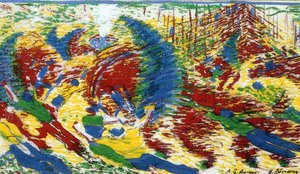
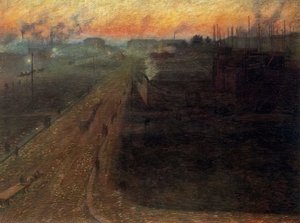
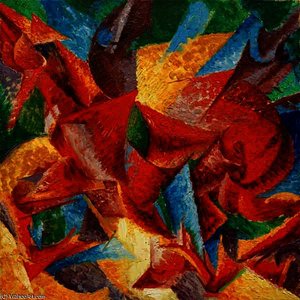
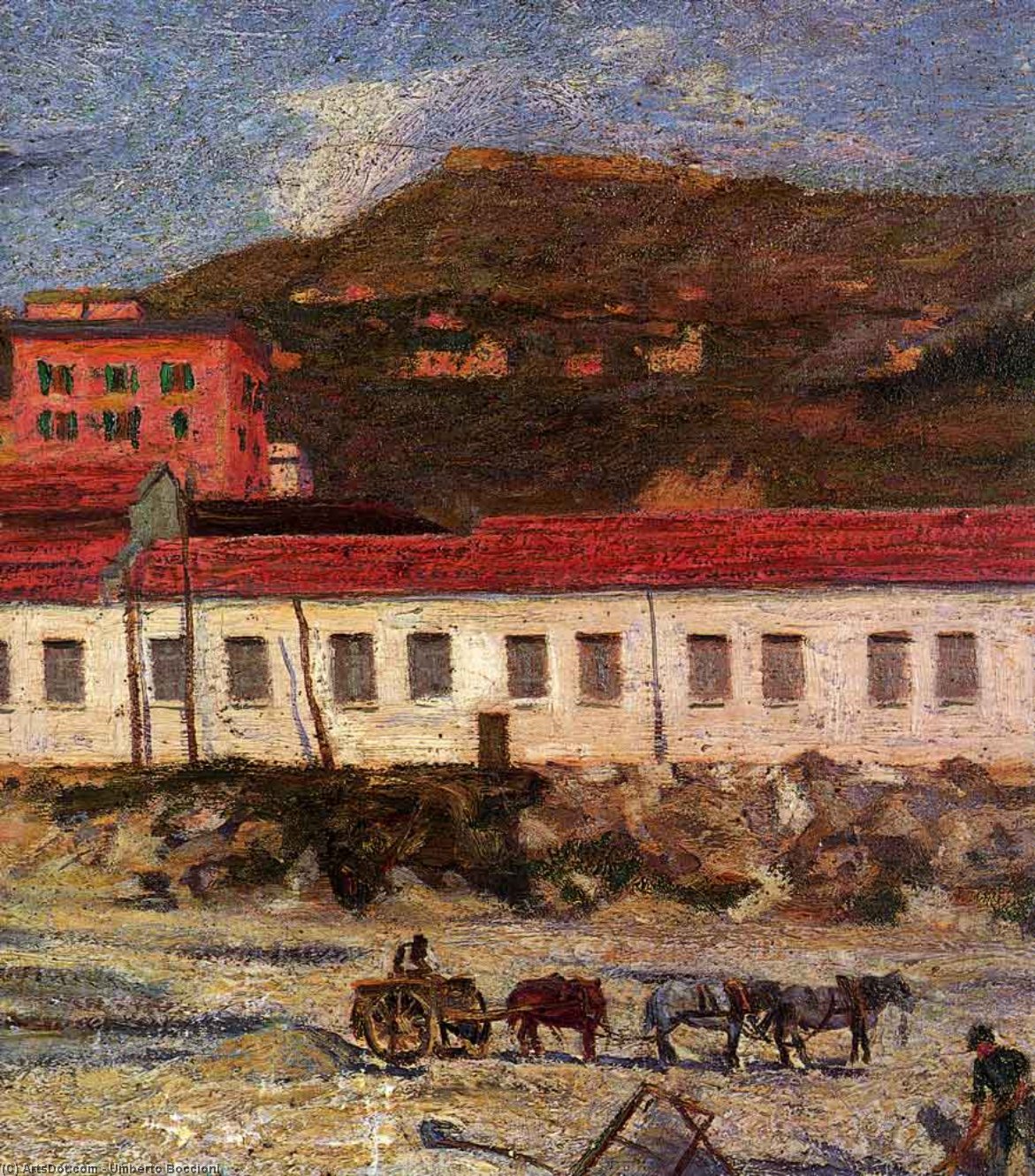
“Factory Foltzer,” painted in 1909 by the pioneering Futurist artist Umberto Boccioni, is a captivating and unsettling glimpse into a potential future – one dominated by industry and propelled by relentless motion. This artwork, depicting a scene of individuals traversing a vast industrial complex on horseback, immediately confronts the viewer with a jarring juxtaposition: the timeless image of equestrian travel colliding with the burgeoning machinery of the early 20th century. The painting’s raw energy and distorted perspective are hallmarks of Boccioni's embrace of Futurism, a movement that sought to capture not just appearances but the very essence of speed, technology, and urban life.
- Subject Matter: The central subject is a bustling factory or industrial facility, rendered with an almost chaotic intensity. Riders on horseback navigate this space alongside a wagon, suggesting a complex system of transport and labor within the facility.
- Style & Technique: Boccioni’s brushwork is deliberately fragmented and dynamic, reflecting the Futurist desire to represent movement and energy. The figures are not depicted with traditional realism but rather as flattened planes of color and form, conveying a sense of acceleration and disruption. Notice the use of bold, contrasting colors – particularly the striking red roofs – which further amplify the painting’s dramatic effect.
Historical Context: Futurism and the Dawn of Modernity
Painted in 1909, “Factory Foltzer” emerged during a period of profound social and technological change in Italy. The rise of industrialization, coupled with the fervor surrounding advancements in transportation – particularly automobiles and airplanes – fueled the Futurist movement’s core tenets. Led by Filippo Tommaso Marinetti, Futurists vehemently rejected traditional artistic values, celebrating speed, violence, technology, and the dynamism of modern life. Boccioni, a key figure within this revolutionary group, sought to translate these ideas onto canvas, creating works that were deliberately provocative and challenging.
- Futurist Ideology: The painting embodies the Futurist belief in embracing the future, rejecting the past’s artistic conventions.
- Industrialization's Influence: It reflects the growing importance of factories and industrial labor in Italian society at the time.
Symbolism and Interpretation
Beyond its depiction of a specific scene, “Factory Foltzer” is laden with symbolic meaning. The horses themselves can be interpreted as representing a stubborn resistance to progress – a nostalgic connection to a simpler past – while the factory signifies the relentless march forward into an industrialized future. The wagon suggests a system of control and organization within this chaotic environment. The overall composition evokes a sense of unease, prompting questions about humanity’s relationship with technology and its potential consequences.
Emotional Impact: The painting's distorted perspective and frenetic energy create a powerful emotional response, conveying a feeling of disorientation, urgency, and perhaps even anxiety. It is a visceral representation of the anxieties and excitement surrounding rapid technological advancement.Artistic Significance & Reproduction
Umberto Boccioni’s “Factory Foltzer” stands as a pivotal work in the history of modern art, demonstrating the radical experimentation and innovative spirit of the Futurist movement. ArtsDot.com is proud to offer meticulously crafted hand-painted reproductions of this iconic artwork, allowing you to experience its power and beauty firsthand. Our skilled artisans employ traditional techniques to faithfully recreate Boccioni’s original vision, ensuring that each reproduction captures the dynamism, color, and emotional intensity of the piece. Whether for your home, office, or collection, a ArtsDot.com reproduction of “Factory Foltzer” is an investment in art history and a testament to the enduring legacy of Umberto Boccioni.
Related Artworks
Artist Biography
A Life Forged in Motion: The Revolutionary Vision of Umberto Boccioni
Umberto Boccioni, born in Reggio Calabria in 1882, was a figurehead of the Italian Futurist movement—a force that sought to shatter artistic conventions and embrace the dynamism of the modern world. His life, though tragically cut short at just thirty-three, became a testament to this fervent belief in progress, speed, and the intoxicating energy of the machine age. Boccioni’s early years were marked by constant relocation due to his father's civil service position, an upbringing that exposed him to diverse landscapes and instilled within him a restless spirit. This nomadic existence eventually led him to Rome, where he initially pursued studies in decorative arts before gravitating towards painting, absorbing influences from the Liberty style poster artists of the time. However, it was his encounter with Futurism, ignited by the writings of Filippo Tommaso Marinetti, that truly set his artistic trajectory ablaze.Embracing the Whirlwind: The Rise of a Futurist
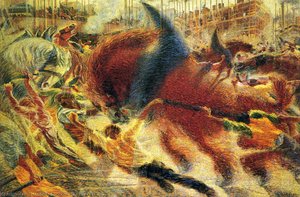
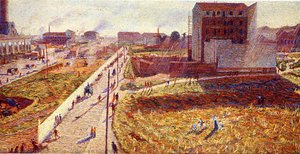
The year 1910 proved pivotal for Boccioni. He signed the *Manifesto dei Pittori Futuristi*, solidifying his commitment to a movement that celebrated technology, velocity, and even violence as emblems of modernity. This wasn’t merely an aesthetic choice; it was a philosophical rebellion against the weight of tradition, a desire to capture the very essence of a world hurtling towards an uncertain future. Boccioni quickly became one of Futurism's most articulate theorists, expanding upon Marinetti’s initial pronouncements and applying them to the visual arts. He argued for a complete break from representational accuracy, advocating instead for paintings that conveyed not just *what* things looked like, but *how* they felt in motion—the sensation of speed, the fragmentation of form, the overwhelming energy of urban life. His early works, while still hinting at Impressionist and Divisionist influences, began to demonstrate this burgeoning obsession with dynamism. Paintings such as *The City Rises* (1910-1911) are monumental in scale and ambition, depicting the chaotic construction of a modern metropolis—a swirling vortex of human figures, buildings, and machinery that embodies the Futurist ideal.Deconstructing Reality: Technique and Themes
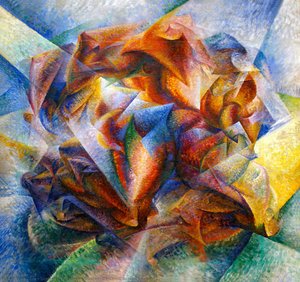
Boccioni’s artistic development was characterized by an increasingly radical approach to form. He moved away from traditional notions of perspective and composition, embracing fragmentation as a means of conveying movement and energy. Objects were broken down into their constituent parts, lines of force radiated outwards, and colors blended in swirling patterns—all designed to create a sense of visual vibration. This deconstruction wasn’t merely stylistic; it was rooted in Boccioni's belief that reality itself was fluid and constantly changing. He sought to represent not the static appearance of things, but their dynamic essence. Key themes emerged throughout his oeuvre: dynamism, the celebration of modernity, and a fascination with the human body as a vehicle for expressing energy and motion. This is powerfully illustrated in works like *Dynamism of a Human Body* (1913), where a figure is depicted not as a solid form but as a series of fragmented shapes suggesting movement through space. Perhaps his most iconic creation, *Unique Forms of Continuity in Space* (1913), transcends painting altogether—a bronze sculpture that embodies the Futurist ideal with breathtaking force. The figure appears to be caught mid-stride, its limbs and torso elongated and distorted, conveying a sense of unstoppable momentum.Legacy and Lasting Impact
Boccioni’s untimely death in 1916, during World War I, robbed the art world of a truly visionary talent. However, his ideas and artworks continued to resonate long after his passing. He profoundly influenced not only subsequent Futurist artists but also movements like Constructivism and Abstract Expressionism. His exploration of motion, dynamism, and the representation of modern life paved the way for new forms of artistic expression, challenging traditional notions of beauty and representation.- Influences: Giacomo Balla’s Divisionist techniques, Cubism's fragmentation of form, and the philosophical writings of Nietzsche.
- Notable Works: *Dynamism of a Human Body*, *Unique Forms of Continuity in Space*, *The City Rises*, *Dynamism of a Cyclist*.
- Historical Significance: A pivotal figure in 20th-century art, Boccioni challenged artistic conventions and helped shape the course of modern art. His theories on dynamism and the representation of motion continue to inspire artists today.
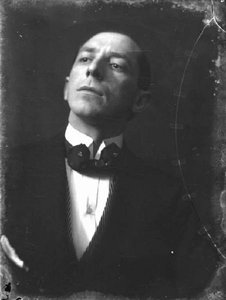
Umberto Boccioni
1882 - 1916 , Italy
Quick Facts
- Artistic Movement Or Style: Futurism
- Artists Or Movements Influenced By This Artist:
- Constructivism
- Abstract Expressionism
- Artists Who Influenced This Artist:
- Giacomo Balla
- Divisionism
- Cubism
- Date Of Birth: 1882-10-19
- Date Of Death: 1916-08-17
- Full Name: Umberto Boccioni
- Nationality: Italian
- Notable Artworks:
- Dynamism of a Human Body
- Unique Forms of Continuity
- The City Rises
- Dynamism of a Cyclist
- Place Of Birth: Reggio Calabria, Italy
Related Articles

Crimson Threads of Narrative: Exploring Symbolism & Representation in Artworks Featuring the Red Dress
Explore the rich symbolism of the red dress in art history! From ancient power displays to iconic portraits like Cézanne’s 'Madame Cezanne', discover the cultural and artistic significance behind this captivating color. Expert analysis & insights.
The Noble Steed on Canvas: A Historical & Artistic Exploration of Horse Painting Across Cultures
Explore the rich history of horse painting! Discover masterpieces from Stubbs to Munnings & learn about symbolism, techniques & artists. Find museum-quality reproductions at ArtsDot.
The Equine Muse: A Historical & Artistic Exploration of Horses in Painting
Explore the captivating history of horses in painting! Discover Renaissance masterpieces, Baroque grandeur & expert insights for collecting equestrian art. Learn about symbolism, techniques & lasting value with ArtsDot.

Umberto Boccioni: Dynamism, Futurist Ideals & the Evolution of Modern Sculpture
Explore the revolutionary art of Umberto Boccioni, a leading figure of Futurism. Discover his iconic sculptures & paintings, and delve into the movement's impact on modern art history with ArtsDot.
The Noble Steed: A Historical and Artistic Exploration of Horses in Fine Art
Explore the rich history of horses in fine art! From ancient depictions to Renaissance masterpieces & beyond, discover iconic artworks and artists. Learn about symbolism, techniques, and find museum-quality reproductions at ArtsDot.