 Preview
 Send
Send Share
Share
 Details

 Download
 Similars
 X-Ray
X-Ray Diaporama
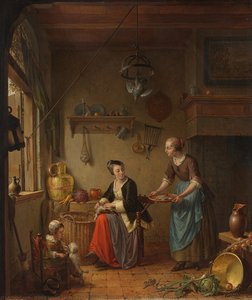
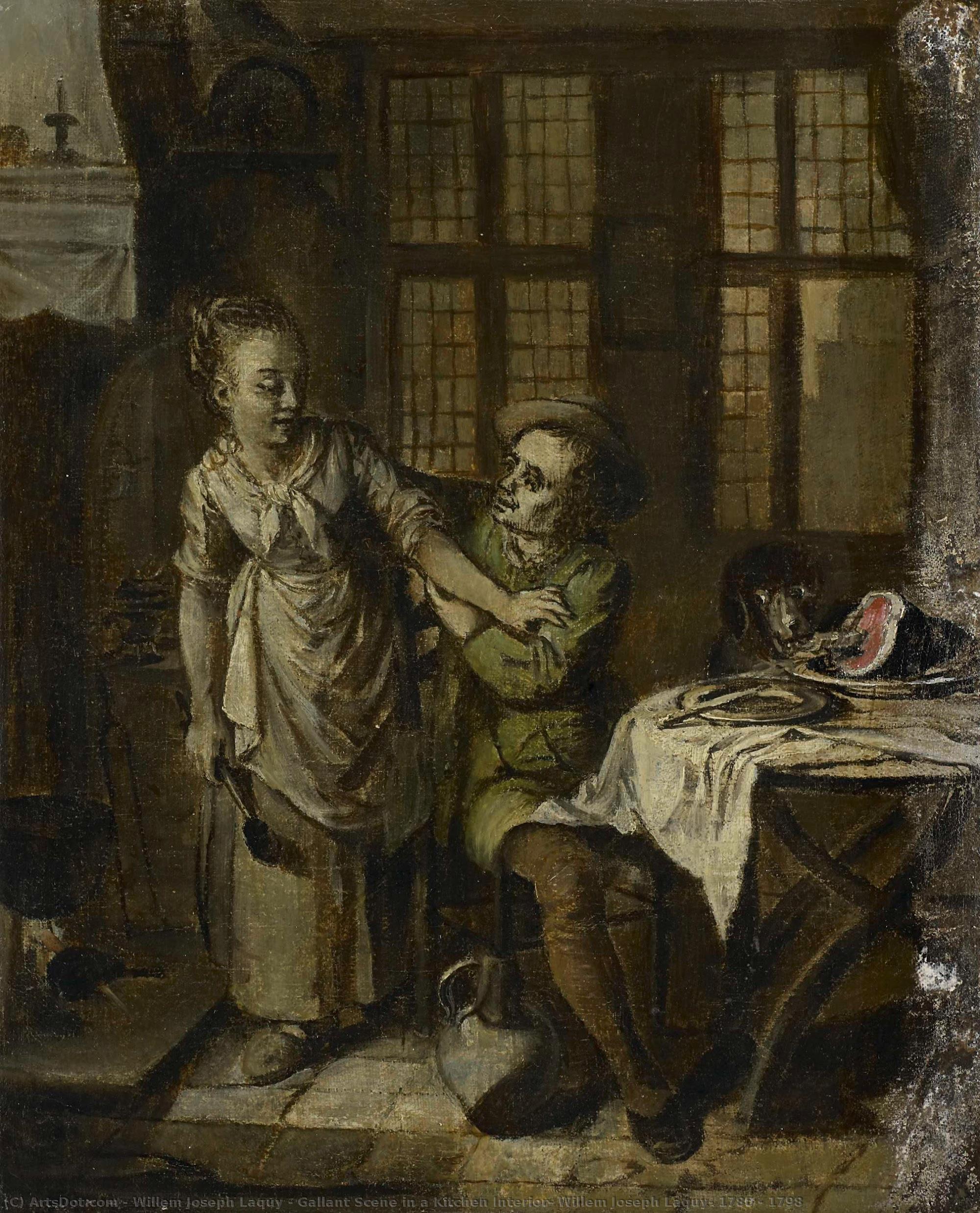
Gallant Scene in a Kitchen Interior, Willem Joseph Laquy, 1780 - 1798
 1798
1798 35.0 x 28.0 cm
 Read More
Hand Made Oil Reproduction
Hand-painted oil on canvas in your size and frame, made to order by our artists. ( Buy Print Buy Image)




































Pick from our preset sizes that match the artwork's original proportions.

You may enter your own dimensions to fit a specific frame or space. If your selected size does not match the original image's proportions, we will either crop the artwork or extend the painting with additional hand-painted elements. A digital mockup will be sent for your approval before production begins.
Please note that the on-screen preview does not reflect the actual cropping or extension. Only the mockup will accurately show the final composition.
While custom sizes are available, we recommend selecting a dimension from the predefined list to preserve the original proportions.
After order, ArtsDot.com team will email client for instructions and provide a mockup preview
Worldwide Delivery () in 3/4 weeks instead of standard 5 weeks. (24 August). No compromise on quality.

Free Worldwide Express Shipping

High-Quality Linen Canvas

Full Shipping Insurance

Customs Tax Refund Guarantee

True Color Matching Guarantee

60-Day Return Policy (Defects Only)

100% Money-Back Guarantee

Bulk Discount Offer
 Glass option is only available in size under 110 CM

Gallant Scene in a Kitchen Interior, Willem Joseph Laquy, 1780 - 1798
Reproduction Medium
Reproduction Size
-


Total Price
$ 263
Artwork Description
Related Artworks


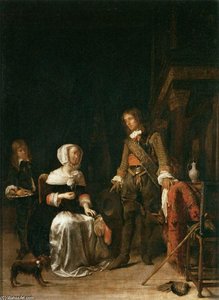
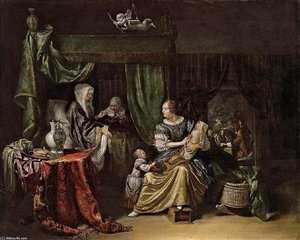
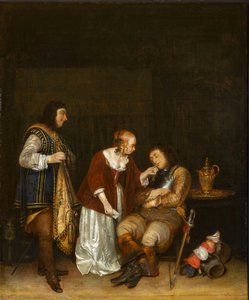


Artist Biography
A Life Immersed in Abstraction: Willem Joseph Laquy
Willem Joseph Laquy, born in 1905 in Galveston, Texas, embarked on a journey that would firmly establish him as a pivotal figure in the development of American Abstract Expressionism. Though often overshadowed by his more celebrated contemporaries like Pollock and Rothko, Laquy’s contribution to the movement was both significant and uniquely personal. His early life offered little indication of the artistic path he would forge. He initially pursued studies in architecture at Tulane University, a discipline that instilled within him a profound understanding of form and spatial relationships – elements that would later become central to his abstract compositions. However, a growing fascination with painting led him to abandon architectural pursuits and relocate to New York City in 1929, a crucible of artistic experimentation on the cusp of immense change.Early Influences and the Pursuit of Pure Color
The New York art scene of the 1930s proved formative for Laquy. He became deeply involved with the American Abstract Artists group, a collective dedicated to promoting non-objective painting in a period dominated by representational styles. This association exposed him to European Modernism, particularly the work of Wassily Kandinsky and Piet Mondrian. Laquy wasn’t simply mimicking these masters; he was absorbing their principles – the power of color, the reduction of form to its essential elements, and the spiritual potential of abstraction – and synthesizing them into his own visual language. He worked for a time as an assistant to Stuart Davis, another key figure in American Modernism, further honing his technical skills and deepening his understanding of compositional dynamics. His early paintings, often geometric and meticulously rendered, reflect this period of exploration and assimilation. However, Laquy soon began to move away from the rigid structures of earlier abstraction, seeking a more fluid and intuitive approach. He was driven by a desire to create paintings that were not *about* something but rather *were* something – pure expressions of color and form, devoid of narrative or representational content.The Development of “Color Field” Painting
The 1940s marked a turning point in Laquy’s artistic development. He began to experiment with larger canvases and increasingly simplified forms, focusing on the interplay of color masses. This period saw the emergence of his signature style: large-scale paintings composed of luminous, overlapping fields of color. He applied paint thinly, often using a spray gun or staining techniques, allowing the colors to bleed into one another, creating subtle gradations and atmospheric effects. These works anticipated the “Color Field” painting that would become prominent in the 1950s and 60s, with artists like Mark Rothko and Barnett Newman exploring similar territory. Laquy’s approach differed from Rothko's more somber and contemplative canvases; his work often possessed a greater sense of vibrancy and dynamism. He embraced brighter palettes and bolder color combinations, creating paintings that were both visually arresting and emotionally resonant. He sought to evoke feeling through the sheer presence of color, believing that color itself could be a powerful vehicle for spiritual experience.Recognition and Legacy
Despite his significant contributions, Laquy remained relatively unknown during much of his career. He was included in important exhibitions like “Abstract Expressionism” at the Museum of Modern Art in 1950, but he never achieved the same level of commercial success or critical acclaim as some of his peers. However, his work continued to evolve throughout his life, and he remained committed to his vision of pure abstraction. In later years, there was a growing recognition of his importance, with major museums acquiring his paintings and scholars re-evaluating his place in the history of American art. Laquy’s legacy lies in his pioneering exploration of color field painting, his unwavering commitment to non-objective expression, and his ability to create works that are both visually stunning and deeply moving. He demonstrated that abstraction could be a powerful means of conveying emotion, spirituality, and the sublime. His paintings continue to inspire artists and captivate audiences with their luminous beauty and profound simplicity.Major Achievements & Historical Significance
- Early advocate for abstract art in America through his involvement with the American Abstract Artists group.
- Pioneered large-scale color field painting, anticipating the movement’s rise to prominence in the 1950s and 60s.
- Developed a unique staining technique that created luminous, atmospheric effects in his paintings.
- Contributed significantly to the development of non-objective art as a valid form of artistic expression.
- His work helped establish New York City as a center for avant-garde art after World War II.