Introduction: Discovering Bernard Cathelin – A Quiet Master of the School of Paris
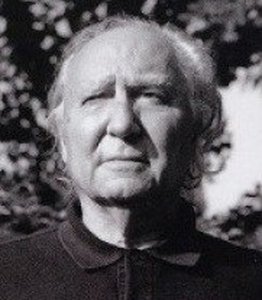 Bernard Cathelin
Discover Bernard Cathelin (1919-2004), a prominent French painter of the School of Paris. Known for vivid oil paintings, textured lithographs, still lifes, landscapes & portraits. Exhibited globally; Legion of Honour recipient.
Bernard Cathelin (1919-2004) remains a somewhat elusive figure within the celebrated constellation of the School of Paris, yet his work possesses a quiet power and enduring beauty that deserves wider recognition. Unlike some of his more flamboyant contemporaries, Cathelin’s artistic journey was marked by consistent dedication to a core set of themes – still life, landscape, and portraiture – executed with a refined sensibility and masterful command of color and texture. He wasn't driven by radical innovation but by an intensely personal vision, one rooted in observation, memory, and a deep affection for the French countryside. To encounter his paintings is to step into a world of subtle harmonies, melancholic grace, and understated elegance.
The School of Paris Influence: Cathelin’s Artistic Lineage and Early Development
 Wikipedia: Bernard Cathelin
Bernard Cathelin (20 May 1919 – 17 April 2004) was a French painter born in Paris and a member of the School of Paris which included Picasso, Chagall, Frenel, Matisse, Dufy and many others including Maurice Brianchon, Cathelin's teacher at the Ecole ...
Born in Paris, Cathelin benefited from an artistic environment steeped in tradition and innovation. The “School of Paris” wasn't a formal academy but rather a loosely defined community of artists – including giants like Picasso, Chagall, Matisse, and Dufy – who gravitated towards the city as a center for creative experimentation in the early to mid-20th century. Cathelin received formative training at the École Nationale Supérieure des Arts Décoratifs under Maurice Brianchon, whose influence instilled in him a respect for classical techniques while encouraging individual expression. While he absorbed elements from various movements – Cubism’s fragmentation of form, Fauvism’s bold color palettes – Cathelin ultimately forged his own path, eschewing overt stylistic imitation in favor of a more introspective approach. His early work demonstrates a keen understanding of composition and light, foreshadowing the mature style that would become his hallmark.
Still Life as Intimacy: Exploring Cathelin's Floral and Object Studies
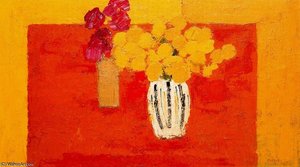 Untitled (361)
Admire Bernard Cathelin’s ‘Untitled (361)’ – a vibrant still life of flowers in a vase. Oil painting, orange background, yellow & red blooms. Hand-painted reproduction available.
Cathelin’s still lifes are not merely depictions of inanimate objects; they are intimate meditations on beauty, transience, and the passage of time. He frequently chose flowers – roses, lilies, peonies – arranged in simple vases, their delicate forms rendered with exquisite detail. These aren't grand, ostentatious displays but rather humble arrangements that evoke a sense of quiet contemplation. The backgrounds often feature rich, saturated colors—deep oranges, warm reds, and muted greens—that heighten the vibrancy of the blooms. Beyond flowers, Cathelin depicted everyday objects – fruit bowls, wine glasses, books – imbuing them with a symbolic weight. A chipped vase might suggest fragility, while a half-empty glass could allude to shared moments and fleeting pleasures. His mastery lies in transforming the ordinary into something profoundly evocative.
Landscapes of the Drôme: Capturing the Essence of French Provincial Beauty
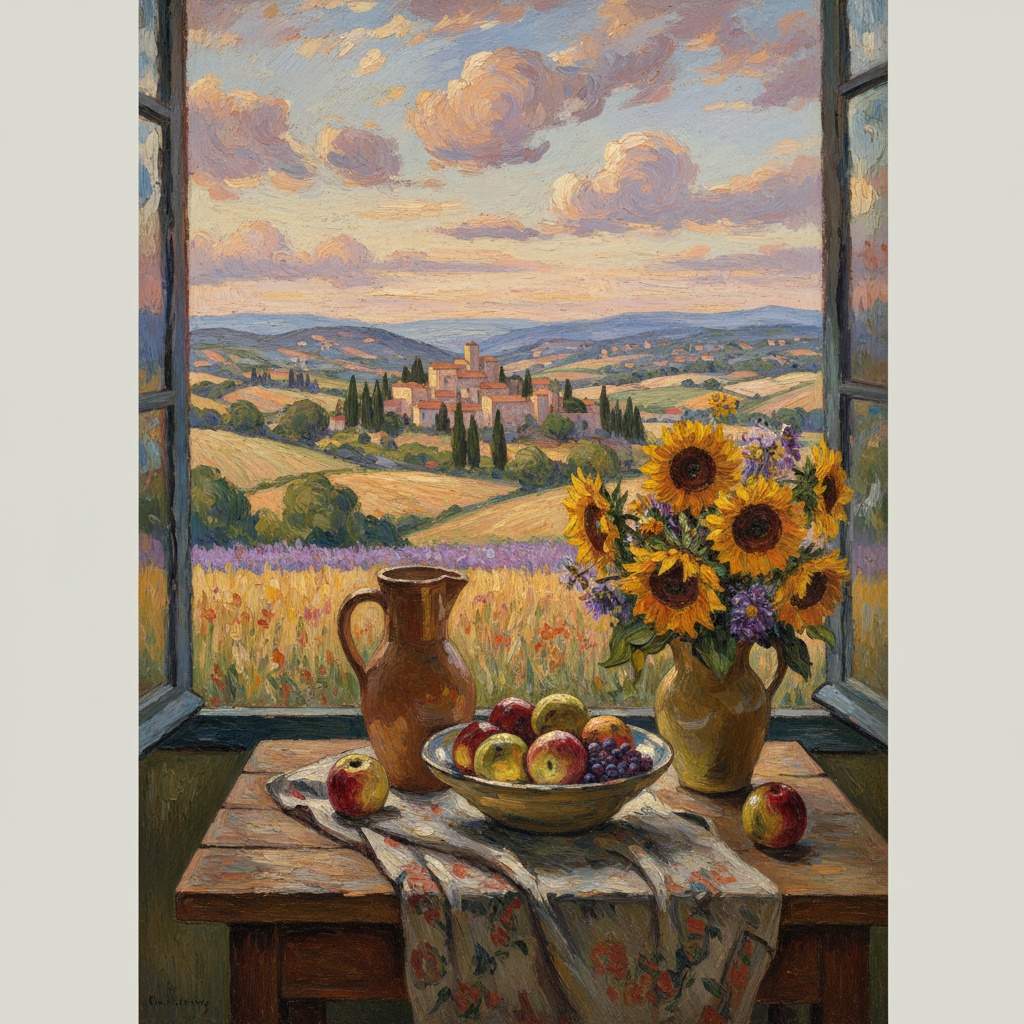
Throughout his life, Cathelin maintained a deep connection to the Drôme region of southeastern France, where his mother originated. This landscape became a recurring motif in his work, offering him a source of endless inspiration. Unlike the dramatic vistas favored by some landscape painters, Cathelin’s depictions of the Drôme are characterized by their subtlety and restraint. He captured the rolling hills, sun-drenched vineyards, and ancient villages with a delicate touch, emphasizing atmosphere and light rather than precise topographical detail. His paintings evoke not just a visual impression but also a sense of place – the warmth of the Mediterranean sun, the scent of lavender in the air, the quiet rhythm of rural life. These landscapes are imbued with a nostalgic quality, reflecting Cathelin’s deep-rooted love for his homeland.
Poetic Realism in Practice: Color, Texture, and Emotional Resonance in Cathelin’s Work
Poetic realism (French: Réalisme poétique) was a film movement in France of the 1930s. More a tendency than a movement, poetic realism is not strongly unified like Soviet montage or French Impressionism but were individuals who created this lyrical s...
While not explicitly aligning himself with any particular movement, Cathelin's work is often associated with Poetic Realism. This tendency, prominent in French art of the 1930s, emphasized lyrical beauty and emotional depth alongside realistic representation. Cathelin achieved this through a masterful use of color and texture. His oil paintings are characterized by rich impasto – thick layers of paint applied with visible brushstrokes – that create a tactile quality and imbue his surfaces with life. He wasn’t interested in photographic accuracy but rather in conveying the *feeling* of a scene, capturing its atmosphere and emotional resonance. The interplay of light and shadow is also crucial, creating a sense of depth and drama. His paintings often possess a melancholic undertone, suggesting a quiet longing or a wistful remembrance.
Cathelin’s Legacy: Exhibitions, Recognition, and Enduring Appeal
Despite receiving critical acclaim as early as 1950, Cathelin didn't achieve widespread commercial success until later in his career. However, since then, his work has steadily gained recognition, with over fifty exhibitions held worldwide. He was honored with the Legion of Honour by the French President François Mitterrand in 1995, and a retrospective exhibition at the Musée de Valence in 1997 drew record crowds. Today, Bernard Cathelin’s paintings are appreciated for their quiet beauty, technical mastery, and emotional depth. He offers a refreshing alternative to more bombastic styles, inviting viewers to slow down, contemplate, and appreciate the subtle harmonies of life. ArtsDot is proud to offer high-quality reproductions of Cathelin’s work, allowing art lovers around the world to experience the beauty of this often overlooked master.