
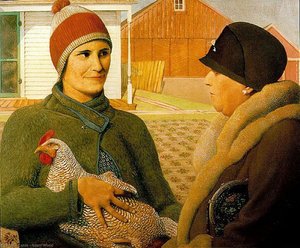
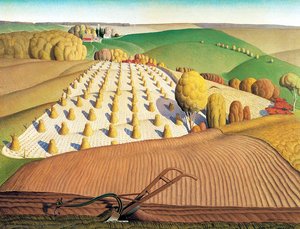

The Great Depression & The Rise of Regionalism: Art as a Response to Crisis
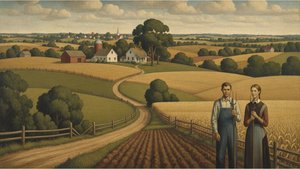 American Regionalism: The Soul of the Heartland and the Mastery of Grant Wood
The Genesis of Regionalism: A Response to Modernity and Crisis Echoes of Place: Regionalism & American Identity in Interwar Art The Rise of Regionalism: A Response to Modernity & Crisis Wikipedia: Regionalism (art) American Regionalism is an American...
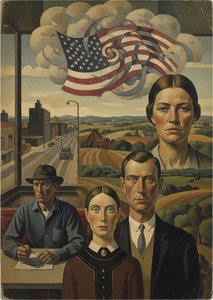
To understand the seismic shift that occurred in the American art scene during the early twentieth century, one must look toward the turbulent landscape of a nation in flux. As the world stood on the precipice of profound change, the prestigious galleries of Europe were erupting with the radical, fragmented energies of Cubism, Surrealism, and Futurism. These avant-garde movements, while intellectually stimulating, often presented an abstract reality that felt increasingly detached from the lived experiences of the American public. Across the Atlantic, a different current was flowing—one that sought not to dismantle representation, but to reaffirm it with a distinctly American inflection.
The emergence of American Regionalism in the 1930s was far more than a mere aesthetic preference; it was a deliberate, soulful reaction against cosmopolitan detachment and the increasing industrialization reshaping the United States. As the Great Depression cast a long, somber shadow over the nation, a collective yearning for stability, authenticity, and groundedness began to take root. This movement arose from a profound need for connection to the soil and the local landscape. It was an era where art functioned as a mirror for national identity, attempting to capture the essence of a people grappling with economic hardship by celebrating the enduring values found within their own borders.
Grant Wood: Blending Flemish Precision with Midwestern Grit
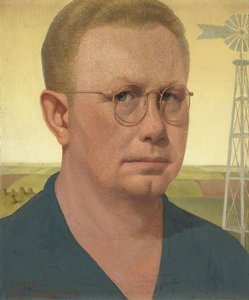 Grant Wood
Early Life and Career Grant DeVolson Wood, an American painter, was born on February 13, 1891, in rural Iowa. His life changed dramatically after the death of his father in 1901, when his mother relocated the family to Cedar Rapids. Wood began his ar...
At the very heart of this movement stood Grant Wood, an artist whose name became inextricably linked with the spirit of the American Midwest. Born in rural Iowa in 1891, Wood’s artistic journey was deeply informed by the rhythms of agricultural life and a fascination with the textures of his homeland. However, his technique was far from provincial. Wood’s mastery lay in his ability to marry the meticulous, luminous precision of the 15th-century Flemish masters—most notably Jan van Eyck—with a uniquely American vision.
This fascinating stylistic duality allowed him to transform ordinary scenes into extraordinary icons. By employing remarkably smooth brushwork and a precise rendering of light, Wood achieved an almost photographic clarity that elevated the mundane to the monumental. His work rejected the perceived chaos of European abstraction in favor of a figurative painting style that celebrated the dignity of rural life. Through his eyes, the Iowa cornfields and small-town streets were not merely subjects of documentation, but stages for a mythic, stylized reality that combined old-world craftsmanship with new-world authenticity.
Beyond the Canvas: Decoding the Symbolism of American Gothic
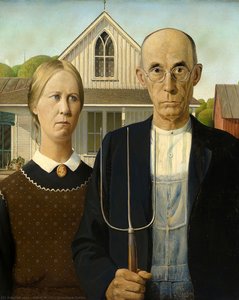 American Gothic
A Quintessential American Vision Grant Wood’s 1930 masterpiece, *American Gothic*, transcends its status as a painting; it is a cultural touchstone. More than just a portrait of rural life, this work encapsulates the anxieties and enduring values of ...
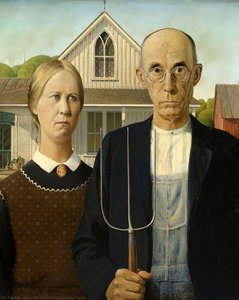
Few images in the history of art possess the cultural resonance of Grant Wood’s 1930 masterpiece, American Gothic. It has transcended its status as a painting to become a global cultural touchstone, an image that encapsulates the anxieties and enduring values of a nation in crisis. While often viewed through a lens of humor or irony, the work is rich with subtle complexities that invite deep contemplation. The iconic depiction of a farmer and his daughter—often mistakenly identified as his wife—standing before a Carpenter Gothic-style farmhouse, serves as a profound meditation on resilience.
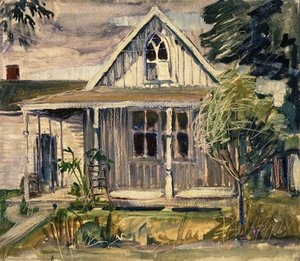
Every element within this composition carries significant symbolic weight. The pitchfork, held firmly by the farmer, represents hard labor and an unbreakable connection to the land, embodying the grit of the American spirit. The distinctive architecture of the house, with its pointed windows, alludes to religious faith and a yearning for traditional moral uprightness. Even the deliberate flattening of space and the emphasis on geometric forms—the rectangular house, the oval faces, the triangular pitchfork—contribute to a sense of permanence and stability. It is a scene that, despite its stillness, vibrates with the quiet strength of a generation refusing to be broken by the hardships of their era.
The Aesthetic of the Heartland: Landscapes, Identity, and Local Color
American literary regionalism, often used interchangeably with the term "local color", is a style or genre of writing in the United States that gained popularity in the mid-to-late 19th century and early 20th century. In this style of writing, which ...
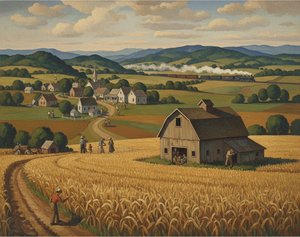
Regionalism was deeply intertwined with the concept of "local color," a style that emphasized the specific features of a region, including its dialect, customs, history, and landscape. This approach allowed artists to create a sense of place that felt intimately connected to the American experience. The movement drew inspiration from the rhythmic cycles of rural life, finding beauty in the weathered textures of old barns, the vastness of the plains, and the quiet dignity of small-town existence.
This aesthetic was not merely about nostalgia; it was about defining a national identity through the lens of local experience. By focusing on the unique character of specific regions, particularly the Midwest, Regionalist artists provided a reassuring image of the American heartland during a time of immense social upheaval. They sought to find the extraordinary within the everyday, turning the familiar landscapes of Iowa and beyond into a shared mythology. This focus on the "local" helped to preserve regional identities while simultaneously contributing to a broader, more inclusive story of what it meant to be American in a rapidly modernizing world.
Legacy of the Movement: How Regionalism Redefined American Identity
 Grant Wood & American Regionalism: Identity, Myth & the Rural Landscape
The Genesis of Regionalism: A Response to Modernity Wikipedia: Regionalism (art) American Regionalism is an American realist modern art movement that included paintings, murals, lithographs, and illustrations depicting realistic scenes of rural and s...
The era of American Regionalism reached its height between 1930 and 1935, eventually winding down in the 1940s as the end of World War II brought new shifts in the global art landscape. Yet, its impact on the trajectory of American art remains indelible. The movement succeeded in creating a visual language that was authentically American, providing a sense of pride and continuity during one of the most turbulent periods in the nation's history.
The legacy of Grant Wood and his contemporaries lives on in the way we perceive the American landscape and its people. They taught us to look closer at the familiar, to find the monumental in the modest, and to recognize that true art can be found in the very soil beneath our feet. By bridging the gap between European technical mastery and Midwestern authenticity, Regionalism ensured that the soul of the heartland would be etched forever into the canon of world art history.