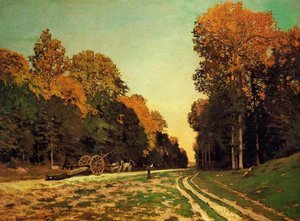
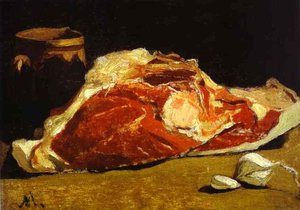
Early Life & Academic Foundations: Vienna and Initial Studies
Carl Eduard Schuch, born in Vienna in 1846, emerged from a period of personal loss that subtly shaped his artistic trajectory. Orphaned at a young age, and later bereaved by the death of his sister, Schuch inherited a modest fortune which afforded him the rare luxury of pursuing art without immediate financial constraint. This independence proved crucial, allowing him to cultivate a deeply personal vision rather than adhering strictly to prevailing academic doctrines. His formal training began in 1865 at the Vienna Academy, where he initially focused on landscape painting under Ludwig Halauska. However, Schuch’s early studies reveal a nascent preoccupation with tonal values and an almost scientific approach to rendering form – a desire, as he himself noted, to paint heads “like still-lifes, tone by tone, without emotion.” This seemingly paradoxical ambition—to strip away sentiment in pursuit of pure visual accuracy—hints at the complex interplay between realism and a more introspective sensibility that would define his later work. While Vienna provided a foundational education, it was travel that truly ignited Schuch’s artistic spirit.
The Influence of Italy: Landscape Painting and Artistic Development
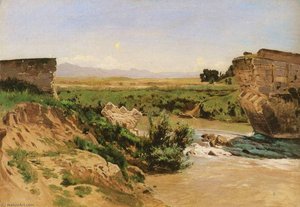 German Brückenruine an einem Flußlauf
Discover "German Brückenruine" by Carl Eduard Schuch – a serene 1870 landscape painting of a historic bridge ruin. Romantic realism, Austrian art.
Following his initial academic training, Schuch embarked on an extended period of travel throughout Italy, beginning around 1869. Venice proved particularly formative, its atmospheric light and decaying grandeur resonating deeply with the artist’s developing aesthetic. He immersed himself in the study of Old Masters, absorbing their techniques while simultaneously forging a distinctly personal style. The Italian sojourn wasn't merely about replicating existing forms; it was a period of intense observation, a meticulous examination of color, light, and composition. Schuch’s landscapes from this era demonstrate a growing confidence in his ability to capture the nuances of natural light and atmosphere, moving beyond mere topographical representation towards a more evocative portrayal of place. These early Italian works foreshadowed his later mastery of plein-air painting, though still rooted in a traditional realist framework.
Parisian Impressions: Monet, Rembrandt, and the Barbizon School
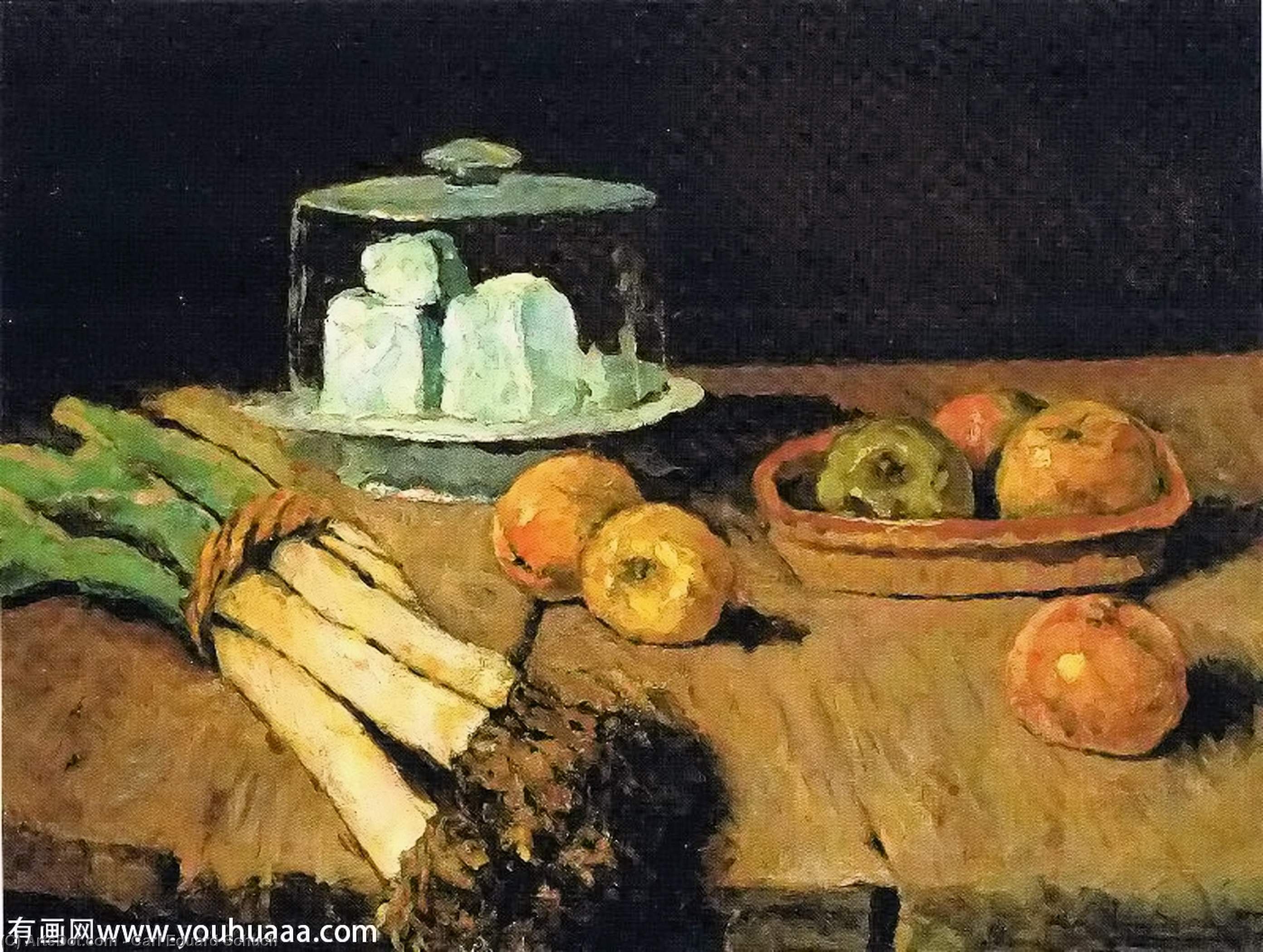 carl eduard schuch
Explore the evocative landscapes & still lifes of Carl Eduard Schuch (1846-1903), a pivotal Austrian painter bridging realism & modernism, influenced by Monet & Rembrandt.
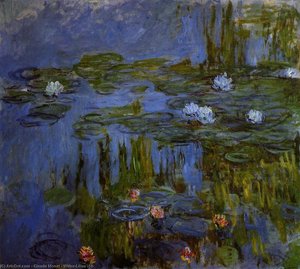
The pivotal moment in Schuch’s artistic evolution arrived with his relocation to Paris in 1882. The city was then a crucible of innovation, teeming with new ideas and challenging established norms. It was here that he encountered the burgeoning Impressionist movement, and particularly the work of Claude Monet. Schuch famously described Monet as “the Rembrandt of plein-air painting,” acknowledging his revolutionary approach to capturing fleeting moments of light and color. However, Schuch’s admiration wasn't limited to the Impressionists; he remained deeply committed to the legacy of Rembrandt, recognizing in the Dutch master a kindred spirit—a fellow explorer of tonal values and psychological depth. He also found kinship with the artists of the Barbizon school, appreciating their dedication to direct observation of nature and their rejection of academic artifice. This confluence of influences – Monet’s luminosity, Rembrandt’s chiaroscuro, and the Barbizon painters’ naturalism – formed the bedrock of Schuch’s unique artistic synthesis.
A Master of Tone: Schuch’s Unique Approach to Realism and Color
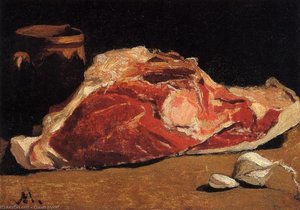
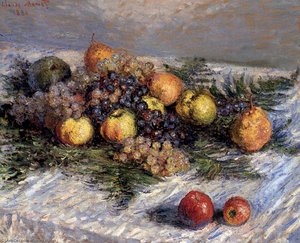
Schuch distinguished himself through an exceptional sensitivity to color and a meticulous approach to tonal modeling. Unlike many of his contemporaries who embraced vibrant, broken color palettes, Schuch favored a more restrained chromatic range, often dominated by browns, grays, and whites. This wasn’t a lack of technical ability but rather a deliberate aesthetic choice—a pursuit of subtle harmonies and nuanced gradations of light and shadow. His still lifes, in particular, exemplify this mastery of tone. Objects are rendered with an almost sculptural solidity, their surfaces imbued with a palpable sense of texture and weight. He didn't simply *depict* objects; he sought to capture their very essence through the careful manipulation of light and color. This dedication to capturing the “character” of his subjects led him to prioritize the application of paint itself—allowing colors to exist as independent surfaces rather than blending them seamlessly, creating a sense of depth and materiality that sets his work apart.
Friendship with Karl Hagemeister & The Transition to Modernity
Schuch’s artistic journey was profoundly shaped by his close friendship with the painter Karl Hagemeister. Their meeting in Bavaria sparked a period of intense collaboration and mutual inspiration, culminating in three years spent together in the small village of Ferch, south of Berlin. This shared existence—living in a modest home, painting the surrounding landscape—fostered an environment of artistic experimentation and intellectual exchange. While Hagemeister provided practical support, tending to their daily needs, Schuch served as a guiding force, encouraging his friend’s artistic development. Their relationship, though deeply affectionate, was not without its tensions; a disagreement over Hagemeister's work ultimately led to a painful separation. Despite this rift, the period in Ferch marked a crucial transition for Schuch, pushing him further towards a more modern sensibility. He began to explore new compositional approaches and embrace a greater degree of abstraction, foreshadowing his later experiments with color and form.
Legacy and Rediscovery: Schuch's Place in Art History
Despite possessing considerable talent and a refined artistic vision, Carl Eduard Schuch remained largely unknown during his lifetime. He sold only one painting and exhibited infrequently, preferring the solitude of his studio to the demands of the art market. His later years were marred by a debilitating illness that forced him to abandon painting in 1891. Following his death in 1903, his work fell into relative obscurity for much of the 20th century. However, recent scholarship has begun to reassess Schuch’s contribution to art history, recognizing him as a pivotal figure bridging the gap between realism and modernism. His unique approach to color, his mastery of tone, and his profound sensitivity to light and atmosphere have earned him a growing reputation among collectors and connoisseurs. Today, Schuch's paintings are increasingly sought after for their quiet beauty, technical brilliance, and enduring emotional resonance. Discover the evocative landscapes & still lifes of Carl Eduard Schuch with ArtsDot, where museum-quality reproductions bring his masterpieces to life.