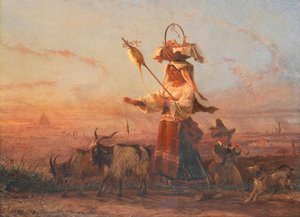
Early Life & Training: From Bavarian Academy to British Watercolors
The art of the United Kingdom refers to all forms of visual art in or associated with the country since the formation of the Kingdom of Great Britain in 1707 and encompasses English art, Scottish art, Welsh art and Irish art, and forms part of Wester...
Carl Haag’s artistic journey began amidst the established traditions of 19th-century Bavaria, a world far removed from the sun-drenched landscapes and vibrant cultures he would later immortalize on paper. Born in Erlangen in 1820, his initial training at the Academy of Fine Arts Nuremberg and Munich laid a solid foundation in portraiture and architectural rendering – skills that would prove surprisingly valuable as he transitioned to the more fluid medium of watercolor. However, it was his relocation to England in 1847 that proved pivotal. The British watercolour tradition, with its emphasis on atmospheric effects, delicate washes, and meticulous detail, resonated deeply with Haag’s developing sensibilities. He quickly absorbed these techniques, recognizing their potential for capturing not just the *appearance* of a scene but also its very essence – the quality of light, the texture of stone, the subtle nuances of human expression.
This early period wasn't merely about technical acquisition; it was a process of artistic re-evaluation. Haag’s initial work in oils and architectural studies provided him with an understanding of form and composition that would later distinguish his more romantic and evocative watercolors. He wasn’t simply adopting a new style, but rather synthesizing his existing skills with the unique possibilities offered by British watercolor painting.
The Allure of the Orient: Haag's Travels in Egypt, Syria & the Holy Land
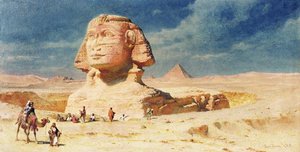 The Sphynx Of Giza
Explore 'The Sphynx of Giza' by Carl Haag – a romantic watercolor depicting Egypt’s iconic monument. Discover Orientalist art & timeless beauty in this stunning piece.
By the 1850s, Haag had established himself as a promising artist within the London art scene. But it was his yearning for something beyond the familiar that truly ignited his creative fire. The mid-19th century witnessed a growing fascination with the “Orient” – a region shrouded in mystery and romanticism for European audiences. Haag embarked on an ambitious series of travels to Egypt, Syria, and Palestine between 1858 and 1860, journeys that would define his artistic career. These weren’t casual expeditions; they were immersive explorations undertaken with the eye of a dedicated observer.
Cairo became a central hub for Haag, where he shared a studio with fellow artist Frederick Goodall. He meticulously documented the bustling city life, ancient monuments like The Sphynx of Giza, and the diverse inhabitants of the region. His subsequent travels through Jerusalem, Lebanon, and Syria further broadened his perspective, providing him with an unparalleled wealth of visual material. He wasn’t merely recording what he saw; he was actively seeking to understand the cultures, traditions, and spiritual landscapes that unfolded before him.
A Master of Detail: Examining Haag’s Artistic Technique and Style
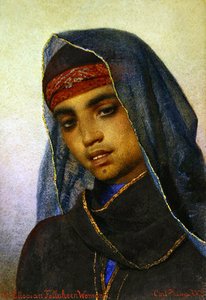 An Ethiopian Fellaheen Woman
Explore 'An Ethiopian Fellaheen Woman' by Carl Haag – a stunning realist portrait blending impressionism & Orientalist detail. Discover this captivating artwork today!
Haag's watercolors are immediately recognizable for their extraordinary level of detail. He possessed a remarkable ability to render textures – the rough-hewn stone of ancient ruins, the intricate patterns of Bedouin clothing, the delicate folds of fabric – with astonishing precision. This wasn’t simply about photographic accuracy; it was about conveying a sense of *presence*, making the viewer feel as though they were standing in the very scene depicted.
His technique involved layering washes of color to create depth and luminosity, often employing subtle gradations to capture the effects of sunlight. He wasn’t afraid to incorporate elements of realism with romantic flourishes, imbuing his scenes with a sense of atmosphere and drama. Works like An Ethiopian Fellaheen Woman demonstrate this balance beautifully – a stunning portrait that blends impressionistic brushwork with meticulous attention to detail. His compositions are often carefully balanced, drawing the eye towards key focal points while simultaneously conveying a broader sense of place.
Royal Patronage & Public Acclaim: Haag’s Career in Victorian Society
Haag's talent didn’t go unnoticed within the discerning circles of Victorian society. His election as an associate and later full member of the Royal Society of Painters in Water Colours solidified his reputation, but it was his patronage by Queen Victoria that truly elevated his status. The Queen commissioned several works from Haag, recognizing his ability to capture scenes with both accuracy and artistic sensitivity.
This royal endorsement opened doors to further commissions and public recognition. His paintings were exhibited widely, garnering critical acclaim and a loyal following of collectors. He became known for his depictions of Middle Eastern life, offering Victorian audiences a glimpse into a world that was both exotic and increasingly accessible through travel and exploration. Haag’s success wasn't simply about fulfilling the demand for Orientalist imagery; it was about providing a nuanced and respectful portrayal of cultures often misrepresented in Western art.
Beyond Representation: Spirituality, Cultural Exchange & Orientalism’s Legacy
While categorized as an “Orientalist” painter, reducing Haag to this label overlooks the deeper complexities of his work. His paintings weren't merely about exotic landscapes and picturesque figures; they were often imbued with a sense of spirituality and cultural sensitivity. He sought to capture not just *what* he saw but also *how* people lived – their traditions, beliefs, and daily routines.
Haag’s meticulous documentation provides valuable insights into the lives of those he encountered, offering a counterpoint to more sensationalized or stereotypical depictions of the Middle East. His work reflects a genuine curiosity about other cultures, a willingness to engage with different perspectives, and a desire to bridge cultural divides. While acknowledging the inherent complexities of Orientalism as a genre – its potential for romanticization and misrepresentation – Haag’s paintings stand out for their level of detail, respect, and artistic integrity.
Collecting Carl Haag: A Guide for Enthusiasts & Building a Fine Art Portfolio
For collectors seeking to acquire works by Carl Haag, a diverse range of options exists. His watercolors, often depicting scenes from Egypt, Palestine, and Syria, are particularly sought after. Smaller studies and sketches offer an accessible entry point into his oeuvre, while larger, more detailed compositions represent significant investments.
When evaluating a Haag watercolor, pay close attention to the level of detail, the quality of light, and the overall sense of atmosphere. Authenticity is paramount; researching provenance and consulting with art experts are essential steps. Haag’s paintings not only offer aesthetic beauty but also provide valuable historical insights into 19th-century Middle Eastern life. Building a collection of his work allows one to appreciate the breadth of his talent, his dedication to detail, and his unique perspective on a world undergoing rapid change. At ArtsDot, we specialize in providing high-quality reproductions of Haag’s masterpieces, allowing art enthusiasts to experience the beauty and artistry of this remarkable painter firsthand.