Early Life & Artistic Foundations: A Promising Start
 Wikipedia: George Frederic Watts
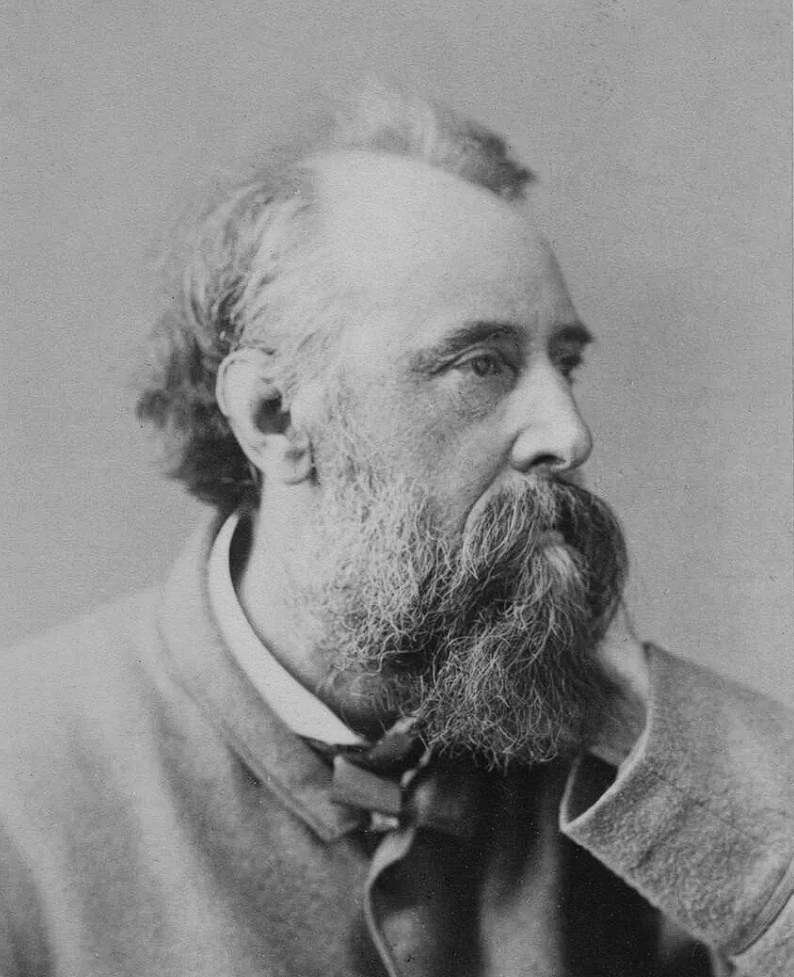
George Frederic Watts (23 February 1817 – 1 July 1904) was a British painter and sculptor associated with the Symbolist movement. Watts became famous in his lifetime for his allegorical works, such as Hope and Love and Life. These paintings were int...
Frederick Waters Watts, born in Marylebone, London, on February 23rd, 1800 – a date deliberately coinciding with the birthday of George Frederic Handel – entered a world already imbued with artistic reverence. His early life was marked by delicate health and personal tragedy; his mother’s untimely death cast a long shadow, leading to a somewhat isolated upbringing focused on classical education and nascent artistic talent. This formative period, however, proved crucial in shaping Watts's unique sensibility. Unlike many of his contemporaries who benefited from formal academy training, Watts received instruction primarily from his father, steeped in both conservative religious principles and the enduring legacy of ancient Greek sculpture. The influence of the Elgin Marbles was particularly profound, instilling within him a deep appreciation for idealized form and narrative power – qualities that would become hallmarks of his mature style. Even at a young age, Watts demonstrated an exceptional aptitude for sculpting, beginning studies with William Behnes at the tender age of ten. This early immersion in three-dimensional art laid the groundwork for his later explorations of texture, volume, and emotional expression within painting.
The Influence of Italy: Shaping Watts’s Aesthetic Vision
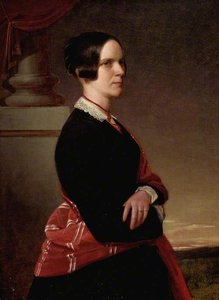
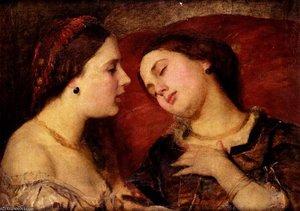 frederick waters (william) watts
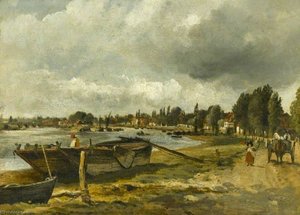
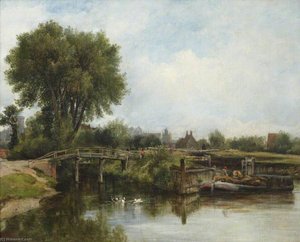
Explore the serene landscapes of Frederick Waters Watts (1800-1870), a British painter influenced by Constable. Discover his idyllic riverside scenes & bucolic views – a key figure in 19th-century English landscape art.
Watts's artistic trajectory underwent a transformative shift with his extended sojourn to Italy beginning in 1843. Funded by a prize awarded for his Westminster mural competition design – a project that, while ultimately unrealized in its full scope, revealed his ambition to create vast allegorical cycles – the Italian experience proved pivotal. He found himself immersed in the artistic heartland of Europe, forging connections with prominent figures like Henry Fox, 4th Baron Holland and his wife Augusta, who provided both patronage and intellectual stimulation. Florence became a crucible for Watts’s developing aesthetic vision. He studied the frescoes of Michelangelo in the Sistine Chapel and Giotto's Scrovegni Chapel with intense dedication, absorbing their mastery of composition, color, and narrative storytelling. This period wasn’t merely about technical acquisition; it was a profound encounter with artistic ideals that resonated deeply with Watts’s own burgeoning spiritual inclinations. He began experimenting with landscape painting, seeking to capture the serene beauty of the Tuscan countryside – a departure from his earlier focus on historical subjects but one that foreshadowed his later idyllic riverside scenes.
Allegory and Symbolism in Watts's Paintings: 'Hope' and the 'House of Life'
Victorian painting refers to the distinctive styles of painting in the United Kingdom during the reign of Queen Victoria (1837–1901). Victoria's early reign was characterised by rapid industrial development and social and political change, which made...
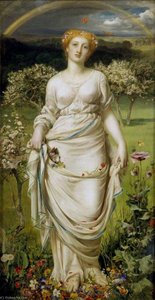
Upon his return to Britain, Watts embarked on a path defined by allegorical works imbued with profound symbolic meaning. He became renowned for paintings like Hope, a powerful depiction of a chained figure gazing towards a distant horizon – an image that captured the Victorian era’s complex blend of optimism and anxiety. However, these individual masterpieces were conceived as components of a far grander vision: the “House of Life.” This ambitious project aimed to encapsulate the entirety of human emotion and aspiration within a universal symbolic language. Watts envisioned a vast cycle of paintings representing the various stages of life – from birth and love to sorrow, loss, and ultimately, transcendence. While the ‘House of Life’ remained incomplete during his lifetime, it served as a guiding principle for much of his oeuvre, informing his choice of subjects and his distinctive stylistic approach. His allegorical figures weren't merely representations of abstract concepts; they were imbued with psychological depth and emotional resonance, inviting viewers to contemplate the fundamental questions of existence.
Watts as a Pre-Raphaelite Adjacent Figure: Style, Philosophy & Connections
Although often discussed in relation to the Pre-Raphaelites, Watts occupied a somewhat unique position within the Victorian art world. He shared their rejection of academic conventions and their emphasis on detailed observation, but he remained largely independent of the Brotherhood’s formal structures and specific stylistic tenets. Like his Pre-Raphaelite contemporaries, Watts was deeply influenced by literary references and embraced a holistic approach to art making – one that encompassed poetry, philosophy, and music. He cultivated close relationships with figures like Henry Thoby Prinsep and Julia Margaret Cameron, participating in their bohemian circles and exchanging ideas about aesthetics and spirituality. However, Watts’s artistic vision diverged from the Pre-Raphaelites' focus on narrative realism; he was more concerned with capturing universal truths through symbolic representation than with depicting specific historical events or literary scenes. His preference for suggesting rather than stating directly, and his exploration of inner emotional states, set him apart as a precursor to Symbolism and Modern Art.
Beyond Representation: Watts’s Exploration of Abstraction and Inner Experience
What truly distinguishes Watts from many of his Victorian peers is his willingness to move beyond mere representation towards abstraction and the exploration of inner experience. He wasn't content with simply depicting external reality; he sought to capture the underlying essence of emotions, ideas, and spiritual forces. This pursuit led him to experiment with increasingly simplified forms and evocative color palettes, anticipating the developments of 20th-century abstract painting. His later works often feature blurred figures and atmospheric landscapes that prioritize mood and suggestion over precise detail. The painting Mammon, for example, serves as a chilling prefiguration of the dehumanizing effects of commercialism, embodying the monster born from unchecked industrial growth. Watts’s fascination with the unconscious mind – evident in his tendency to portray subjects with closed eyes – further underscores his commitment to exploring the depths of human psychology and spirituality. He painted “ideas, not things,” as he famously stated, a radical stance for his time that paved the way for future generations of artists.
Legacy and Rediscovery: The Watts Gallery – Artists’ Village and Enduring Appeal
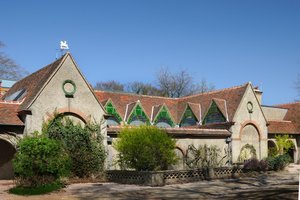 Watts Gallery – Artists' Village
Discover Watts Gallery – Artists’ Village in Surrey, showcasing Victorian art by G.F. Watts, Arts & Crafts history, Limnerslease studio, and the stunning Watts Mortuary Chapel. A unique, single-artist art experience in the UK.
The enduring legacy of Frederick Waters Watts is beautifully preserved at the Watts Gallery – Artists’ Village in Surrey, England. This unique institution showcases not only his own remarkable paintings but also the history of the Arts & Crafts movement and the stunning Watts Mortuary Chapel—a testament to his profound spiritual beliefs. The gallery offers a rare glimpse into the artist's world, revealing his holistic approach to art making and his unwavering commitment to beauty and truth. In recent years, there has been a renewed appreciation for Watts’s work, as scholars and audiences alike recognize his pioneering role in bridging the gap between Victorian romanticism and Modern Art. His allegorical paintings continue to resonate with contemporary viewers, offering profound insights into the human condition and inspiring contemplation on timeless themes of love, hope, despair, and transcendence. Discover the serene landscapes and captivating symbolism of Frederick Watts – a true visionary whose artistic journey continues to captivate and inspire.