
Early Life & Artistic Foundations: From The Hague Academy to Early Influences
George Hendrik Breitner’s artistic journey began not amidst the bustling streets he would later immortalize, but within the structured walls of the Koninklijke Academie van Beeldende Kunsten in The Hague. Born in Rotterdam in 1857, his early aptitude for drawing led him to this prestigious institution in 1876, where he quickly distinguished himself as a gifted student. However, Breitner was never one to conform entirely; an expulsion in 1880 – reportedly for destroying the regulations board – hints at a rebellious spirit that would later manifest in his unconventional approach to subject matter and technique. This early defiance wasn’t born of mere contrariness, but rather a burgeoning desire to break free from academic constraints and capture the raw essence of life as he saw it.
His formative years weren't solely defined by formal training. The influence of Willem Maris, a prominent member of the Hague School, proved pivotal. Sharing lodgings with Maris allowed Breitner access to a different way of seeing – one focused on natural light and atmospheric effects. Membership in Pulchri Studio further exposed him to established artistic circles, yet he soon began to diverge from the prevailing Hague School aesthetic, seeking a more direct engagement with urban life rather than solely focusing on landscapes. These early experiences laid the groundwork for his unique style, blending meticulous observation with an increasingly independent vision.
The Painter of Amsterdam: Capturing Urban Realism in a Changing City
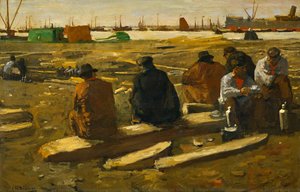 Lunchtime at the Building Site on the Van Diemenstraat in Amsterdam, George Hendrik Breitner, 1897
George Hendrik Breitner’s "Lunchtime at the Building Site" captures 19th-century Amsterdam's gritty realism. Explore this oil painting’s textured details & poignant depiction of working-class life.
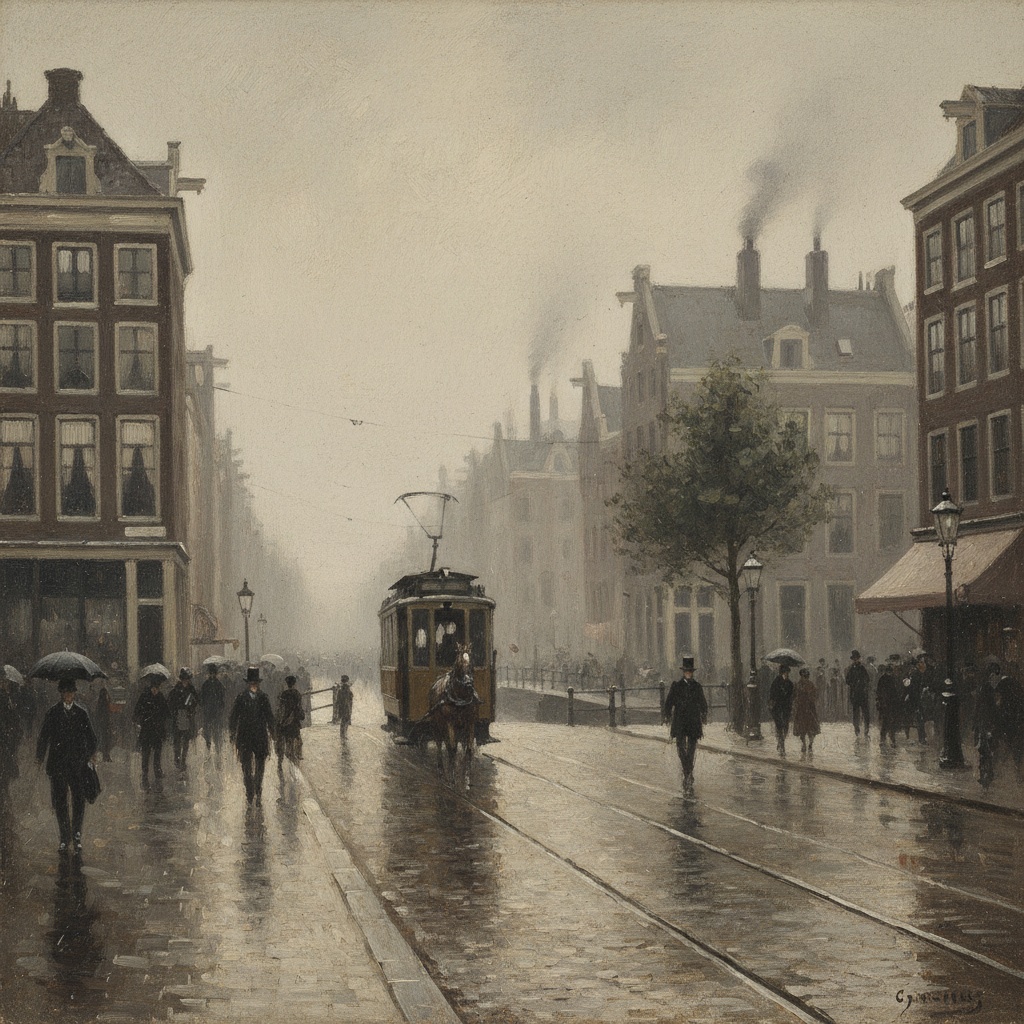
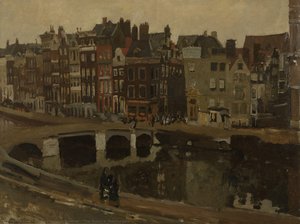
Breitner’s name became inextricably linked with Amsterdam, and it was within this vibrant metropolis that he truly found his artistic voice. Unlike the idyllic scenes favored by many of his contemporaries, Breitner turned his gaze to the everyday realities of city life – the bustling streets, the working-class neighborhoods, the transient moments of light and shadow. He wasn’t interested in grand narratives or idealized representations; instead, he sought to capture the fleeting beauty within the ordinary. Paintings like “Neighborhood Street in The Hague or Scheveningen” (c. 1880-1923) offer a glimpse into this early exploration of urban spaces, showcasing his developing skill in depicting atmospheric conditions and capturing the energy of street life.
As Amsterdam underwent rapid industrialization and social change, Breitner’s work became increasingly focused on the lives of those affected by these transformations. He documented construction sites, bustling markets, and the daily routines of laborers, offering a poignant portrayal of working-class existence. “Lunchtime at the Building Site on the Van Diemenstraat in Amsterdam” (1897) exemplifies this commitment to realism, its textured details and somber palette conveying both the hardship and resilience of the workers depicted.
Photography as Observation: Breitner’s Unique Documentary Approach
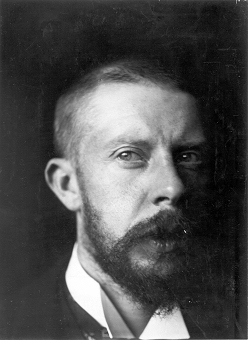 Wikipedia: George Hendrik Breitner
George Hendrik Breitner (12 September 1857 – 5 June 1923) was a Dutch painter and photographer. An important figure in Amsterdam Impressionism, he is noted especially for his paintings of street scenes and harbours in a realistic style. He painted en...
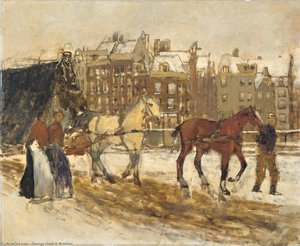
What sets Breitner apart is his innovative use of photography not merely as a tool for reproduction, but as an integral part of his artistic process. Recognizing its ability to capture fleeting moments and atmospheric effects with unparalleled accuracy, he embraced the medium as a means of documenting street life – particularly rainy weather – which served as invaluable reference material for his paintings. This wasn’t simply about creating accurate depictions; it was about understanding how light and shadow shaped perception and imbued urban scenes with a particular mood.
The rediscovery of a vast collection of Breitner's photographic prints in 1996 revealed the extent of this practice, showcasing his meticulous documentation of Amsterdam’s streets and its inhabitants. These photographs weren’t intended for public display; they were private studies, used to inform his paintings and capture nuances that might otherwise be lost. This unique approach demonstrates a commitment to observation and a desire to translate the complexities of urban life onto canvas with authenticity.
Brushstrokes and Atmosphere: Exploring Breitner's Distinctive Style and Technique
Breitner’s distinctive style is characterized by its loose brushwork, emphasis on light and shadow, and a deliberate rejection of academic polish. He painted *en plein air* whenever possible, capturing the immediacy of his surroundings and allowing the changing conditions to dictate the direction of his work. His use of color wasn't about creating vibrant displays; it was about conveying mood and atmosphere, often employing muted tones and subtle gradations to capture the grittiness and realism of urban life.
Unlike the broken brushstrokes of Impressionism, Breitner’s technique involved a more deliberate layering of paint, creating textured surfaces that evoke a sense of movement and energy. His ability to capture the effects of rain – the glistening pavements, the blurred reflections, the somber atmosphere – is particularly noteworthy. This mastery of atmospheric perspective wasn't merely technical skill; it was about conveying the emotional weight of the urban environment.
Social Commentary & the 'Schilderbeest': Depicting Working-Class Life with Empathy
Breitner’s focus on working-class life wasn’t simply an aesthetic choice; it reflected a deep sense of social empathy and a desire to challenge conventional artistic norms. He often depicted laborers, servant girls, and marginalized individuals, giving visibility to those who were typically overlooked by the art world. This commitment earned him the nickname “Schilderbeest” – roughly translated as ‘painter of the people’ – a testament to his dedication to portraying the realities of everyday life.
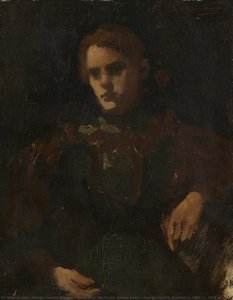
His association with the Dutch literary group known as the *Tachtigers* further fueled this social consciousness, exposing him to progressive ideas and encouraging him to explore themes of inequality and injustice. Paintings like “Study after the Model (Geesje Kwak?)” (c. 1880-1923) reveal a sensitivity towards his subjects, portraying them with dignity and respect rather than as mere objects of study. This empathetic approach set him apart from many of his contemporaries and cemented his reputation as a champion of the working class.
Breitner’s Legacy & Influence on Modern Dutch Art
George Hendrik Breitner's influence on modern Dutch art is profound, extending far beyond his immediate circle. He challenged traditional notions of beauty and subject matter, paving the way for future generations of artists to explore new forms of expression. His innovative use of photography as a tool for observation, combined with his commitment to realism and social commentary, established him as a pioneering figure in Amsterdam Impressionism.
While initially met with criticism from some quarters, Breitner’s work gained increasing recognition in the 20th century, and today he is celebrated as one of the most important figures in Dutch art history. His paintings continue to captivate audiences with their evocative brushstrokes, atmospheric effects, and poignant depictions of urban life. At ArtsDot.com, we are proud to offer high-quality reproductions of Breitner’s masterpieces, allowing you to experience the beauty and power of his work firsthand. Explore our collection today and discover the enduring legacy of this remarkable artist.