Early Life & Artistic Foundations: A Privileged Start
 Wikipedia: Gustave Caillebotte
Gustave Caillebotte (French: [ɡystav kɑjbɔt]; 19 August 1848 – 21 February 1894) was a French painter who was a member and patron of the Impressionists, although he painted in a more realistic manner than many others in the group. Caillebotte was kno...
Gustave Caillebotte, born into a wealthy Parisian family in 1848, occupied a unique position within the burgeoning art world of his time. Unlike many of his Impressionist contemporaries who struggled for recognition and financial stability, Caillebotte inherited both privilege and an astute business sense from his father, a successful textile manufacturer. This fortunate circumstance afforded him not only the freedom to pursue painting without immediate economic pressure but also the means to become a significant patron of the arts, shaping the trajectory of Impressionism itself. However, to characterize Caillebotte solely as a “gentleman artist” would be a profound disservice. His early training was rigorous; he studied under Léon Bonnat, a respected academic painter known for his realistic depictions of working-class life. This foundation in traditional techniques—a meticulous attention to detail and anatomical accuracy—would become a defining characteristic of Caillebotte’s work, setting him apart from the more overtly spontaneous brushwork favored by artists like Monet or Renoir.
The Tension Between Realism and Impressionism: Caillebotte's Unique Style
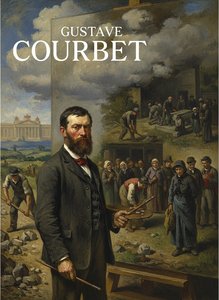
Caillebotte’s artistic identity resided in a fascinating interplay between these two dominant movements. While he exhibited consistently with the Impressionists, his paintings rarely embraced their full aesthetic. He wasn’t interested in fleeting impressions of light or atmospheric effects for their own sake; rather, he employed Impressionistic techniques – broken color, loose brushwork – to enhance the realism of his compositions. This is where the debate surrounding his work often centers: was he a Realist painter utilizing Impressionistic methods, or an Impressionist with a penchant for meticulous detail? Marnin Young’s scholarship highlights this very division, arguing that Caillebotte's early works are deeply rooted in the mid-century Realism of artists like Courbet and Millet. He wasn’t simply *depicting* modern life; he was meticulously constructing it, analyzing its spatial dynamics and social complexities with a cool, almost photographic precision. This analytical approach, combined with his mastery of perspective and composition, resulted in paintings that feel both strikingly contemporary and remarkably controlled.
Parisian Life as Subject Matter: Capturing Modernity in Urban Scenes
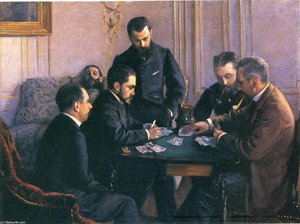 The Bezique Game
Discover Gustave Caillebotte’s ‘The Bezique Game,’ a captivating Impressionist painting of Parisian leisure. Explore its realism, warm lighting & unique style – a masterpiece from 1880.
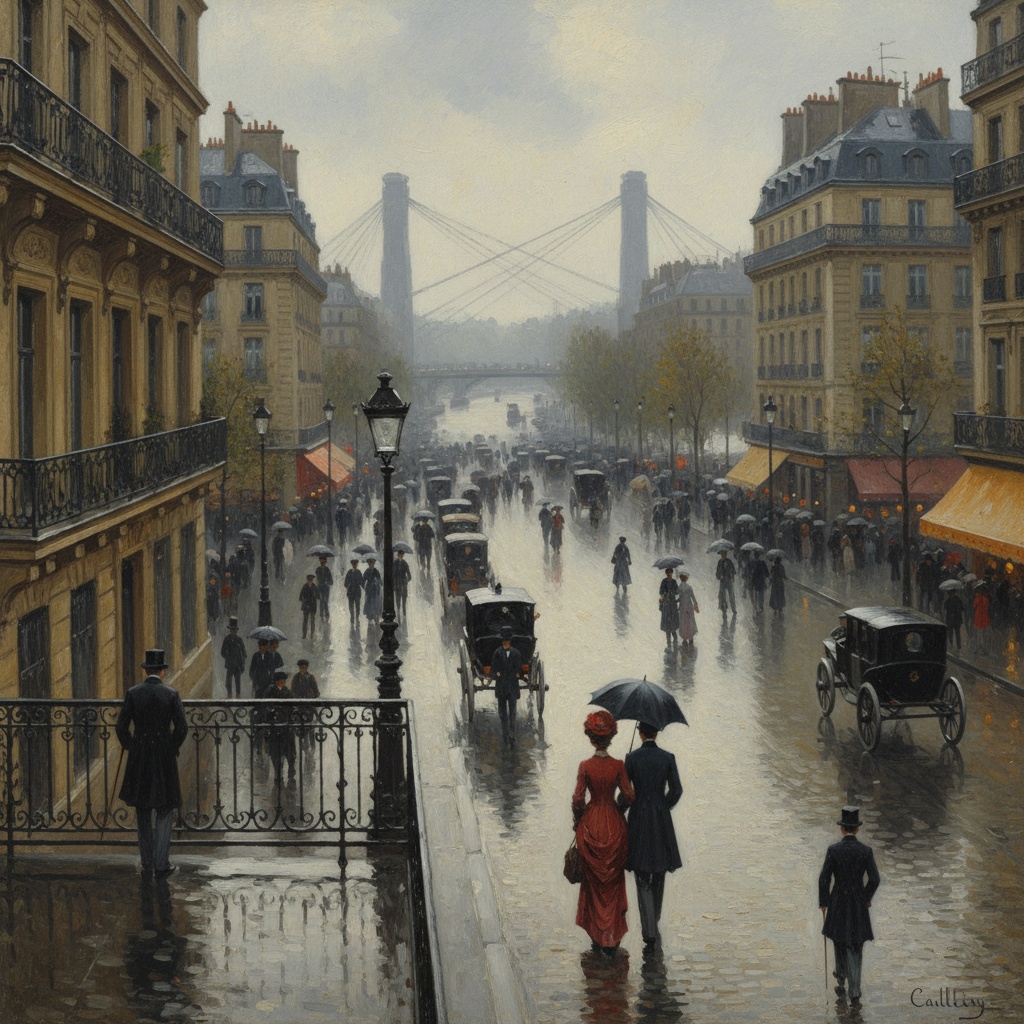
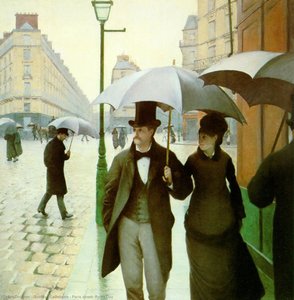
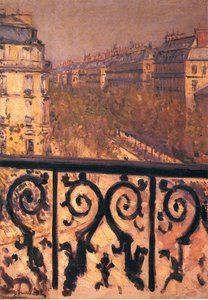
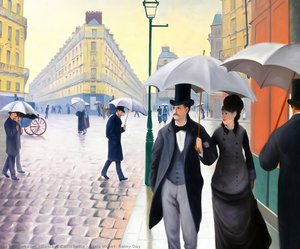
The rapid transformation of Paris during the Second Empire—Haussmann’s grand boulevards, the rise of a new middle class, the increasing pace of urban life—became Caillebotte’s primary subject matter. He wasn't interested in idyllic landscapes or historical narratives; his focus was firmly on the everyday experiences of Parisians. Paintings like The Bezique Game (1880) offer intimate glimpses into bourgeois leisure, while works such as The Yerres, Effect of Light capture the serenity of suburban life. However, it is his depictions of urban spaces—particularly Paris Street; Rainy Day (1877)—that truly cemented his reputation. This monumental canvas isn’t merely a representation of a rainy Parisian street; it's an exploration of social alienation, class dynamics, and the anonymity of modern life. The carefully arranged figures, the dramatic perspective, and the shimmering reflections on the wet pavement all contribute to a sense of both realism and psychological depth.
Key Works & Masterpieces: 'Rainy Day,' 'Floor Scrapers,' and Beyond
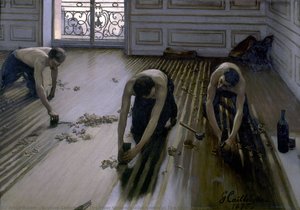
Paris Street; Rainy Day, arguably his most famous work, continues to captivate viewers with its complex composition and ambiguous narrative. The painting’s innovative use of cropping—inspired by the emerging art of photography—and its unconventional perspective create a sense of immediacy and dynamism. The figures are not arranged in a traditional compositional hierarchy; instead, they appear as isolated individuals navigating the bustling cityscape. The Floor Scrapers (1875), another early masterpiece, presents a similarly unflinching depiction of working-class life. The painting’s stark realism and monumental scale challenge conventional notions of artistic subject matter, elevating the mundane labor of floor scrapers to the level of high art. Beyond these iconic works, Caillebotte also excelled in still life painting, as evidenced by Melon and Bowl of Figs, demonstrating his ability to capture texture, light, and form with remarkable precision. His later landscapes, while less well-known, reveal a growing interest in atmospheric effects and the interplay of color.
Caillebotte’s Patronage & Legacy: A Collector Shaping the Impressionist Movement
Beyond his own artistic endeavors, Caillebotte played a crucial role as a patron of the arts. He was an avid collector of works by his fellow Impressionists—Monet, Renoir, Degas, Manet, Pissarro—and actively supported their exhibitions and careers. Upon his death in 1894, he bequeathed his entire collection to the French state, forming the core of what would eventually become the Musée d’Orsay. This act of generosity was initially met with resistance from conservative art circles who dismissed Impressionism as frivolous and lacking artistic merit. However, Caillebotte's foresight ensured that these groundbreaking works would be preserved for future generations. His collection not only provided a vital platform for the recognition of Impressionism but also shaped the narrative of 19th-century French art.
Rediscovery & Contemporary Appreciation: Caillebotte's Enduring Influence
For decades after his death, Caillebotte remained largely overlooked. His paintings were often overshadowed by those of his more celebrated Impressionist colleagues. It wasn’t until the 1970s that a renewed interest in his work began to emerge, fueled by scholarly research and major exhibitions. Today, Gustave Caillebotte is recognized as a pivotal figure in the transition from Realism to Impressionism—an artist who masterfully captured the complexities of modern life with both analytical precision and artistic sensitivity. His paintings continue to resonate with contemporary audiences, offering a unique glimpse into the social dynamics, urban landscapes, and psychological nuances of 19th-century Paris. Discovering Caillebotte is discovering a nuanced vision—a bridge between tradition and innovation that continues to inspire and challenge our understanding of art history. Explore the world of Gustave Caillebotte and other masterpieces with ArtsDot.com, where fine art reproductions bring the beauty of the past into your home.