

Beyond the Narrative: The Philosophy of Formalism
In art history, formalism is the study of art by analyzing and comparing form and style. Its discussion also includes the way objects are made and their purely visual or material aspects. In painting, formalism emphasizes compositional elements such ...
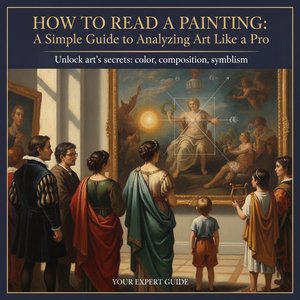
To the casual observer, a painting often serves as a mere window into a story—a silent stage where a noblewoman poses in quiet dignity, a landscape rests under a summer sun, or a historical tragedy unfolds in dramatic tension. We are conditioned to seek the what: the identity of the subject, the era of its creation, or the biography of the artist. However, for the dedicated student of art and the true connoisseur, the narrative is merely the surface layer of a much deeper, more complex reality. To truly read a painting, one must learn to look past the story and begin investigating the how.
This practice, known in academic circles as formalism, invites us to strip away the distractions of historical context and biographical anecdote to focus on the intrinsic properties of the work itself. Formalism is the study of art through the analysis of form and style, emphasizing the way objects are constructed and their purely visual or material aspects. When we engage in this level of observation, we treat the canvas as an autonomous universe, governed by its own internal laws of physics and aesthetics. By focusing on form rather than content, we unlock a universal language that transcends era and culture, allowing us to appreciate the profound intellectual labor involved in every brushstroke.
The roots of this analytical approach reach back to the philosophical foundations laid by Immanuel Kant, who posited that true aesthetic judgment arises from a purely subjective experience of form. In this light, the power of a masterpiece does not reside solely in the recognition of its subjects, but in the way the artist has manipulated raw materials—pigment, oil, and fiber—to create a sensory experience. It is here, in the silent dialogue between the eye and the medium, that the true essence of art is revealed.
The Grammar of Vision: Decoding Line, Shape, and Geometric Structure
--- title: Line url: https://www.getty.edu/education/teachers/building_lessons/formal_analysis.html hostname: getty.edu description: This page provides definitions and examples of the elements of art and principles of design that are used by artists ...
If we consider a painting to be a language, then line and shape constitute its fundamental grammar. A line is more than just an edge; it is an identifiable path created by a point moving through space, capable of directing the viewer's gaze with surgical precision. In the hands of a master, lines can be horizontal, suggesting a sense of rest, repose, or the eternal stillness of a landscape; they can be vertical, communicating height, strength, and an upward aspiration toward the divine; or they can be diagonal, injecting a sudden, kinetic energy that disrupts the composition and creates tension.
When these lines intersect and enclose space, they give birth to shape. These shapes may be geometric—the rigid, mathematical certainty of circles, triangles, and squares found in the structured compositions of the Renaissance—or they may be organic, mirroring the irregular, flowing forms found in nature. The interplay between these geometric structures and organic silhouettes creates a rhythmic pulse within the frame. By tracing the edges where one shape meets another, we begin to understand the underlying skeletal structure of the work, discovering how the artist has organized chaos into a coherent, visually stable architecture.
The Alchemy of Light and Color: Analyzing Value and Palette
--- title: How to do visual (formal) analysis in art history (video) | Khan Academy url: https://www.khanacademy.org/humanities/ap-art-history/start-here-apah/intro-art-history-apah/v/visual-analysis hostname: khanacademy.org description: Giovanni Be...
Beyond the structural skeleton lies the emotive soul of the painting: color and value. The use of color is perhaps the most immediate way an artist communicates mood and atmosphere. A palette dominated by cool blues and greens may evoke a sense of melancholy or tranquility, while the sudden intrusion of a warm cadmium red can ignite passion or even violence. However, color does not act alone; it relies heavily on value—the degree of light and dark within a design.
The manipulation of value creates contrast, the dramatic tension between light and shadow that gives figures their weight and presence. Consider the profound impact of chiaroscuro, where extreme shifts in value create a spotlight effect, pulling subjects out of an impenetrable darkness. This interplay of light and dark does more than just define form; it dictates the emotional temperature of the piece. Even in monochromatic works, the subtle gradations of gray allow for a sophisticated exploration of tone, proving that the most profound visual stories are often told through the simplest of palettes.
Spatial Dynamics: Understanding Depth, Perspective, and Composition
 Decoding Masterpieces: A Practical Guide for Art Historians – Techniques, Contexts, and Interpretations Across Eras
Foundations of Art Historical Analysis: Object, Experience, and Context The pursuit of understanding art transcends mere aesthetic appreciation; it’s a rigorous intellectual journey demanding a systematic approach to unraveling the layers of meaning ...
A painting is a two-dimensional surface attempting to simulate a three-dimensional experience. The mastery of space is what allows a flat canvas to transform into an expansive vista or an intimate chamber. Artists utilize various tools to create this illusion, most notably perspective. Through linear perspective, the convergence of lines toward a single vanishing point creates a mathematical sense of depth, pulling the viewer into the heart of the scene. Conversely, atmospheric perspective uses the blurring of edges and the cooling of colors in the distance to mimic the way air affects our vision over long distances.
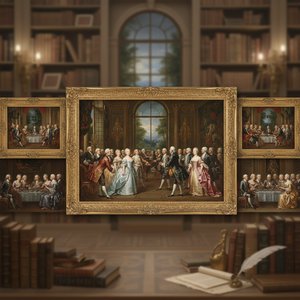
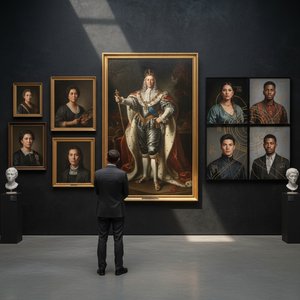
All these elements are organized through composition—the deliberate arrangement of parts within the whole. A pyramidal composition, frequently used in Renaissance portraiture, provides a sense of stability and eternal permanence. In contrast, an asymmetrical or fragmented composition might evoke the restless energy of modernism. By analyzing how much space is allocated to foreground versus background, and how objects are scaled relative to one another, we can decipher the artist's intent to either ground us in a specific moment or launch our imagination into an infinite horizon.
Tactile Truths: Investigating Texture, Medium, and Brushwork
 How to Read a Painting: A Masterclass in Formal Art Analysis for the Discerning Eye
The Foundation of Observation: Moving Beyond Subject Matter to Pure Form Formalism (art) In art history, formalism is the study of art by analyzing and comparing form and style. Its discussion also includes the way objects are made and their purely v...
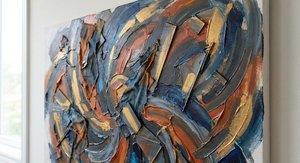
To truly read a painting, one must eventually acknowledge its physical existence as a material object. This is the study of texture—the surface quality that can be seen and felt. In some works, the texture is smooth and invisible, a polished surface that seeks to disappear into the illusion of reality. In others, particularly in the impasto style popularized by masters like Van Gogh, the paint itself becomes a sculptural element. Here, the thick, visible ridges of pigment catch the light, creating a tactile topography that records the very movement of the artist's hand.
The medium—whether oil, tempera, or watercolor—dictates the possibilities of the work. The meticulous layering of oils allows for unparalleled depth and luminosity, as seen in the works of Jan van Eyck, where light seems to emanate from within the layers themselves. By observing the way the brush interacts with the canvas, we witness the artist's technical mastery over their tools. We see the delicate glazing that creates translucency and the vigorous strokes that convey urgency. This physical evidence of creation connects us directly to the moment of the artwork's birth.
Synthesizing the Experience: From Observation to Interpretation
The ultimate goal of formal analysis is not merely to catalog elements, but to synthesize them into a profound understanding of the work's impact. When we combine our knowledge of line, color, space, and texture, we move from simple recognition to deep interpretation. We begin to see how a specific diagonal line works in tandem with a high-contrast shadow to create a sense of dread, or how a soft, organic shape is balanced by a rigid geometric frame to suggest harmony amidst chaos.
This rigorous intellectual journey allows us to appreciate the "significant form" that distinguishes true art from mere decoration. It empowers us to stand before a masterpiece and engage with it not just as a spectator of history, but as an active participant in its aesthetic truth. Through formal analysis, we learn that the most enduring power of art lies in its ability to communicate through a universal visual language—a language that remains vibrant and resonant long after the historical context of its creation has faded into the archives of time.
At ArtsDot.com, we believe that every home deserves the profound intellectual and emotional resonance of a true masterpiece. Our collection is curated for the discerning eye, offering meticulously hand-painted oil reproductions of the world's most iconic works. Each piece is a labor of passion, created by master artists on 100% cotton canvas to preserve the visible brushstrokes and deep tonal ranges that define the originals. Whether you seek to transform your space with the dramatic light of a Caravaggio or the serene landscapes of Monet, our museum-grade reproductions bring the grandeur of history into your personal sanctuary.