
The Rebellion of 1848: Challenging the Royal Academy's Rigid Traditions
 The Pre-Raphaelite Brotherhood: Rebellion, Romance & Medieval Revival
The Seeds of Discontent: Challenging Academic Art The year is 1848, a period of revolutionary fervor sweeping across Europe. Yet, within the relatively stable confines of London’s art world, another kind of rebellion was brewing. A group of young pai...
In the mid-19th century, as revolutionary fervor swept across the European continent, a different kind of uprising was quietly brewing within the hallowed, stifling corridors of London’s art establishment. The year 1848 marked a turning point not just for politics, but for the very soul of British painting. A small, fervent circle of young visionaries—including William Holman Hunt, John Everett Millais, and Dante Gabriel Rossetti—found themselves increasingly suffocated by the rigid conventions of the British Royal Academy. To these artists, the prevailing aesthetic was a hollow imitation of greatness, characterized by formulaic compositions and a polished, often sterile, adherence to the idealized shadows of Raphael.
This group, which would become known as the Pre-Raphaelite Brotherhood (PRB), did not seek to destroy skill, but rather to reclaim its lost sincerity. They viewed the Academy’s preference for muted tones and staged, artificial arrangements as a decline in artistic standards—a mechanistic approach that had abandoned the raw emotional truth of the masters. Their rebellion was an act of profound dissatisfaction with the academic artifice of their era, a daring attempt to bypass the polished veneer of the Renaissance to rediscover a more authentic, unadulterated way of seeing the world.
A Return to the Quattrocento: The Aesthetic Foundations of Pre-Raphaelite Truth
 Pre-Raphaelite Romanticism: A Guide to Vivid Detail and Medieval Beauty in Victorian Art
The Rebellion Against Tradition: The Birth of the Pre-Raphaelite Brotherhood The Pre-Raphaelite Brotherhood: Rediscovering Romanticism, Mythological Depth, and Vivid Detail in Victorian Art The Rebellion Against Tradition: The Birth of the Pre-Raphae...
The name "Pre-Raphaelite" itself serves as a manifesto. By looking backward, these artists intended to move forward, seeking inspiration in the era before Raphael, specifically the abundant detail and spiritual depth found in the Quattrocento Italian art. They yearned for the clarity, vibrant color, and complex compositions of early Renaissance painters, which they believed possessed a moral and aesthetic purity that had been lost to the more "perfected" and often artificial styles of later centuries.
This pursuit of truth was manifested through an uncompromising commitment to meticulous detail. Where the Academy encouraged a soft-focus approach to background elements, the Pre-Raphaelites demanded absolute precision. Every leaf, every fold of fabric, and every glint of light was rendered with a scientific intensity. This was not merely about ornamentation; it was about a spiritual engagement with reality. By capturing the minute particulars of the physical world, they sought to honor the divine truth inherent in all creation, creating works that felt both hyper-real and deeply symbolic.
Medievalism and Myth: Weaving Chivalry and Allegory into Victorian Canvas
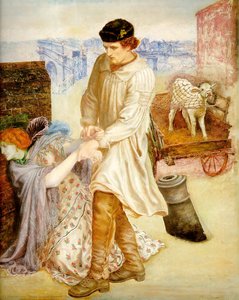 Found
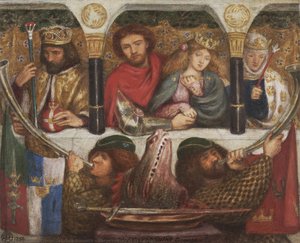
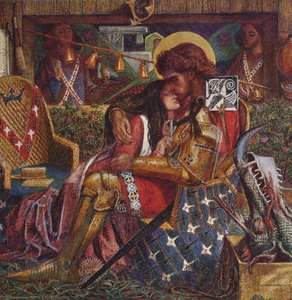
FoundThe Wedding of St George and the Princess – A Pre-Raphaelite Vision Dante Gabriel Rossetti’s “Wedding of St George and the Princess,” completed in 1857, stands as a cornerstone of the Pre-Raphaelite Brotherhood's artistic endeavor. More than just a d...
To escape the industrial grime and social upheaval of Victorian England, the Pre-Raphaelites turned their gaze toward the romanticized past. They found a sanctuary in the legends of King Arthur, the tales of chivalry, and the rich tapestry of Christian allegory. This fascination with medievalism allowed them to weave complex narratives that resonated with themes of love, innocence, and spiritual struggle. A prime example can be found in Dante Gabriel Rossetti’s The Wedding of St George and the Princess. Completed in 1857, this work is far more than a depiction of marital bliss; it is an elaborate tapestry of medieval chivalry and profound psychological insight.
In such works, symbolism becomes the primary language of the artist. The slaying of a dragon by St George serves as a powerful emblem of courage and righteousness, while figures like Princess Pavlina embody purity and grace. This era of painting transformed the canvas into a portal for mythological depth, where characters were not merely figures in a scene but symbols of enduring human virtues and vices. Through this lens, the Pre-Raphaeliente movement offered a way to explore the complexities of the human soul through the safe, yet evocative, distance of legend and myth.
Nature as a Sacred Mirror: Meticulous Detail and the Pursuit of Naturalism
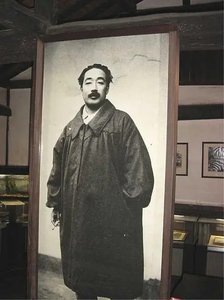 kitahara shikajiro
John Everett Millais: A Pre-Raphaelite Pioneer of Light and Nature Born in Southampton on June 8, 1829, John Everett Millais was a pivotal figure in the burgeoning art world of Victorian England. His early life, marked by a prodigious talent nurtured...
Central to the Pre-Raphaelite ethos was an almost religious reverence for the natural world. They did not merely paint landscapes; they engaged in a profound dialogue with nature, treating it as a sacred mirror reflecting the divine. This commitment to "truth to nature" required an extraordinary level of observation. Artists like John Everett Millais and even those influenced by the movement, such as the schoolmaster-painter John Keates, utilized luminous color palettes and precise draughtsmanship to capture the fleeting beauty of the environment.
The technique employed was often revolutionary. Rather than relying on the smooth glazing techniques prevalent in mainstream circles, many Pre-Raphaelites embraced a more tactile approach. They utilized rich, saturated colors—deep greens, warm reds, and shimmering golds—to evoke an otherworldly opulence. In works like Edward Coley Burne-Jones’s Cupid's Hunting Fields, the canvas breathes with a quiet intensity, inviting the viewer into a lush, green realm where the boundaries between the human, the divine, and the natural are beautifully blurred. This meticulous rendering of foliage, skin tones, and light created an immersive experience that felt both tangibly real and ethereally beautiful.
The Legacy of the Brotherhood: From Rossetti’s Symbolism to Burne-Jones’s Reverie
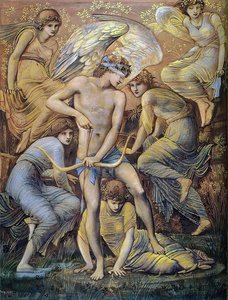 Cupid's Hunting Fields
Cupid's Hunting Fields: A Pre-Raphaelite Reverie Edward Coley Burne-Jones’s “Cupid’s Hunting Fields” is more than simply a depiction of a mythological scene; it’s an immersion into the very heart of Pre-Raphaelite ideals – a yearning for beauty, a re...
As the movement evolved, its influence expanded far beyond the original seven members of the Brotherhood. The aesthetic principles established by the founders—the emphasis on symbolism, the love for medieval themes, and the dedication to natural detail—flowed into the works of later artists like Edward Burne-Jones and William Morris. While the initial rebellion was rooted in a specific rejection of the Royal Academy, its legacy became a broader movement of aestheticism, championing "art for art's sake" and a pursuit of beauty in all its forms.
From the enigmatic and psychologically complex portraits of Emma Sandys to the dreamlike, mythological reveries of Burne-Jones, the Pre-Raphaelite spirit continued to shape the trajectory of Victorian art. They left behind a world where art was not just a decoration, but a profound exploration of identity, history, and the natural order. Their works remain timeless, inviting modern viewers to step into a realm where every brushstroke tells a story and every color holds a secret.
At ArtsDot.com, we celebrate this enduring legacy by offering museum-quality reproductions of these iconic masterpieces. Whether you are drawn to the symbolic depth of Rossetti or the lush landscapes of the Pre-Raphaelite era, our hand-painted oil recreations allow you to bring the soul of history into your own home. Each piece is meticulously crafted on 100% cotton canvas by skilled artists, ensuring that the texture, light, and emotional resonance of the original are preserved for generations to come.