The Classical Foundation: From Greek Idealism to Renaissance Rediscovery
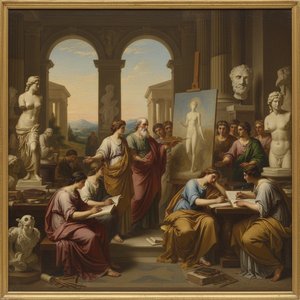
The human form, rendered with meticulous detail and imbued with symbolic weight, has been central to Western art since its inception. While the term “model” as we understand it today—a person employed specifically for artistic representation—didn’t exist in antiquity, the pursuit of ideal beauty within the Greek world laid the groundwork for centuries of artistic practice centered on the observation and depiction of the human body. Sculptors like Phidias and Praxiteles didn't rely on individuals posing in isolation; rather, athletes, citizens, and even slaves served as references, their physiques embodying societal ideals of strength, grace, and proportion. These weren’t merely aesthetic exercises; they were reflections of philosophical concepts – the perfect form mirroring a divine order. The rediscovery of classical sculpture during the Renaissance sparked a renewed fascination with anatomical accuracy and the human figure. Artists like Leonardo da Vinci undertook detailed studies of anatomy, dissecting cadavers to understand the underlying structure that informed surface beauty. This period saw a shift towards more individualized portraiture, yet the fundamental principle remained: the body as a vessel for expressing both physical reality and intellectual ideals.
The 19th-Century Model: Academic Training, Social Status, and Artistic Observation
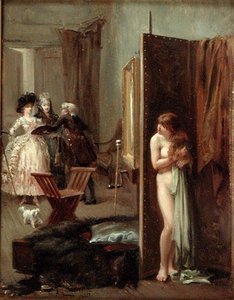 The Artist's Studio Or Unexpected Visitors
Explore 'The Artist’s Studio' by Albert Junior Ludovici – a captivating 19th-century oil painting of observation & intrigue. Academic realism meets Romantic drama in this evocative scene.
The 19th century witnessed the formalization of the art model’s role within the academic system. Art academies across Europe established life drawing classes as a cornerstone of artistic education. Models – often women, though male models were also employed – became essential components of this rigorous training process. However, their position was complex and frequently precarious. While providing a vital service to aspiring artists, they occupied a liminal social space, often facing economic hardship and societal stigma. Albert Junior Ludovici’s “The Artist’s Studio Or Unexpected Visitors” (1865) offers a compelling glimpse into this world, revealing the model as both subject of artistic scrutiny and an individual within a dynamic social context. The painting subtly hints at the power dynamics inherent in the studio environment – the observing artists, the curious onlookers, and the model herself, poised between vulnerability and agency. The emphasis on academic realism demanded precise anatomical knowledge, leading to a detailed study of musculature, bone structure, and skin tones. Sir Frederic Lord Leighton’s “Head of an Italian Male Model” exemplifies this dedication to technical mastery, showcasing the rich textures and dramatic lighting that characterized Victorian portraiture.
Posing for Perfection: Techniques and the Pursuit of 'Truth' in Representation
 Academic Portraiture: Tradition, Technique & the Evolution of Representational Art
Explore the rich history & masterful techniques of academic portraiture. Discover iconic artists, learn about collecting, and commission a bespoke oil painting reproduction with ArtsDot.
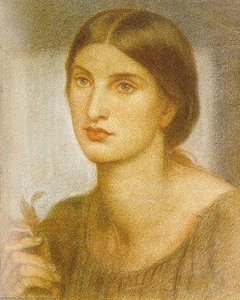
The act of posing itself became a skilled practice. Models weren’t simply static figures; they were expected to understand anatomy, maintain composure for extended periods, and even convey specific emotions or narratives through their posture and expression. Artists developed elaborate techniques to guide their models, employing props, lighting schemes, and carefully constructed compositions to achieve the desired effect. The pursuit of “truth” in representation was paramount, yet this truth wasn’t necessarily about photographic accuracy. Rather, it involved a selective interpretation of reality – an idealization or exaggeration of certain features to convey beauty, character, or symbolic meaning. This is evident in the works of Dante Gabriel Rossetti, whose “Study of a Girl” (1857) exemplifies the Pre-Raphaelite fascination with ethereal beauty and atmospheric detail. Rossetti’s model isn't merely a physical presence; she embodies a romantic ideal, her pose and expression conveying a sense of serene contemplation.
Beyond Anonymity: The Emerging Identity of the Art Model
For centuries, art models remained largely anonymous figures, their individual identities subsumed by their role as artistic references. However, the 19th century saw a gradual shift towards recognizing them as individuals with their own stories and experiences. The rise of realism in art coincided with a broader social awareness of class differences and marginalized communities. Artists like Christian Krohg began to explore the psychological complexities of their subjects, portraying models not simply as objects of beauty but as individuals grappling with their own emotions and circumstances. This shift is reflected in the increasing attention paid to the model’s gaze – a subtle yet powerful indicator of agency and self-awareness. The very act of being observed became a subject of artistic inquiry, prompting questions about power dynamics, representation, and the construction of identity.
Psychological Depth: Exploring the Emotional Labor of Modeling
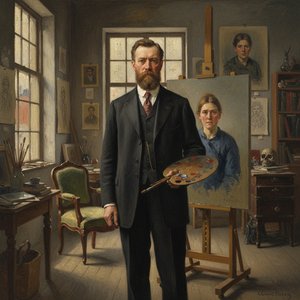 Christian Krohg: A Pioneer of Norwegian Realism & Psychological Portraiture
Explore the life & work of Christian Krohg, a pivotal figure in Norwegian realism. Discover his social commentary, Skagen influences, and lasting impact on Scandinavian art history. Learn more at ArtsDot.
Modeling is not merely a physical endeavor; it’s an emotionally demanding performance. Models are required to maintain composure, project specific emotions, and navigate the often-intimate gaze of the artist and observers. This requires a significant degree of self-awareness, vulnerability, and emotional labor. The ability to embody different characters or narratives while remaining physically still demands a unique skillset – a delicate balance between control and expressiveness. Contemporary artists are increasingly acknowledging this psychological dimension, exploring the model’s inner life and challenging traditional notions of objectification. The concept of “truthfulness,” as explored by Sara Lawrence-Lightfoot in *The Art and Science of Portraiture*, becomes particularly relevant here—posing can be a tool for revealing authentic aspects of the sitter's personality, rather than simply presenting an idealized facade.
The Model Today: Contemporary Approaches and Shifting Perspectives
Today, the role of the art model continues to evolve. While life drawing classes remain an important part of artistic education, contemporary artists are exploring new approaches to representation that challenge traditional norms. There’s a growing emphasis on diversity and inclusivity, with models representing a wider range of body types, ethnicities, and gender identities. Furthermore, artists are increasingly collaborating with their models, recognizing them as active participants in the creative process rather than passive subjects. This collaborative approach fosters a more equitable power dynamic and allows for a deeper exploration of identity, vulnerability, and self-expression. At ArtsDot, we celebrate this rich history of representation by offering high-quality reproductions of masterpieces featuring iconic models, as well as the opportunity to commission custom portraits that capture the unique essence of your own subjects. Whether you’re drawn to the classical ideals of Greek sculpture or the psychological depth of 19th-century realism, our team of skilled artists and art consultants can help you bring your vision to life. Explore our collection today and discover the enduring allure of the pose.