

The Emergence of International Gothic: A Synthesis of Courtly Elegance and Naturalism
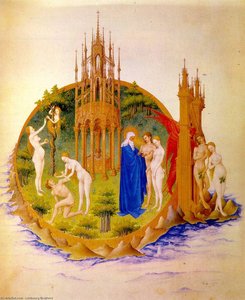
The transition from the austere, symbolic rigidity of the Romanesque to the fluid grace of the International Gothic period represents one of the most enchanting chapters in European art history. This era, flourishing roughly between the late 14th and early 15th centuries, was not merely a stylistic shift but a profound cultural synthesis. It emerged from the interconnected courts of Europe—from Paris to Prague, and from Burgundy to Northern Italy—where a shared language of aristocratic refinement began to take root. This movement bridged the gap between the spiritual abstraction of the Middle Ages and the burgeoning humanism of the Renaissance, weaving together a tapestry of courtly elegance and an unprecedented interest in the natural world. At its heart, International Gothic art sought to capture the splendor of the secular and the sacred through a lens of extreme refinement. The figures within this style possess a rhythmic, flowing quality; their drapery cascades in delicate, calligraphic folds that seem to dance with a life of their and their gestures are imbued with a gentle, courtly grace. Yet, beneath this veneer of aristocratic poise, a new observational spirit was stirring. Artists began to look more closely at the flora, the fauna, and the atmospheric nuances of the landscape, introducing a subtle naturalism that would eventually pave the way for the masters of the Renaissance. It was an era where the divine was increasingly reflected in the exquisite details of the earthly realm.The Art of the Page: Masterpieces of Illuminated Manuscripts and Scriptorium Craftsmanship
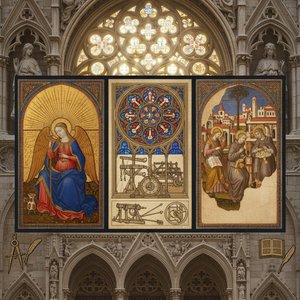
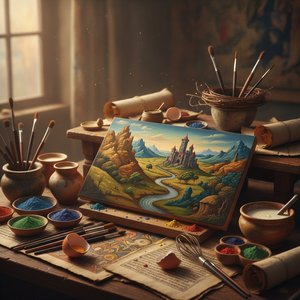
While monumental altarpieces commanded the cathedrals, the true soul of the International Gothic resided within the intimate confines of the illuminated manuscript. These precious volumes, often commissioned by royalty and high clergy, served as portable sanctuaries of beauty and devotion. The production of such works was a Herculean feat of collaborative artistry, centered in legendary workshops known as scriptoria. In these quiet, disciplined spaces, monks and professional lay artists labored over vellum—fine calfskin prepared to an almost translucent smoothness—to create miniature worlds that were as much triumphs of engineering as they were of aesthetic vision. The craftsmanship involved in a manuscript like the Exaltation of the Cross by the Limbourg Brothers or the intricate works emerging from the North Western Italy Scriptorium reveals a level of devotion that borders on the miraculous. Every stroke of the brush was a deliberate act of creation, requiring immense patience and a mastery of pigments derived from rare minerals, plants, and insects. The scriptorium was a place where calligraphy met illustration, where the text itself became part of the visual rhythm. These manuscripts were not merely books; they were luminous objects of prestige, designed to be pored over by candlelight, their intricate borders and marginalia offering a meditative journey through both scripture and splendor.Luminosity and Detail: The Role of Gold Leaf and Jewel Tones in Medieval Devotion
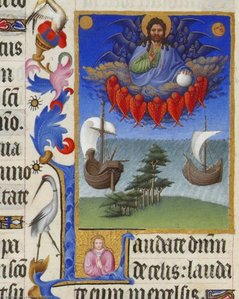
To understand the visual impact of International Gothic art, one must contemplate the transformative power of light. The period was defined by an obsession with luminosity, achieved through the masterful application of gold leaf and a palette of rich, saturated jewel tones. The use of gold was not merely decorative; it served a profound theological purpose. By gilding backgrounds and halos, artists created a "divine light" that seemed to emanative from within the artwork itself, separating the sacred figures from the mundane world and transporting the viewer into a celestial realm. This brilliance was complemented by an extraordinary use of color. Deep ultramarines, derived from precious lapis lazuli, were paired with vibrant vermilions, malachite greens, and deep madder reds to create a sense of opulent depth. In works such as the beautifully illuminated Missals, one can observe how these colors interact with the reflective surfaces of gold to produce a shimmering, multidimensional effect. This interplay of light and pigment was essential in conveying the majesty of religious narratives. The visual splendor served to evoke awe, making the intangible mysteries of faith tangible through the sheer sensory power of color and radiance.Pioneers of the Style: Exploring the Boucicaut Master and the Limborg Brothers
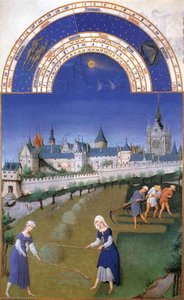
The evolution of this elegant style was propelled by individual geniuses whose innovations redefined the boundaries of miniature painting. Among the most influential was the Boucicaut Master, a renowned illuminator of early 15th-century France. His work represents a pinnacle of the International Gothic tradition, characterized by an advanced understanding of light and a pioneering approach to perspective. The Boucicaut Master possessed a singular ability to render atmospheric depth, using subtle gradations of tone to suggest distance and air, thereby bringing a sense of three-dimensional reality to the flat surface of the page. Parallel to this development were the Limbourg Brothers, whose collective work, particularly the Très Riches Heures du Duc de Berry, remains perhaps the most celebrated achievement of the era. Their ability to blend the courtly, idealized figures of the Gothic tradition with meticulous, almost scientific observations of seasonal landscapes and peasant life was revolutionary. Through their hands, the manuscript became a window into both the heavens and the earth. These artists did not merely decorate; they innovated, pushing the technical limits of their medium and establishing a visual vocabulary that would resonate across the European continent for generations.From Courtly Splendor to Renaissance Foundations: The Legacy of the International Gothic
As we look back upon the International Gothic period, we see it not as a stagnant era of medievalism, but as a vibrant, transitional bridge. It was the "elegant dawn" that prepared the European consciousness for the profound shifts of the 15th and 16th centuries. The movement’s emphasis on naturalistic detail, its sophisticated use of light, and its mastery of color provided the essential groundwork upon which the Renaissance would be built. The seeds of perspective and anatomical observation were already being sown in the delicate margins of Gothic manuscripts. The legacy of this era lives on in our enduring fascination with the beauty of the handmade and the profound impact of meticulous detail. It reminds us that art has always been a pursuit of both the sublime and the tangible. Today, as we seek to preserve and celebrate these historical masterpieces, we find inspiration in their ability to harmonize the spiritual with the physical. The International Gothic period remains a testament to the enduring power of human creativity to transform simple materials—vellum, pigment, and gold—into eternal expressions of grace and light.At ArtsDot.com, we are dedicated to preserving this legacy of human creativity. Our mission is to bring the grandeur of the Old Masters into the modern home through exquisite, hand-painted reproductions and museum-quality Giclée prints. Whether you seek a custom oil masterpiece that captures the tactile texture of a historical treasure or a beautifully framed print to adorn your collection, our artists work with academic excellence to ensure every piece retains the soul and spirit of art history. Explore our vast library and discover how we can help you bring the elegance of the past into your contemporary space.