The Genesis of Die Brücke: Defining German Expressionism
To understand the seismic shift that Ernst Ludwig Kirchner brought to the European landscape, one must first look toward the bohemian spirit of Dresden at the dawn of the twentieth century. It was here, in 1905, that a group of ambitious young artists—including Kirchner, Erich Heckel, and Karl Schmidt-Rottluff—formed Die Brücke, or The Bridge. This was not merely an art collective; it was a manifesto in motion, a bridge intended to span the gap between the stagnant academic traditions of the past and the raw, unbridled vitality of a new, modern era.
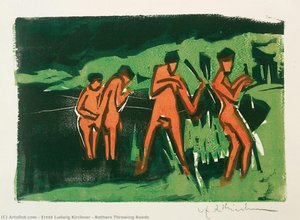
The movement emerged as a visceral reaction against the polished, often superficial aesthetics of Impressionism. While the Impressionists sought to capture the fleeting effects of light upon the eye, the members of Die Brücke sought to capture the tremors of the soul. They rejected the refined techniques taught in prestigious academies, opting instead for a primitive, almost primal approach to creativity. By embracing woodcut prints and jagged, unrefined lines, they created a visual language that felt as urgent and fractured as the changing social fabric of Germany itself.
This era was characterized by an intense desire for authenticity. The artists sought refuge in the natural landscapes of the Moritzburg Lakes, yet their work remained deeply tethered to the psychological tensions of urban life. Through this tension, German Expressionism was born—a movement that did not merely observe the world but interrogated it, forcing the viewer to confront the underlying anxieties and spiritual yearnings of a civilization on the precipice of monumental change.
The Visual Language of Emotion: Color, Distortion, and Form
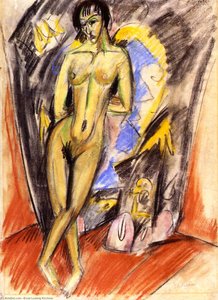
In the hands of Kirchner, color ceased to be a descriptive tool and became a psychological weapon. The palette of German Expressionism is famously non-naturalistic; it is a world where skies might burn with an acidic yellow and faces may take on the sickly hues of emerald green or bruised violet. This deliberate use of clashing, vibrant pigments was designed to bypass the intellect and strike directly at the viewer's emotional core. When we gaze upon a work like Die Russin, we are not looking at a literal representation of a subject, but rather an encounter with intense feeling, conveyed through bold, unapologetic brushstrokes.
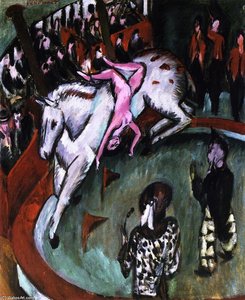
Complementing this chromatic intensity is the deliberate use of distortion. Kirchner and his contemporaries abandoned the harmonious proportions of classical anatomy in favor of elongated limbs, sharp angles, and jagged silhouettes. This fragmentation of form serves to mirror the psychological fragmentation of the modern individual. The world appears tilted, unstable, and often claustrophively compressed. By warping the physical reality of the subject, the artist reveals a deeper, more subjective truth—a truth that resides in the tension between the seen and the felt.
The texture of these works further enhances their emotive power. There is a tactile urgency in the way paint is applied, often in thick, impasto layers that create a sense of movement and struggle on the canvas. This rejection of smooth, finished surfaces ensures that the process of creation remains visible, reminding the observer that art is an act of profound human exertion. In this visual vocabulary, every line and every hue serves a singular purpose: to articulate the unspoken complexities of the human condition.
Urban Psychosis: Capturing the Energy of Berlin through Kirchner's Lens
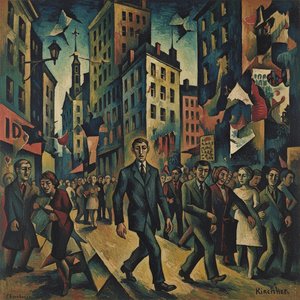
As the movement progressed, the focus shifted from the pastoral idylls of the countryside to the frenetic, often overwhelming pulse of the metropolis. Berlin, in particular, became a central protagonist in Kirchner’s oeuvre. The city was a site of unprecedented transformation—a sprawling, electrified labyrinth of commerce, nightlife, and anonymity. For Kirchner, the streetscape was a stage for a new kind of drama, one defined by the alienation and electric energy of the modern crowd.
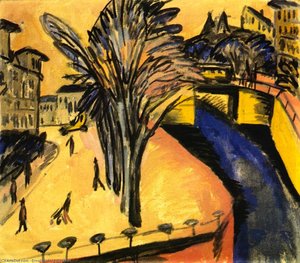
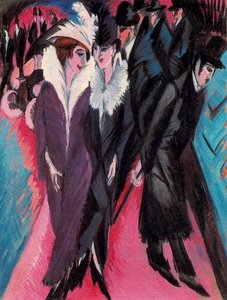
His depictions of Berlin are masterclasses in capturing urban psychoses. The compositions often feel crowded and restless, with figures appearing to collide or drift past one another in a state of disconnected motion. The architecture itself seems to lean inward, creating a sense of claustrophobia that mirrors the psychological pressure of city life. In works such as Red Elisabeth Riverbank, Berlin, we see the vibrant energy of the early twentieth century captured through dynamic brushstrokes and a color palette that vibrates with the rhythm of the streets.
Yet, beneath this surface-level vitality lies a profound sense of loneliness. The figures in Kirchner’s urban scenes—often streetwalkers, musicians, or anonymous passersby—frequently possess mask-like faces, suggesting a loss of individual identity within the mass. This duality, between the outward spectacle of the city and the inward isolation of the soul, is what gives his Berlin period such enduring power. He captured not just the light of the streetlamps, but the shadows cast by the modern psyche.
Masterworks Analyzed: From 'Die Russin' to the Riverbanks of Berlin
To truly appreciate the breadth of Kirchner’s genius, one must engage in a close reading of his most pivotal compositions. Consider Dodo and Her Son (1908), an early masterpiece that showcases his burgeoning interest in portraiture and symbolic depth. Here, the presence of a masked man alongside an elegant woman introduces an element of mystery and theatricality, hinting at the layers of identity that the Expressionists sought to peel away. The painting is a striking study in contrast, utilizing form to suggest a narrative that remains tantalizingly out of reach.
Moving forward into his more mature period, Die Russin stands as a testament to his mastery of raw emotion. In this work, the boundaries between subject and background begin to dissolve into a sea of vibrant color and distorted shapes. The painting does not ask for permission to be felt; it demands an emotional response through its sheer intensity. It is a quintessential example of how Kirchner used the canvas to explore the visceral, often uncomfortable, intersections of human desire and social reality.
Finally, returning to the landscapes of his urban experience, Red Elisabeth Riverbank, Berlin (1913) offers a glimpse into the rhythmic vitality of the city. The use of bold, saturated reds and energetic linework captures a moment of temporal flux. It is a painting that breathes with the movement of the water and the pulse of the crowd, demonstrating how Kirchner could transform a specific geographic location into a universal symbol of modern existence. Each of these works acts as a window into a world where the boundaries of reality are perpetually being redrawn.
The Legacy of Kirchner: Influence on Modernism and Contemporary Aesthetics
The ripples of Ernst Ludwig Kirchner’s influence extend far beyond the era of Die Brücke. His radical departure from representational accuracy paved the way for subsequent movements, including Abstract Expressionism, where the gesture of the artist became the primary subject of the work. The freedom he claimed—the right to distort, to clash, and to scream through color—became a foundational principle for much of twentieth-century modernism.
Today, we see the echoes of Kirchner’s aesthetic in contemporary graphic design, film noir, and even the raw energy of street art. The way he utilized high-contrast shadows and jarring color palettes continues to inform how artists communicate tension and drama in a visual medium. His ability to find profound meaning within the fragmented and the grotesque remains a vital lesson for any creator seeking to explore the depths of human experience.
Ultimately, the legacy of Kirchner is one of courage. He had the courage to look into the chaos of a changing world and find a way to give it form. For the art enthusiast, his work serves as a perennial reminder that true beauty often lies not in perfection, but in the honest, sometimes painful, expression of our most fundamental truths. His vibrant, distorted, and deeply human world continues to invite us to see the world through eyes that are wide open.
At ArtsDot.com, we celebrate the enduring power of masters like Ernst Ludwig Kirchner. Our mission is to bring the profound textures and emotional depths of art history into your personal space. Whether you are drawn to the tactile impasto of a Handmade Oil Reproduction or the museum-grade precision of our Giclée prints, we provide unparalleled access to the world's most significant movements. From custom commissions that reimagine your own memories in an Expressionist style to professional consultations for collectors, ArtsDot is dedicated to preserving and sharing the soul of human creativity.