The Rise of a Satirist: Hogarth’s Early Life & Influences
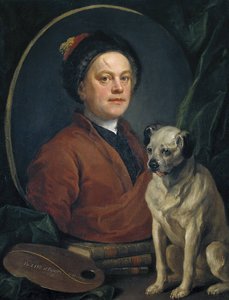 William Hogarth
Explore the satirical world of William Hogarth (1697-1764), pioneering English painter & engraver. Discover *A Harlot's Progress* & insightful social commentary.
William Hogarth, born in London in 1697, wasn't destined for artistic greatness by birthright. His father, Richard Hogarth, a Latin school teacher and occasional writer, experienced fluctuating fortunes – periods of stability punctuated by imprisonment for debt. This early exposure to the precariousness of life, the stark realities beneath the veneer of Georgian society, would profoundly shape young William’s worldview and ultimately fuel his artistic vision. While initially apprenticed to an engraver, Ellis Gamble, Hogarth's restless spirit led him down a path of self-education, sketching the bustling streets of London and absorbing the energy of its diverse inhabitants. His formal training at St Martin’s Lane Academy, alongside future luminaries like Joseph Highmore, provided technical grounding, but it was his apprenticeship with Sir James Thornhill, serjeant painter to George I, that truly ignited his passion for painting – though even then, a playful independence simmered beneath the surface.
Hogarth’s early works hinted at the direction he would take. He wasn't immediately drawn to grand historical narratives or idealized portraiture; instead, he began crafting “conversation pieces,” intimate scenes of everyday life that captured the nuances of social interaction. These paintings, while successful, felt limiting to Hogarth. He yearned for a more impactful form of expression, one that could not only reflect society but also critique it – and this desire would soon blossom into his groundbreaking series of “modern moral subjects.” The influence of French Rococo art, particularly the elegance of Antoine Watteau, is visible in these early works, yet Hogarth quickly moved beyond mere aesthetic imitation, infusing his compositions with a distinctly English sensibility and a sharp satirical edge.
A Rake's Progress & Harlot's Progress: Narratives of 18th-Century London
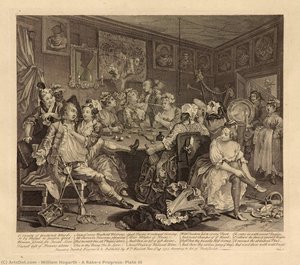
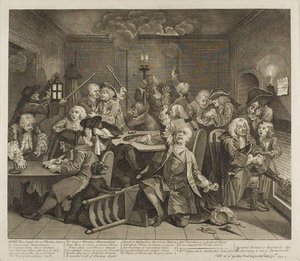 Plate six, from A Rake's Progress
Immerse yourself in Hogarth’s "Plate six" – a vibrant 18th-century satire! Explore this intricate engraving's chaotic tavern scene, masterful technique & historical significance.
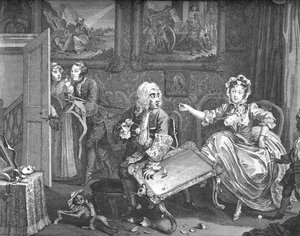
The publication of *A Harlot’s Progress* in 1731 marked a turning point, not just for Hogarth but for the very landscape of British art. This series of six engravings followed the tragic descent of Moll Hackabout, a young woman who arrives in London with naive optimism only to be swallowed by the city's underbelly of exploitation and despair. Each plate is a meticulously detailed tableau vivant, teeming with characters and symbolic details that expose the hypocrisy and moral failings of 18th-century society. Hogarth didn’t simply depict Moll’s story; he dissected it, offering a scathing commentary on the lack of opportunity for women and the pervasive sexual exploitation they faced.
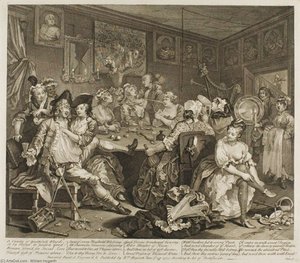
Five years later came *A Rake's Progress*, perhaps his most famous work. This eight-part series charts the ruinous trajectory of Tom Rakewell, an heir who squanders his fortune through gambling, debauchery, and reckless abandon. Like *Harlot’s Progress*, *Rake’s Progress* is a masterclass in narrative storytelling, each engraving functioning as a self-contained scene yet contributing to a larger, overarching moral tale. The series isn't merely a condemnation of individual vice; it’s a critique of the social conditions that foster such behavior – the corrupting influence of wealth, the superficiality of aristocratic values, and the indifference of a society obsessed with appearances. Hogarth’s genius lay in his ability to blend humor and pathos, creating works that were both entertaining and profoundly unsettling.
Beyond Morality: Decoding the Social Commentary in Hogarth’s Art
O the Roast Beef of Old England is perhaps one of Hogarth's most famous paintings – it's also one of his most overtly patriotic.
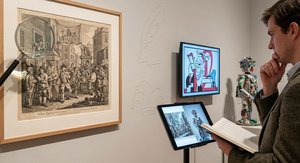
To view Hogarth solely as a moralist is to underestimate the complexity of his artistic vision. While his works undoubtedly carry strong ethical messages, they are far more than simple cautionary tales. He was a keen observer of human nature, acutely aware of the contradictions and absurdities that lay beneath the surface of polite society. His art serves as a mirror reflecting the anxieties, aspirations, and hypocrisies of 18th-century England.
Consider *Southwark Fair*, a chaotic and vibrant depiction of a bustling London fairground. On the surface, it’s a lively celebration of popular culture; however, closer inspection reveals a darker undercurrent – pickpockets ply their trade, drunken revelers brawl, and social boundaries are blurred. Hogarth isn't simply documenting the scene; he’s offering a commentary on the excesses and inequalities of urban life. Similarly, *The Four Times of the Day* series, while seemingly straightforward in its depiction of different stages of life, subtly critiques the class system and the moral compromises people make to survive. His works are rich with symbolism – recurring motifs, allegorical figures, and visual puns that invite viewers to engage in a deeper level of interpretation.
The Roast Beef of Old England and Patriotic Satire
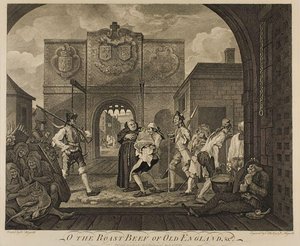 The Roast Beef of Old England
Explore William Hogarth’s ‘The Roast Beef of Old England’! A satirical masterpiece depicting 18th-century culture & British identity. Stunning engraving reproduction available.
Hogarth’s satirical reach extended beyond social critique to encompass national identity. *The Roast Beef of Old England* (1748) is perhaps one of his most famous paintings, and also one of his most overtly patriotic. Created in response to French caricatures mocking English cuisine and culture, the painting depicts a lavish feast celebrating traditional British fare – a massive roast beef, surrounded by symbols of national pride. It’s a bold statement of cultural defiance, asserting England's unique identity in the face of foreign criticism.
However, even within this seemingly straightforward patriotic image, Hogarth introduces layers of complexity. The painting subtly critiques the excesses of aristocratic dining and hints at the social inequalities that underpinned English society. It’s a testament to his artistic skill that he could create a work that is both celebratory and critical, simultaneously affirming national pride while questioning its underlying assumptions.
Hogarth as Printmaker: Innovation, Copyright & Public Access
Hogarth's impact wasn't limited to the paintings themselves; it was his innovative use of printmaking that truly democratized art and brought his satirical messages to a wider audience. In an era before mass media, prints were the primary means of disseminating images, and Hogarth recognized their potential as powerful tools for social commentary. He meticulously crafted each engraving, transforming his oil paintings into accessible works that could be purchased by a broad spectrum of society.
However, this accessibility came with a challenge: widespread piracy. His works were frequently copied without authorization, depriving him of income and undermining his artistic control. Hogarth fought tirelessly to protect his copyright, eventually lobbying for the Copyright Act of 1735 – one of the first steps towards modern intellectual property laws. This act not only safeguarded his own work but also established a precedent for protecting the rights of artists and writers. His commitment to ensuring public access to his art while simultaneously defending his creative ownership is a testament to his forward-thinking vision.
Legacy and Influence: The Enduring Impact of a British Master
William Hogarth’s influence on subsequent generations of artists and social commentators cannot be overstated. His pioneering use of narrative storytelling, his sharp satirical wit, and his commitment to depicting the realities of everyday life paved the way for new forms of artistic expression. From political cartoonists to graphic novelists, countless artists have drawn inspiration from his groundbreaking work.
The term “Hogarthian” itself has become synonymous with satirical political illustration – a testament to the enduring power of his visual language. His works continue to resonate today, offering insights into the complexities of human nature and the timeless challenges of social inequality. At ArtsDot.com, we are proud to offer high-quality reproductions of Hogarth’s iconic engravings, allowing you to experience firsthand the brilliance of this British master and engage with his enduring legacy. Explore our collection today and discover the satirical world of William Hogarth – a world that is as relevant now as it was in the 18th century.