The Master of Miniature Majesty
In the grand tapestry of the Renaissance, where monumental frescoes and towering marble statues often command our gaze, there exists a more intimate realm of artistry—one defined by exquisite precision and the delicate capture of human essence. Antonio Abondio (1538–1591) was the preeminent architect of this miniature world. Born in the serene landscape of Riva del Garda, Italy, Abondio emerged from the cultural richness of Lake Garda to become a pioneer of a truly unique medium: the colored wax relief portrait miniature. His life’s work represents a profound intersection of sculptural permanence and the ephemeral beauty of fine detail, allowing the fleeting expressions of the powerful to be preserved in a way that stone alone could never achieve.
Abondio’s artistic journey began under the rigorous tutelage of the renowned sculptor Leone Leoni. This early apprenticeship in Italy provided him with a foundation in the heavy, muscular language of Mannerism and the technical mastery required for large-scale stone carving. During his formative years in Milan, Abondio contributed to monumental works, such as the colossal atlantes for the facade of the Casa degli Omenoni. Yet, even while working on these grand architectural elements, a fascination with the minute began to take root. He possessed an uncanny ability to translate the weight and drama of large-scale sculpture into the tiny, delicate surfaces of wax and metal, effectively shrinking the grandeur of the Renaissance into the palm of a hand.
A Legacy in Wax and Metal
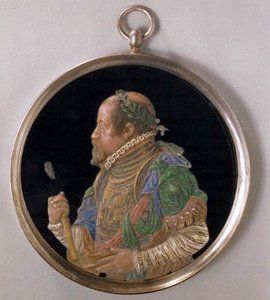
The true genius of Abondio lies in his revolutionary approach to portraiture. While many artists of his era focused on oil paintings, Abondio mastered the art of the wax relief. These miniature portraits, often set upon round black slate bases and adorned with precious pearls and gemstones, offered a tactile and luminous quality that captured the light in ways traditional media could not. Through these works, he achieved a level of lifelike nuance that made each subject appear almost breathing within their small, sculpted frames. This innovation allowed for a new kind of intimacy between the viewer and the sitter, turning a piece of art into a precious, wearable, or handheld treasure.
Beyond the delicate wax reliefs, Abondio’s influence extended deep into the world of numismatics. As a master medallist, he produced approximately sixty portrait medals that served as both commemorative tokens and political instruments. His work was characterized by:
- Technical Precision: The ability to render complex allegorical scenes on the reverse side of medals with incredible clarity.
- Imperial Grandeur: Creating works that honored the dignity of the Habsburg dynasty, including significant commissions for Emperor Maximilian II and Emperor Rudolf II.
- Versatility in Material: Moving seamlessly from the soft, malleable nature of colored wax to the enduring, sharp-edged precision of struck metal and silver enameling.
The Imperial Court and Historical Significance
Abondio’s career was a nomadic odyssey through the most influential courts of Europe. Following his early years in Italy, he moved to Vienna to serve the Habsburg court, later traveling to Prague, France, the Netherlands, and Germany. This movement allowed his style to absorb a diverse array of influences, blending the structured elegance of Italian Mannerism with the burgeoning dramatic energy of the Early Baroque. His presence in Prague during the reign of Rudolf II placed him at the very heart of a cultural renaissance, where art, science, and mysticism converged.
The historical significance of Antonio Abondio transcends the mere creation of beautiful objects. He bridged the gap between the monumental and the miniature, proving that the impact of an artist is not measured by the scale of their canvas, but by the depth of their detail. By innovating the wax relief portrait, he provided a medium for the preservation of identity that was both durable and exquisitely sensitive to human emotion. His legacy lived on through his son, Alessandro, who continued the family tradition of mythological and portrait reliefs, ensuring that the Abondio name remained synonymous with the pinnacle of Renaissance craftsmanship.