A Life of Displacement and Artistic Renaissance
Baroness Hansi Staël von Holstein was an artist whose very existence was defined by the shifting borders and tumultuous tides of twentieth-century Europe. Born in Budapest in 1913, her early years were shadowed by the decline of the Austro-Hungarian Empire and the profound instability brought about by the First World War. This sense of movement—of being a citizen of a world in flux—became the heartbeat of her creative identity. Her education was as much a journey across landscapes as it was an academic pursuit, as she absorbed the rigorous traditions of Vienna’s Arts and Crafts Academy and the Budapest Fine Arts Academy. These formative years instilled in her a profound respect for both classical technique and the burgeoning modernism that was beginning to reshape the continent.
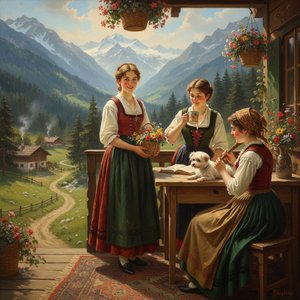
As she navigated the interwar period, her travels through territories such as the Dolomites and Fiume exposed her to a rich tapestry of cultural identities. The nationalist fervor of these regions did not stifle her; rather, it deepened her fascination with folk art forms and the raw, expressive power of local traditions. This period of wandering was marked by an increasing ability to synthesize diverse influences into a singular, cohesive aesthetic. Even when she found herself in Hamburg, where her paintings began to garner critical acclaim, there was always an underlying thread of exploration—a search for beauty amidst the encroaching shadows of a continent on the brink of further conflict.
From Stockholm Shadows to Portuguese Light
The Second World War forced another profound transformation upon Staël’s life. Seeking refuge in Stockholm, she entered a period of intense creative adaptation. In the relative isolation of wartime Sweden, her focus shifted toward the delicate realms of textile design and illustration. This was not merely a change in medium but a survival strategy; through book illustrations and the creation of intricate fabric patterns, she found a way to communicate beauty while navigating the heavy hand of wartime censorship. It was during this Swedish chapter that her reputation as a versatile designer was solidified, proving her ability to thrive even when the traditional avenues of fine art were constricted by global strife.
However, it was her arrival in Portugal in 1946 that would ultimately define her historical legacy. Settling in a land of vibrant light and deep tradition, she found the perfect canvas for her industrial ambitions. Her work during this era transcended the boundaries of the solitary studio, as she sought to bridge the gap between high art and mass production. By integrating her sophisticated aesthetic into the realm of functional objects, she ensured that her artistic vision could reach far beyond the elite galleries, touching the daily lives of a much broader public.
The Revolution of Industrial Ceramics
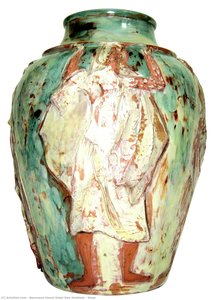
The zenith of Staël’s career arrived through her transformative leadership at SECLA (Sociedade de Exportação e Cerâmica Lda.). As Artistic Director, she did not merely decorate existing forms; she revolutionized the very concept of Portuguese industrial ceramics. She championed a collaborative spirit that brought together the precision of industry with the soul of the individual artist. Her designs for SECLA were characterized by:
- A masterful integration of folk motifs with modern, streamlined silhouettes.
- An innovative use of color and glaze that breathed new life into ceramic surfaces.
- A profound ability to translate textile-inspired patterns onto the medium of clay.
Through these efforts, she helped transform Portuguese ceramics from a local craft into an internationally recognized symbol of modern design. Her work at SECLA remains a testament to her belief that art should be accessible, functional, and deeply rooted in cultural heritage. Though her life was tragically short, ending in London in 1961, the impact of Baroness Hansi Staël von Holstein continues to resonate. She remains a pioneer who navigated the wreckage of a broken Europe to build something enduring, beautiful, and profoundly transformative for the world of industrial design.