

A Celestial Descent: The Architectural Splendor of the Würzburg Residenz
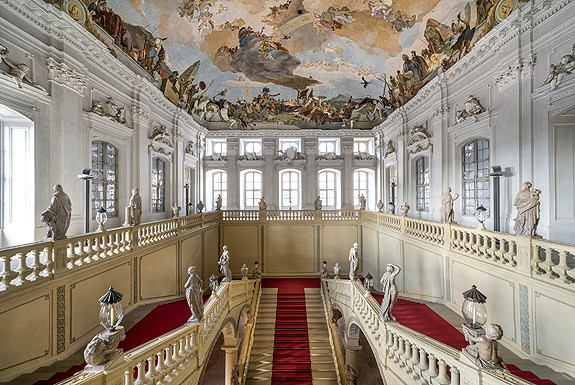
To step into the stairwell of the Würzburg Residenz is to abandon the terrestrial world and ascend into a realm where stone, light, and pigment converge in a singular, breathtaking moment of transcendence. This architectural marvel, a crown jewel of the German Baroque, serves as more more than just a passage between palace chambers; it is a profound sensory experience designed to overwhelm the viewer with the sheer magnitude of princely power and divine grace. As one approaches the grand staircase, the structural genius of Balthasar Neumann begins to reveal itself. A master of spatial innovation, Neumann utilized groundbreaking ribbed vaults and sophisticated engineering to create an expansive, airy volume that defies the heavy limitations of masonry. His vision was one of fluid movement and light, ensuring that as visitors climbed toward the upper galleries, the architecture seemed to expand upward, mirroring a spiritual ascent into the heavens.
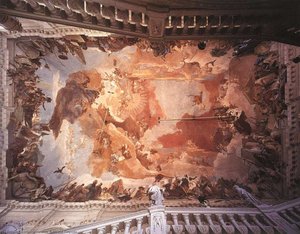
The true soul of this space resides in the monumental ceiling fresco by the Venetian virtuoso Giovanni Battista Tiepolo. Spanning an incredible 600 square meters, this is arguably the largest and most ambitious ceiling painting ever executed, a dizzying panorama that dissolves the physical boundary between the palace walls and the infinite sky. In this masterwork, Tiepolo employs his signature light-filled palette and illusionistic technique to depict the continents of Europe, Asia, Africa, and America as celestial entities. The central composition, featuring Apollo surrounded by mythological figures, acts as a radiant sun around which the entire universe of the fresco revolves. Through masterful use of chiaroscuro and perspective, Tiepolo creates a sense of di sotto in sù —looking from below upwards—making the heavy architecture appear to vanish into a luminous, cloud-strewn ether where gods and mortals coexist in a choreographed dance of light.
Beyond the immediate visual impact of the staircase, the Residenz stands as a testament to the enduring legacy of the Schönborn family, whose patronage transformed Würzburg into a vibrant epicenter of European culture. The palace is a symphony of interconnected artistic achievements, where the delicate stucco ornamentation of the Rococo period meets the monumental scale of Baroque ambition. For the art historian, the complex offers a deep dive into the socio-political landscape of 18th-century Bavaria; for the interior designer, it provides an inexhaustible source of inspiration in its harmonious proportions and opulent textures. Every corner of the Residenz, from the gilded Imperial Hall to the tranquil, meticulously manicured gardens designed by Johann Christian Dillhoff, reflects a period when art was used not merely for decoration, but as a profound language of prestige, intellect, and eternal beauty.
Today, the Würzburg Residenz remains an essential pilgrimage site for those who seek to understand the pinnacle of European decorative arts. It is a place where the boundaries between architecture and painting are erased, leaving only a pure, emotive experience of grandeur. Whether one is captivated by the technical brilliance of Neumann’s structural feats or lost in the mythological narratives of Tiepolo’s brushstrokes, the Residenz offers an encounter with the sublime that continues to resonate across centuries, inviting every visitor to witness the moment where human craftsmanship touches the divine.