 Preview
 Send
Send Share
Share
 Details

 Download
 Similars
 X-Ray
X-Ray Diaporama
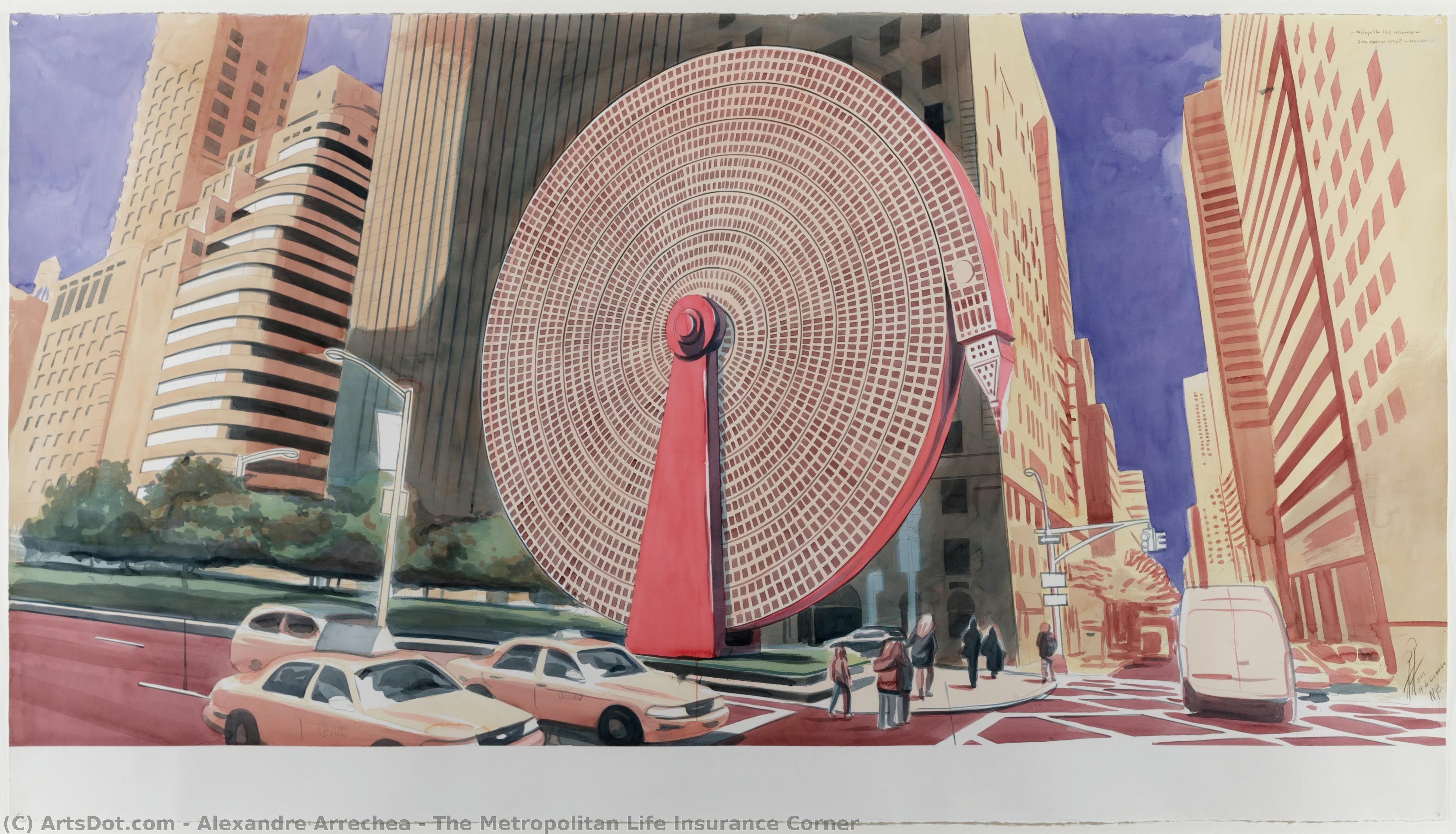
The Metropolitan Life Insurance Corner


 Read More
Giclée / Art Print
Museum-quality giclée or canvas print with fast production and flexible finish options. ( Buy Hand Made Painting Buy Image)




P118B $10

P118H $10

P118W $10

P438Z $10

P508JH $12

P508YH $12

P805H $10

P805Z $10

P919BZ $10

P919G $10

P919XJ $10

P959ZH $10

P968JZ $12

W106C $8

W218G $10

W218JH $8

W218Y $10

W307PJ $10

W316G $10

W316PJ $8

W316Y $10

W398PJ $8

W4111J $10

W500HY $15

W500JH $15

W692G $12

W849H $8

W940BG $15

W953PJ $8




Pick from our preset sizes that match the artwork's original proportions.

You may enter your own dimensions to fit a specific frame or space. If your selected size does not match the original image's proportions, we will either crop the artwork or extend the image with a mirrored or solid-fill edge. A digital mockup will be sent for your approval before production begins.
Please note that the on-screen preview does not reflect the actual cropping or extension. Only the mockup will accurately show the final composition.
While custom sizes are available, we recommend selecting a dimension from the predefined list to preserve the original proportions.
Worldwide Delivery () in 2 weeks instead of standard 4/5 weeks. (22 August)

Free Worldwide Express Shipping

High-Quality Linen Canvas

Full Shipping Insurance

Customs Tax Refund Guarantee

True Color Matching Guarantee

60-Day Return Policy (Defects Only)

100% Money-Back Guarantee

Bulk Discount Offer
 Glass option is only available in size under 110 CM

The Metropolitan Life Insurance Corner
Giclée / Art Print
Reproduction Size
-


Total Price
$ 63
Collectible Description
A Visionary Urban Tapestry
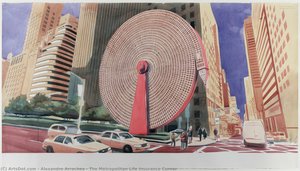
In the evocative watercolor study titled The Metropolitan Life Insurance Corner, Cuban artist Alexandre Arrechea invites us into a dreamlike, futuristic cityscape that breathes with the pulse of architectural evolution. This piece serves as a profound meditation on the fluidity of urban life, acting as a preparatory study for his monumental No Limits series. Through delicate washes and precise geometric forms, Arrechea captures a world where the rigid, towering structures of New York City—including the iconic Met Life and Empire State buildings—are reimagined through a lens of elasticity and change. The artwork does not merely depict a skyline; it captures the very essence of a city in flux, suggesting that even the most permanent monuments are subject to the shifting tides of economic and cultural history.
The composition is masterfully anchored by a colossal, crimson Ferris wheel that dominates the center of the frame. This striking focal point acts as a mechanical heart for the metropolis, drawing the eye inward toward a bustling street scene where pedestrians and vehicles navigate the shadows of giants. The artist employs a fascinating blend of illustrative realism and slightly exaggerated proportions to create a sense of wonder. By placing such a whimsical, leisure-oriented structure amidst the heavy, rectangular silhouettes of skyscrapers, Arrechea creates a tension between the industrial permanence of architecture and the transient joy of urban recreation.
Technique and Atmospheric Depth
Executed with the masterful touch of traditional watercolor, the piece relies on soft, layered washes to build a sense of atmospheric depth. The palette is a sophisticated arrangement of earthy browns, muted grays, and deep reds, punctuated by sudden, vibrant accents of yellow and blue that mimic the flickering lights of a city at dusk. There is a beautiful, slightly grainy texture present in the paper, which lends a nostalgic, mid-20th-century quality to the work, reminiscent of vintage urban planning illustrations. The lighting is diffused and soft, suggesting an overcast afternoon where the boundaries between the sky and the steel structures begin to blur.
Arrechea’s use of line is both structural and poetic. While sharp, defined outlines provide the necessary skeletal strength to the buildings, the softer edges of the watercolor washes allow the city to feel organic rather than static. This technique mirrors the artist's underlying philosophy: that architecture, much like a living organism, is exposed to the elements—the heat, the rain, and the fog—and is thus constantly being reshaped by its environment. For the collector or interior designer, this piece offers a sophisticated layer of intellectual depth, providing a conversation starter that bridges the gap between structural stability and the beautiful unpredictability of life.
Symbolism and Emotional Resonance
Beyond its visual splendor, The Metropolitan Life Insurance Corner is rich with symbolic weight. The Ferris wheel serves as a powerful metaphor for the cyclical nature of progress, consumerism, and the rise and fall of economic eras. It represents the "spinning" motion of history, where the verticality of power—represented by the skyscrapers—is met by the circular, repetitive movement of social life. Arrechea explores themes of surveillance and control through the very way these buildings loom over the streets, yet he subverts this rigidity by introducing elements of play and movement.
For those looking to adorn a space with art that inspires contemplation, this work offers an unparalleled emotional impact. It evokes a sense of nostalgia for a future that never quite arrived, while simultaneously feeling strikingly modern in its exploration of urban sociology. Whether placed in a contemporary gallery setting or a refined residential study, this reproduction brings with it the spirit of transformation, reminding the viewer that even the most formidable structures are part of an ever-changing, beautiful dance of existence.
Related Artworks
Artist Biography
The Architect of Power: The Artistic Journey of Alexandre Arrechea
Born in the culturally vibrant city of Trinidad, Cuba, in 1970, Alexandre Arrechea has emerged as a profound voice in contemporary visual art. His origins in a landscape steeped in history and complex social structures provided the foundational lens through which he views the world. Educated at the prestigious Escuela de Arte in Cuba, Arrechea developed an early mastery of form that would later serve his more conceptual and monumental ambitions. His formative years were not merely about learning technique, but about absorbing the socio-political textures of his homeland, a process that would eventually become the heartbeat of his artistic practice.
For over a decade, Arrechea’s identity was inextricably linked to the influential art collective Los Carpinteros. As a member of this group until July 2003, he participated in a movement that challenged political narratives and explored the intersection of sculpture and social commentary. However, his departure from the collective marked a pivotal transition toward a solo career defined by an even more intimate yet expansive investigation into the mechanics of authority. Moving beyond the collaborative framework, Arreelleca began to craft a singular visual language capable of dissecting the invisible threads that bind society together.
Mapping the Networks of Control
Arrechea’s body of work is a hauntingly beautiful exploration of the structures that govern human existence. He does not merely depict objects; he maps the invisible architectures of power, surveillance, and hierarchy. His art invites the viewer to contemplate the subtle ways in which control is exerted through urban design, architectural prohibitions, and the psychological weight of subjection. Through his monumental projects, he transforms abstract concepts of dominance into tangible, often overwhelming, physical experiences.
The themes present in his work are deeply rooted in the study of how systems function:
- Surveillance and Visibility: Investigating the gaze that monitors and regulates public and private spaces.
- Hierarchies of Space: Analyzing how architectural layouts can enforce social stratification and exclusion.
- The Mechanics of Control: Exploring the physical and symbolic barriers that dictate movement and behavior within urban environments.
His fascination with these themes often draws upon historical philosophical concepts, such as the influence of Jeremy Bentham and the Panopticon, to illustrate how modern society remains caught in a web of self-regulating discipline. By utilizing scale and installation, Arrechea forces his audience to confront their own position within these vast, unseen networks.
Global Presence and Lasting Legacy
The significance of Alexandre Arrechea’s contribution to contemporary art is reflected in the prestigious institutions that have hosted his work. His ability to bridge the gap between sculptural installation and sociological critique has earned him recognition far beyond the borders of Cuba. From the Museo Nacional de Bellas Artes de la Habana to the Butler Institute of American Art in Ohio, his installations serve as critical interventions in the global art dialogue.
Represented by the Casado Santapau Gallery in Madrid since 2006, Arrechea has maintained a consistent presence in the international gallery circuit, including notable exhibitions in the United Kingdom. His work continues to challenge the viewer to look upward and inward, questioning the very foundations of the spaces we inhabit. As he continues to evolve, his legacy remains anchored in his ability to make the invisible visible, turning the silent structures of power into a profound and unavoidable aesthetic experience.

alexandre arrechea
1970 - , Cuba
Quick Facts
- Artistic Movement Or Style: Figurative painting
- Artists Or Movements Influenced By This Artist:
- YBA scene
- Neo-conceptual art
- Artists Who Influenced This Artist:
- Rubenes
- Cubism
- Baroque
- Abstract Expressionism
- Date Of Birth: 1970
- Full Name: Jenny Saville
- Nationality: British
- Notable Artworks:
- Swollen Head
- Propped
- Meat Tree
- Place Of Birth: Cambridge, UK
Related Articles

Watercolor Wonders: 10 Masterpieces That Redefined Art History | ArtsDot
Journey through 10 legendary watercolor masterpieces by Sargent, Turner & Homer! Explore iconic landscapes, portraits & floral art that redefined history. Find museum-quality reproductions and curated decor ideas at ArtsDot.com.

Ephemeral Visions: Exploring the Artistic Legacy & Contemporary Practice of Watercolor Painting
Explore the captivating world of watercolor painting! Discover its rich history, essential techniques, influential artists & collecting tips. A comprehensive guide for art enthusiasts from ArtsDot.

Ephemeral Visions: Exploring the Artistic Legacy & Nuances of Watercolor Painting
Explore the captivating world of watercolor painting! Discover its rich history, essential techniques, influential artists & collecting tips from art experts. A comprehensive guide for enthusiasts.

Ephemeral Visions: Exploring the History & Emotional Resonance of Watercolor Painting
Explore the captivating history of watercolor painting, from ancient techniques to modern masters like Kandinsky & Blake. Discover essential artists, collecting tips & the emotional power of this luminous medium. Expert insights for art enthusiasts.

The Enduring Appeal of Watercolor: History, Techniques & Contemporary Practice
Explore the captivating world of watercolor painting! Discover its rich history, essential techniques, influential artists, and collecting tips. A comprehensive guide for art enthusiasts.