 Preview
 Send
Send Share
Share
 Details

 Download
 Similars
 X-Ray
X-Ray Diaporama
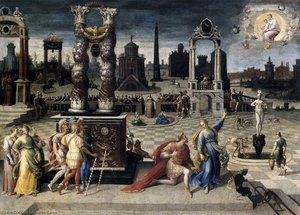
Augustus and the Sibyl
 Oil On Canvas
- WallArt
- Renaissance
 1575
1575- Renaissance
 125.0 x 170.0 cm
 The Louvre
 Read More
Giclée / Art Print
Museum-quality giclée or canvas print with fast production and flexible finish options. ( Buy Hand Made Painting Buy Image)




P118B $10

P118H $10

P118W $10

P438Z $10

P508JH $12

P508YH $12

P805H $10

P805Z $10

P919BZ $10

P919G $10

P919XJ $10

P959ZH $10

P968JZ $12

W106C $8

W218G $10

W218JH $8

W218Y $10

W307PJ $10

W316G $10

W316PJ $8

W316Y $10

W398PJ $8

W4111J $10

W500HY $15

W500JH $15

W692G $12

W849H $8

W940BG $15

W953PJ $8




Pick from our preset sizes that match the artwork's original proportions.

You may enter your own dimensions to fit a specific frame or space. If your selected size does not match the original image's proportions, we will either crop the artwork or extend the image with a mirrored or solid-fill edge. A digital mockup will be sent for your approval before production begins.
Please note that the on-screen preview does not reflect the actual cropping or extension. Only the mockup will accurately show the final composition.
While custom sizes are available, we recommend selecting a dimension from the predefined list to preserve the original proportions.
Worldwide Delivery () in 2 weeks instead of standard 4/5 weeks. (21 August)

Free Worldwide Express Shipping

High-Quality Linen Canvas

Full Shipping Insurance

Customs Tax Refund Guarantee

True Color Matching Guarantee

60-Day Return Policy (Defects Only)

100% Money-Back Guarantee

Bulk Discount Offer
 Glass option is only available in size under 110 CM

Augustus and the Sibyl
Giclée / Art Print
Reproduction Size
-


Total Price
$ 63
Collectible Description
A Vision of Imperial Grandeur: Augustus and the Sibyl
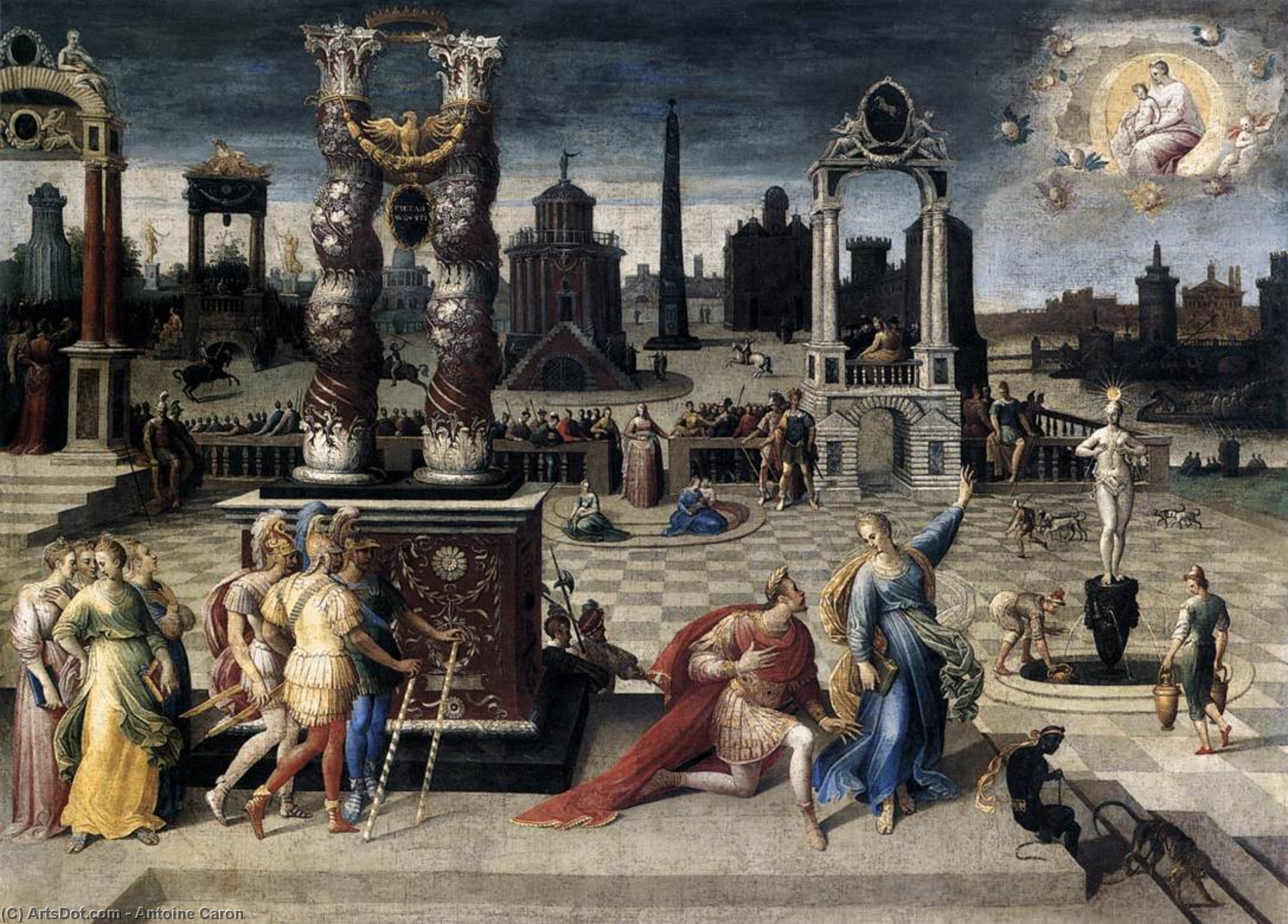
To stand before this magnificent depiction of Augustus and the Sibyl is to be transported across the centuries, directly into the heart of imperial Rome at its zenith. This large oil on canvas, executed in 1575 by Antoine Caron, is far more than a mere portrait; it is a meticulously constructed tableau vivant, an eloquent meditation on power, prophecy, and the enduring weight of history. The scene immediately envelops the viewer in the rich atmosphere of ancient Roman life, rendered with an almost palpable sense of drama and monumental scale.
The Allure of Classical Narrative and Symbolism
At the core of the composition stands Augustus Caesar, the embodiment of restored order and imperial might. His presence is commanding, yet tempered by the profound mystery emanating from the venerable Sibyl beside him. The Sibyl, traditionally a prophetess, holds her book not just as an object, but as a conduit to divine or forgotten knowledge. Surrounding these central figures are supporting characters—figures that appear to be angels or gods—and the architectural backdrop itself, replete with columns and statues. These elements do not merely decorate; they function symbolically. They root the narrative in a classical understanding of civilization, suggesting that Augustus’s reign is blessed by divine sanction and guided by ancient wisdom.
Mastery in Technique: Caron's Brushwork
Antoine Caron, whose own life bridged the worlds of glassmaking and painting, imbues this canvas with a unique textural richness. His technique allows for both breathtaking detail—visible in the folds of the ancient Roman drapery and the subtle expressions on the faces—and sweeping grandeur. The oil medium is handled to create deep shadows juxtaposed against luminous highlights, giving the entire scene an almost theatrical depth. One can observe the careful layering that gives weight to the marble structures and a lifelike quality to the skin tones, hallmarks of a master deeply versed in both illusionistic painting and material representation.
Historical Resonance and Emotional Impact
The context of the late Renaissance, filtered through Caron’s dramatic lens, imbues this work with an undercurrent of turbulent elegance. While celebrating the stability represented by Augustus, the surrounding drama hints at the volatile nature of power itself. For the modern collector or designer, owning a reproduction of this piece is acquiring not just art, but a conversation piece steeped in history. It speaks to themes of legacy, divine right, and the enduring human quest for meaning amidst monumental change. The sheer intricacy invites prolonged contemplation, making it a breathtaking focal point for any grand hall or scholarly interior.
Related Artworks

Artist Biography
Antoine Caron: A Master of Turbulent Elegance
Antoine Caron (1521–1599) stands as a singular figure in French Renaissance art, a glassmaker by trade and an illustrator whose artistic vision transcended his craft. Born in Beauvais, France, he emerged from the School of Fontainebleau during its zenith—a period marked by fervent religious debate and royal instability—leaving behind a legacy of dramatic paintings that capture both grandeur and unsettling psychological depth. Unlike many artists of his era who adhered to established conventions, Caron possessed a distinctive artistic personality, reflecting the volatile atmosphere of the Valois court.
Caron’s formative years were spent honing skills beyond mere craftsmanship. He apprenticed as a glassmaker, gaining invaluable experience in manipulating materials and achieving precise visual effects—a skill that would subtly inform his later painting style. However, it was his involvement with the Fontainebleau School under Francesco Primaticcio and Niccolò dell'Abbate that truly cemented his artistic trajectory. Here, he absorbed the influences of Mannerism, characterized by elongated figures, stylized drapery, and a deliberate rejection of naturalistic representation in favor of expressive symbolism. This exposure to dell’Abate’s masterful technique—particularly his use of dramatic chiaroscuro—would prove crucial to Caron's artistic development.
The Spectacle of the Valois Court
Caron swiftly ascended the ranks of royal patronage, becoming Catherine de' Medici’s court painter in 1561 and subsequently serving as an advisor to the crown. This position afforded him unparalleled access to the royal court and allowed him to participate actively in shaping its visual identity. He was not merely a painter of canvases but an architect of spectacle, orchestrating elaborate pageants commemorating significant events like the coronation of Charles IX and the wedding of Henry IV to Marguerite de Valoi. Through his meticulous drawings and designs for festival decor, he documented the splendor of the era, much of which served as the foundational inspiration for the legendary Valois Tapestries.
His role extended into the realm of the applied arts, where his background in glassmaking allowed him to contribute to the decorative embellishment of the Château de Fontainebleau. He worked alongside the great masters to restore and decorate royal apartments, blending the boundaries between fine art and ornamental design. This ability to navigate both the monumental and the minute—from massive fresco cycles to delicate illustrations for humanist manuscripts like L'Histoire d'Artemise—marked him as a versatile virtuoso of the late sixteenth century.
Allegory, Violence, and the Shadows of History
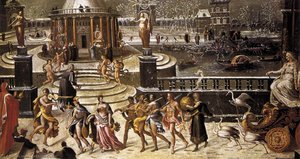
While much of Caron's work celebrated the refined elegance of courtly life, his art was deeply haunted by the political and religious bloodshed of the French Wars of Religion. His oeuvre is often categorized into three evocative themes that reflect the fractured psyche of his age: allegory, violence, and magic. In his allegorical works, such as the Triumph of the Seasons, one finds a world of picnics, orchestras, and idealized courtly gatherings. Yet, this veneer of peace was frequently punctured by the brutal reality of his time.
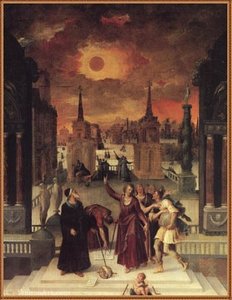
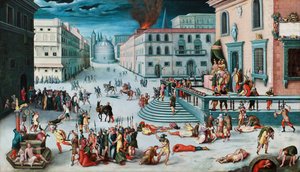
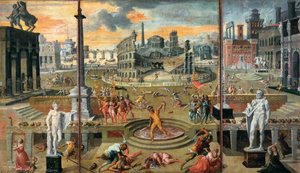
Caron’s "massacre" paintings, most notably his signed masterpiece The Massacres of the Triumvirate (1566), serve as harrowing chronicles of the era's instability. In these works, he utilized unusual architectural forms and bright, jarring colors to frame scenes of profound carnage, often placing human figures almost insignificantly against grand, sweeping stages. This technique created a sense of cosmic indifference to human suffering, a hallmark of his unique Northern Mannerist style. Alongside these grim chronicles, Caron explored the ethereal through themes of astrology and magic, as seen in Astrologers Studying an Eclipse, proving that his brush could capture both the terrifying reality of war and the mystical wonders of the unknown.
Ultimately, Antoine Caron remains a vital link in the history of French art. He was a painter who could navigate the delicate diplomacy of a queen mother while simultaneously capturing the visceral terror of a nation at war. His legacy is one of turbulent elegance, a testament to an artist who found beauty within the chaos of a changing world.
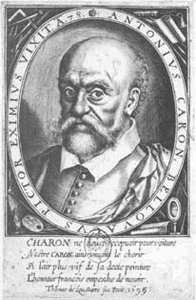
Antoine Caron
1521 - 1599 , France
Quick Facts
- Artistic Movement Or Style: Northern Mannerism
- Artists Or Movements Influenced By This Artist: ['Fontainebleau School']
- Artists Who Influenced This Artist: ["Niccolò dell'Abbate"]
- Date Of Birth: 1521 Beauvais France
- Date Of Death: 1599 Paris France
- Full Name: Antoine Caron
- Nationality: French
- Notable Artworks:
- Massacres under the triumvirate
- Christ and the adulteress
- The Triumph of Winter
- Place Of Birth: Beauvais France
Related Articles
Antoine Blanchard (Marcel Masson): Parisian Abstraction & the Legacy of Automatism
Explore the captivating world of Antoine Blanchard (Marcel Masson) and his nostalgic Parisian scenes. Discover his artistic influences, unique style, and the challenges of authentication. Expert insights & art appraisal information.
Sir Augustus Wall Callcott: A Life Painted with Light & Atmosphere
Explore the life & art of Sir Augustus Wall Callcott, a celebrated British landscape painter known for his serene scenes and elegant compositions. Discover his Romantic influences & lasting legacy at ArtsDot.
The Fête Galante & Beyond: Exploring the Artistic World of Jean-Antoine Watteau
Discover the captivating world of Jean-Antoine Watteau, master of the Fête Galante! Explore his iconic paintings, symbolism, and lasting influence on Rococo art. A deep dive for classic art enthusiasts.
John Augustus Atkinson: Romantic Visions of Rural England & Genre Painting's Evolution
Explore the captivating world of John Augustus Atkinson (1775-1830), a key figure in British Romanticism and genre painting. Discover his stunning Russian history scenes, naval art & delicate watercolors. Learn about his legacy at ArtsDot.
The Barbizon School: Pioneering Realism & the Pastoral Vision in 19th-Century French Painting
Explore the Barbizon School's pivotal role in 19th-century French painting. Discover how these artists revolutionized landscape art with their commitment to Realism and a profound connection to nature. Learn about key figures like Rousseau, Millet & Corot.