 Preview
 Send
Send Share
Share
 Details

 Download
 Similars
 X-Ray
X-Ray Diaporama
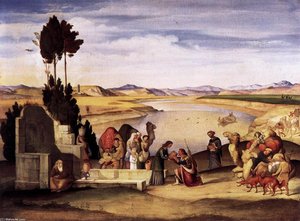
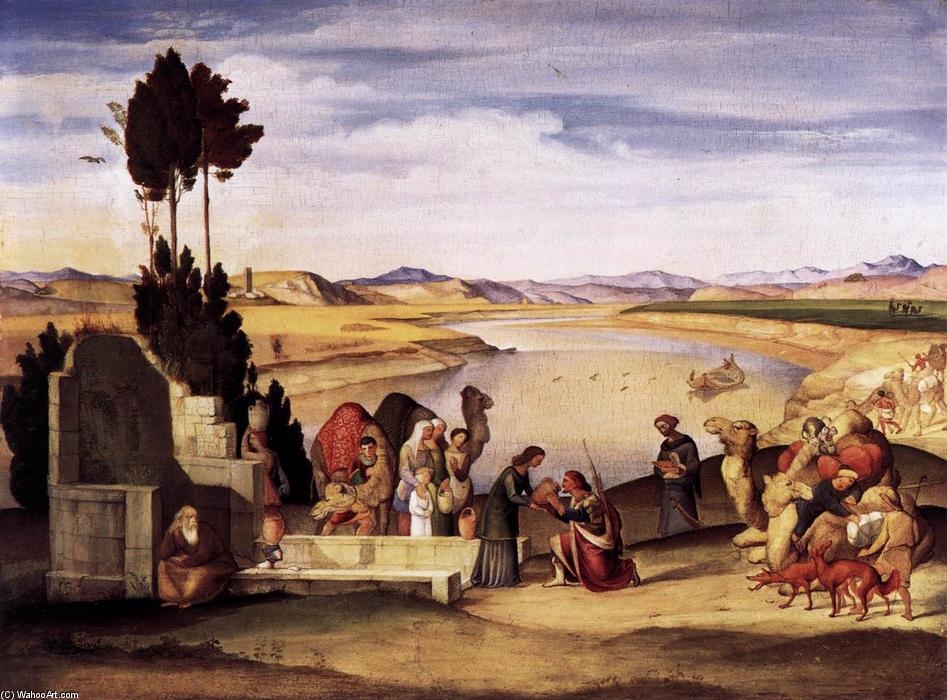
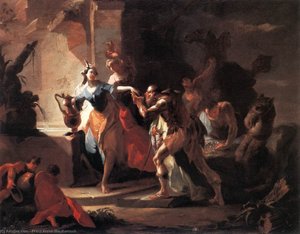
Rebecca and Eliezer at the Well
 Oil On Panel
- Nazarene
 1819
1819- 19th Century
 52.0 x 88.0 cm
 Nationalgalerie
 Read More
Hand Made Oil Reproduction
Hand-painted oil on canvas in your size and frame, made to order by our artists. ( Buy Print Buy Image)




P118B $10

P118H $10

P118W $10

P438Z $10

P508JH $12

P508YH $12

P805H $10

P805Z $10

P919BZ $10

P919G $10

P919XJ $10

P959ZH $10

P968JZ $12

W106C $8

W218G $10

W218JH $8

W218Y $10

W307PJ $10

W316G $10

W316PJ $8

W316Y $10

W398PJ $8

W4111J $10

W500HY $15

W500JH $15

W692G $12

W849H $8

W940BG $15

W953PJ $8




Pick from our preset sizes that match the artwork's original proportions.

You may enter your own dimensions to fit a specific frame or space. If your selected size does not match the original image's proportions, we will either crop the artwork or extend the painting with additional hand-painted elements. A digital mockup will be sent for your approval before production begins.
Please note that the on-screen preview does not reflect the actual cropping or extension. Only the mockup will accurately show the final composition.
While custom sizes are available, we recommend selecting a dimension from the predefined list to preserve the original proportions.
After order, ArtsDot.com team will email client for instructions and provide a mockup preview
Worldwide Delivery () in 3/4 weeks instead of standard 5 weeks. (28 August). No compromise on quality.

Free Worldwide Express Shipping

High-Quality Linen Canvas

Full Shipping Insurance

Customs Tax Refund Guarantee

True Color Matching Guarantee

60-Day Return Policy (Defects Only)

100% Money-Back Guarantee

Bulk Discount Offer
 Glass option is only available in size under 110 CM

Rebecca and Eliezer at the Well
Reproduction Medium
Reproduction Size
-


Total Price
$ 388
Johann Anton Alban Ramboux’s ‘Rebecca and Eliezer at the Well’: A Window into Romantic Faith
Anton (Alban) Ramboux's “Rebecca and Eliezer at the Well,” painted in 1819, is more than just a depiction of a biblical scene; it’s a profound meditation on faith, perseverance, and the delicate balance between humanity and nature. Measuring 52 x 88 cm, this oil-on-panel masterpiece immediately draws the viewer into its meticulously rendered world – a sun-drenched desert landscape teeming with life and imbued with a palpable sense of spiritual yearning. The painting’s enduring appeal lies not only in its technical brilliance but also in its ability to evoke a powerful emotional response, rooted firmly within the artistic currents of the early 19th century.
- Subject Matter: The scene unfolds as recounted in Genesis 24:10-27, capturing the pivotal moment when Eliezer, Abraham’s servant, encounters Rebecca at a well. This narrative, rich with symbolism – the well representing life and sustenance, the travelers embodying faith and determination – forms the very core of the artwork's meaning.
- Artistic Style & Technique: Ramboux was a key figure in the Nazarene movement, a reaction against the perceived excesses of Neoclassicism. His style is characterized by an almost obsessive attention to detail, a commitment to realism that borders on the photographic, and a deep engagement with religious themes. The use of oil on panel allows for remarkable textural richness and subtle gradations of color, contributing significantly to the painting’s luminous quality.
A Window into the Nazarene Movement
Ramboux's work exemplifies the Nazarene movement’s core tenets: a return to devotional art, an emphasis on emotional intensity over intellectual calculation, and a preference for detailed, naturalistic representations of biblical subjects. Unlike the polished surfaces and idealized forms favored by many of his contemporaries, Ramboux deliberately embraced imperfections – visible brushstrokes, slightly rough textures – believing that these qualities enhanced the painting’s spiritual impact. This approach reflects a desire to reconnect with the emotional power of early Christian art, before it was diluted by academic conventions.
- Composition: The composition is remarkably balanced, guiding the viewer's eye from Rebecca's kneeling figure towards Eliezer and the surrounding landscape. The horizontal emphasis created by the expansive desert vista reinforces a sense of timelessness and grandeur.
- Color Palette: The artist skillfully employs a muted color palette dominated by ochres, browns, and greens – colors that evoke the arid beauty of the desert environment. Subtle blues and whites are used to represent the sky and water, creating a harmonious contrast with the earth tones.
Symbolism and Historical Context
“Rebecca and Eliezer at the Well” was created during a period of significant social and intellectual change in Europe. The rise of Romanticism challenged Enlightenment rationalism, emphasizing emotion, intuition, and the power of nature. Ramboux’s painting reflects this shift, portraying not just a biblical story but also a profound respect for the natural world and its ability to inspire awe and wonder. The scene's depiction of travelers navigating a harsh environment speaks to themes of resilience and faith – qualities highly valued during this era.
- Historical Significance: The painting’s creation in 1819 places it firmly within the context of early 19th-century German art, a period marked by both artistic innovation and religious revival.
- Materials & Technique: The oil on panel medium was particularly favored by artists seeking rich color saturation and textural depth – characteristics that are vividly apparent in Ramboux’s work.
Collecting this Masterpiece
This exceptional reproduction captures the essence of Ramboux's original vision, offering a stunning addition to any art collection or interior design scheme. Its evocative imagery and masterful technique make it a timeless piece that will continue to inspire and captivate viewers for generations to come. Consider its ability to bring a touch of classical beauty and spiritual contemplation into your space.
Related Artworks
Artist Biography
The Soul of the Moselle: The Life and Art of Anton Alban Ramboux
In the quiet, mist-laden landscapes of the nineteenth century, few artists captured the delicate intersection of spiritual devotion and natural beauty as poignantly as Johann Anton Alban Ramboux. Born in 1790 in the historic city of Trier, Germany, Ramboux emerged as a painter whose brush served as a bridge between two profound artistic currents: the disciplined, spiritually-driven Nazarene movement and the emotive, atmospheric depths of Romanticism. His life was a journey through the great art centers of Europe, from the rigorous classical training in Paris under the legendary Jacques-Louis David to the academic refinement of the Munich Academy. This diverse education allowed him to master a technique that could oscillate between the precise, iconographic clarity required for biblical narratives and the soft, observational nuance essential for capturing the shifting light of the German countryside.
Ramboux’s artistic development was deeply rooted in his ability to find the divine within the terrestrial. While many of his contemporaries sought grandeur through epic historical scenes, Ramboux found profound meaning in the intimate and the local. His immersion into the Nazarene movement—a group of German Romantic painters who sought to revive spirituality in Christian art through a return to medieval and early Renaissance aesthetics—left an indelible mark on his soul. This influence is most vibrantly seen in his religious compositions, such as 'Rebecca and Eliezer at the Well'. In this work, the desert landscape is not merely a setting but a vessel for spiritual yearning, where every meticulously rendered detail of the sun-drenched earth contributes to a larger meditation on faith and providence.
A Legacy Written in Light and Landscape
Beyond the sacred halls of biblical storytelling, Ramboux was a master observer of his homeland. He possessed an uncanny ability to translate the atmosphere of the Moselle River and the surrounding Trier environs into works of enduring charm. Through watercolors and lithographs, he documented the changing seasons and the play of light upon the water, creating a visual record that is as much about feeling as it is about topography. His landscapes often carry a sense of quietude, inviting the viewer to step into a world where nature and contemplation exist in perfect harmony. This mastery of atmosphere allowed him to stand alongside the giants of German landscape painting, offering a more intimate, localized perspective that complemented the sweeping, often melancholic visions of Caspar David Friedrich.
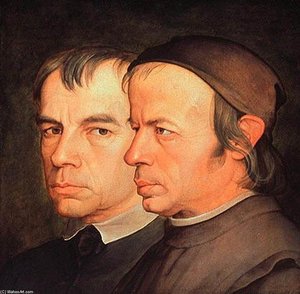
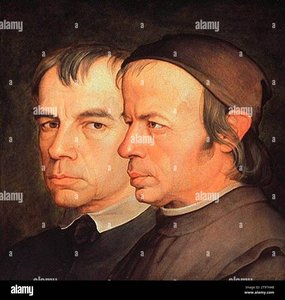
The breadth of his technical skill is further evidenced by his contributions to portraiture and printmaking. His ability to capture the human essence was particularly evident in works like 'The Eberhard Brothers', where he utilized the dramatic interplay of light and shadow—a hallmark of the Romantic style—to imbue his subjects with a sense of psychological depth and narrative mystery. Whether working on the delicate surface of an ivory-wove paper lithograph or the robust texture of an oil on canvas, Ramboux maintained a commitment to a certain artistic idealism that sought to elevate the subject matter beyond the mundane.
As we reflect on the historical significance of Anton Alban Ramboux, we see an artist who successfully navigated the complexities of a changing Europe. His work remains a testament to a period when art was deeply entwined with identity, faith, and a burgeoning love for the natural world. His legacy lives on in the museums of Cologne, Berlin, and Düsseldorf, where his paintings continue to whisper stories of devotion, tradition, and the timeless beauty of the German landscape.
anton (alban) ramboux
1790 - 1866 , Germany
Quick Facts
- Artistic Movement Or Style: Nazarene
- Artists Or Movements Influenced By This Artist: ['Romanticism']
- Artists Who Influenced This Artist:
- Jean-Henri Gilson
- Jacques-Louis David
- Date Of Birth: October 5, 1790
- Date Of Death: October 2, 1866
- Full Name: Johann Anton Alban Ramboux
- Nationality: German
- Notable Artworks:
- Rebecca & Eliezer at the Well
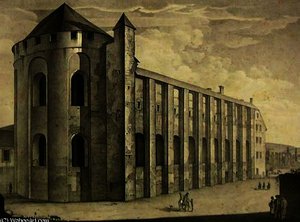
- Exterior View Of The Imperial Baths In Trier
- Place Of Birth: Trier, Germany
Related Articles

Anton von Werner: Imperial Painter, Historical Witness & Shifting German Identity
Explore the life & work of Anton von Werner, Imperial Germany's leading painter. Discover his dramatic depictions of war, unification, and court life – a fascinating insight into 19th-century German history & art.

German Expressionism's 10 Defining Masterpieces | Art for Your Home
Explore 10 defining German Expressionism masterpieces – from Munch's 'The Scream' to Kandinsky’s abstracts. Discover the artists, stories & bold colors behind this powerful art movement. Find museum-quality reproductions at ArtsDot.com.

Cultivating Serenity: An Exploration of Art's Role in Biophilic Design for Spa and Wellness Environments
Discover how biophilic design transforms spa & wellness spaces into havens of tranquility. Expert insights on natural materials, art, light & ROI for enhanced guest well-being. Learn more!
The Northern Awakening: Artistic Innovation & Cultural Transformation in the German Renaissance
Explore the artistic innovation of the German Renaissance! Discover Dürer, the Danube School & Reformation art. Learn about techniques, materials & lasting influence. Find museum-quality reproductions at ArtsDot.
Curating Serenity: A Designer's Guide to Transforming Wellness Centers with Masterpiece Reproductions
Elevate your wellness center with expert art curation. Discover how museum-quality masterpiece reproductions and bespoke murals create serene, restorative environments for luxury hospitality design.