 Preview
 Send
Send Share
Share
 Details

 Download
 Similars
 X-Ray
X-Ray Diaporama
Unsere Stube in Dauphin Street 67, New Orleans\n\nrecto


 Read More
Hand Made Oil Reproduction
Hand-painted oil on canvas in your size and frame, made to order by our artists. ( Buy Print Buy Image)




































Pick from our preset sizes that match the artwork's original proportions.

You may enter your own dimensions to fit a specific frame or space. If your selected size does not match the original image's proportions, we will either crop the artwork or extend the painting with additional hand-painted elements. A digital mockup will be sent for your approval before production begins.
Please note that the on-screen preview does not reflect the actual cropping or extension. Only the mockup will accurately show the final composition.
While custom sizes are available, we recommend selecting a dimension from the predefined list to preserve the original proportions.
After order, ArtsDot.com team will email client for instructions and provide a mockup preview
Worldwide Delivery () in 3/4 weeks instead of standard 5 weeks. (6 September). No compromise on quality.

Free Worldwide Express Shipping

High-Quality Linen Canvas

Full Shipping Insurance

Customs Tax Refund Guarantee

True Color Matching Guarantee

60-Day Return Policy (Defects Only)

100% Money-Back Guarantee

Bulk Discount Offer
 Glass option is only available in size under 110 CM

Unsere Stube in Dauphin Street 67, New Orleans\n\nrecto
Reproduction Medium
Reproduction Size
-


Total Price
$ 263
A Window into the Soul of Nineteenth-Century New Orleans
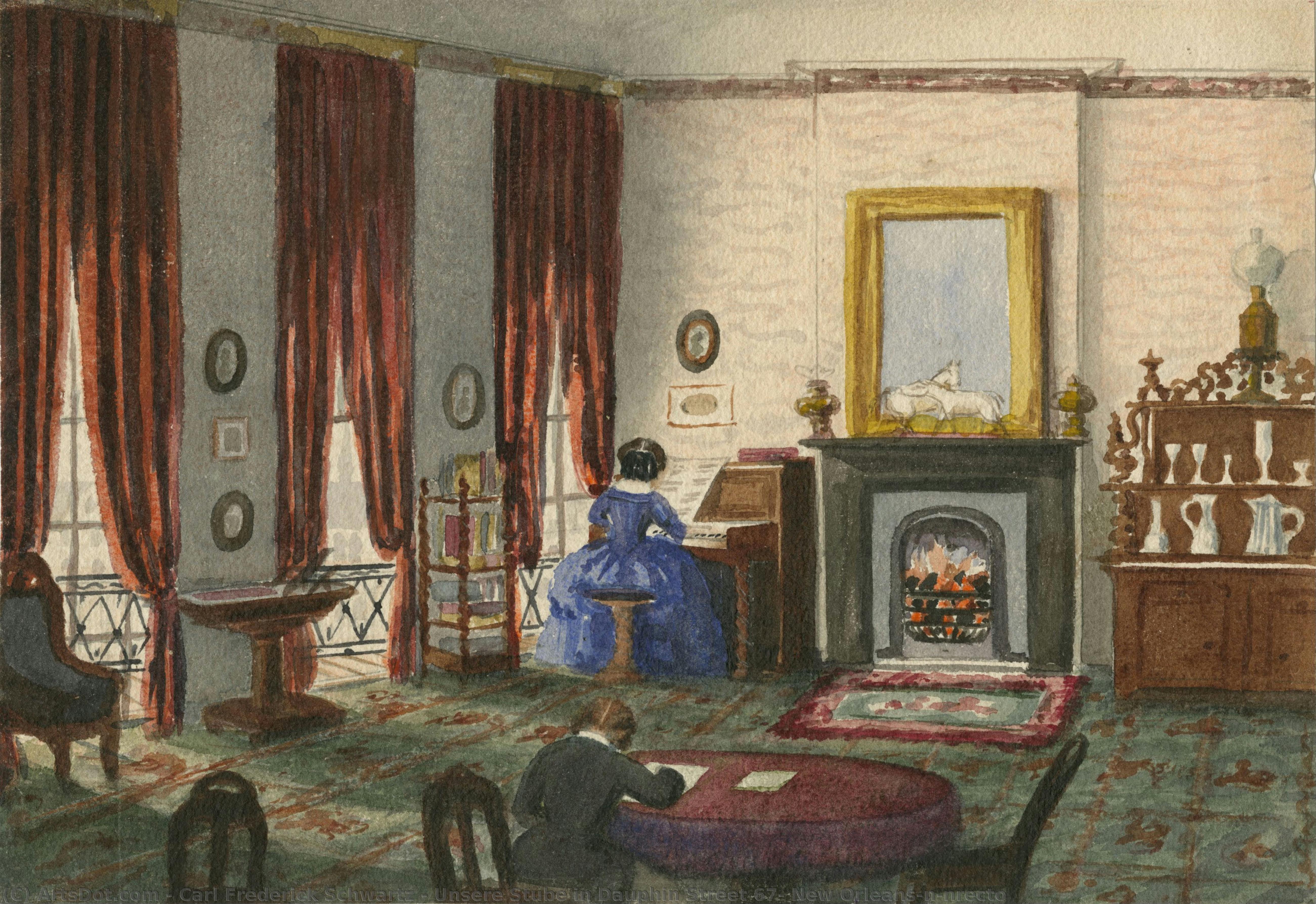
In the delicate, watercolor strokes of Carl Frederick Schwartz’s 1859 masterpiece, Unsere Stube in Dauphin Street 67, New Orleans, we are invited to step through a portal into a bygone era of Southern elegance and domestic tranquility. This exquisite work is far more than a mere architectural record; it is a tender, intimate portrait of a life lived with grace. The scene unfolds within a parlor that breathes with the warmth of a well-loved home, where the soft glow of a fireplace dances against the rich, crimson drapery framing the windows. Schwartz captures a moment of profound stillness—a woman lost in the melody of a piano and a child absorbed in the quiet magic of a book. Through his masterful use of light and shadow, the artist transforms a private interior into a universal stage for the beauty of everyday existence.
The technique employed by Schwartz reveals a sophisticated command of the watercolor medium, characterized by a meticulous attention to detail that borders on the photographic. Every element within the room—from the intricate ironwork of the balcony visible through the glass to the delicate porcelain pieces resting upon the dresser—is rendered with a precision that speaks to his dedication to American Realism. The artist utilizes a layered approach to color, allowing the deep reds of the curtains and the warm tones of the wooden furniture to create a sense of depth and tactile richness. This careful orchestration of texture and light creates a rhythmic visual flow, guiding the viewer's eye from the flickering hearth to the quiet corners of the bookshelf, ultimately settling on the human figures who anchor the composition with their peaceful presence.
Beyond its aesthetic splendor, the painting serves as a poignant historical document, capturing the unique cultural intersection of New Orleans in the mid-1800s. The German inscription on the reverse of the work hints at the immigrant narratives that shaped the city's vibrant tapestry, suggesting that this room was not just a space, but a sanctuary for a family far from their ancestral roots. There is a profound sense of nostalgia embedded in the brushwork; the presence of the horses and ginger jars on the mantelpiece acts as a subtle symbol of worldly connection and domestic stability. For the modern collector or interior designer, this piece offers more than just decoration; it provides an emotional anchor. A high-quality reproduction of this work brings a sense of storied history and quiet sophistication to any space, evoking a timeless atmosphere of comfort, warmth, and enduring elegance.
Related Artworks


Artist Biography
The Quiet Dignity of Domestic Realism
Carl Frederick Schwartz (1836-1889) remains a singular and evocative figure in the tapestry of American art history, a master who found profound beauty within the stillness of the everyday. Born in Reading, Ohio, Schwartz’s early life was marked by a contemplative atmosphere shaped by his Lutheran upbringing. While he initially considered a path toward theological studies alongside his brothers, his destiny was ultimately claimed by an innate, undeniable passion for visual representation. This transition from the spiritual to the observational allowed him to approach his subjects with a unique sense of reverence, treating the mundane corners of a home with the same sanctity one might find in a cathedral.
Schwartz’s artistic journey is most poignantly realized through his meticulous depictions of interior life. He possessed an extraordinary ability to transform domestic spaces into narratives of quiet dignity and historical weight. His most celebrated work, “Unsere Stube in Dauphin Street 67, New Orleans,” serves as a breathtaking window into the past, capturing the atmosphere of a Louisiana home with such remarkable precision that the viewer can almost feel the stillness of the room. Through his lens, the domestic sphere is not merely a setting, but a living character imbued with memory and light.
Influences and the Realist Tradition
The development of Schwartz’s style was deeply intertwined with the burgeoning American Realist movement, most notably influenced by the legendary Winslow Homer. Much like Homer, Schwartz embraced an unwavering commitment to portraying his subjects with unflinching honesty and a rigorous observational accuracy. He drew inspiration from the way Homer utilized light and composition to convey profound emotional resonance within seemingly simple scenes. By studying the techniques of masters who prioritized the tangible world over romanticized idealization, Schwartz learned to find the extraordinary within the ordinary.
This connection to the Realist tradition is evident in his technical approach to texture and atmosphere. Schwartz did not rely on flamboyant or distracting color schemes; instead, he mastered a muted, sophisticated palette of browns, creams, and ochres. This tonal harmony allowed him to focus the viewer's attention on the subtle interplay of light and shadow, creating immersive environments that feel palpably real. His work reflects a broader 19th-century aesthetic desire for artistic sincerity—a movement away from the theatrical and toward an engagement with the authentic, lived experience.
Legacy and Artistic Significance
The historical significance of Carl Frederick Schwartz lies in his ability to document the intimate textures of American life during a transformative era. While many artists of his time sought the grandeur of sweeping landscapes or epic historical battles, Schwartz found his purpose in the quiet corners of the home. His meticulous attention to detail—the way light falls across a wooden surface or the specific texture of a household object—serves as a vital historical record of 19th-century domesticity.
Schwartz’s achievements can be summarized through several key artistic contributions:
- Mastery of Interiority: He elevated the genre of interior painting, moving beyond mere documentation to create emotionally resonant spaces.
- Technical Precision: His ability to render light, shadow, and texture provided a sense of depth and realism that remains captivating to modern audiences.
- Tonal Harmony: Through his use of a restrained palette, he achieved a sense of peace and permanence in his compositions.
- Historical Preservation: His works act as poignant visual archives of American domestic life, particularly within the unique cultural landscape of New Orleans.
Today, the work of Carl Frederick Schwartz continues to resonate with those who find beauty in the subtle nuances of existence. He remains a testament to the power of the observant eye, reminding us that the most profound stories are often told in the quietest of rooms.

carl frederick schwartz
1836 - 1889 , United States of America
Quick Facts
- Artistic Movement Or Style: American Realism
- Artists Or Movements Influenced By This Artist: Frederic Remington
- Artists Who Influenced This Artist: Winslow Homer
- Date Of Birth: 1836
- Full Name: Carl Frederick Schwartz
- Nationality: American
- Notable Artworks: ['Unsere Stube in Dauphin Street 67, New Orleans']
- Place Of Birth: Reading, United States
Related Articles

Watercolor Wonders: 10 Masterpieces That Redefined Art History | ArtsDot
Journey through 10 legendary watercolor masterpieces by Sargent, Turner & Homer! Explore iconic landscapes, portraits & floral art that redefined history. Find museum-quality reproductions and curated decor ideas at ArtsDot.com.

Ephemeral Visions: Exploring the Artistic Legacy & Contemporary Practice of Watercolor Painting
Explore the captivating world of watercolor painting! Discover its rich history, essential techniques, influential artists & collecting tips. A comprehensive guide for art enthusiasts from ArtsDot.

Ephemeral Visions: Exploring the History & Emotional Resonance of Watercolor Painting
Explore the captivating history of watercolor painting, from ancient techniques to modern masters like Kandinsky & Blake. Discover essential artists, collecting tips & the emotional power of this luminous medium. Expert insights for art enthusiasts.

Ephemeral Visions: Exploring the Artistic Legacy & Nuances of Watercolor Painting
Explore the captivating world of watercolor painting! Discover its rich history, essential techniques, influential artists & collecting tips from art experts. A comprehensive guide for enthusiasts.
The Enduring Appeal of Watercolor: History, Techniques & Contemporary Practice
Explore the captivating world of watercolor painting! Discover its rich history, essential techniques, influential artists, and collecting tips. A comprehensive guide for art enthusiasts.