 Preview
 Send
Send Share
Share
 Details

 Download
 Similars
 X-Ray
X-Ray Diaporama
Therese Malfatti von Rohrenbach zu Dezza (1792-1851)


 Read More
Giclée / Art Print
Museum-quality giclée or canvas print with fast production and flexible finish options. ( Buy Hand Made Painting Buy Image)




P118B $10

P118H $10

P118W $10

P438Z $10

P508JH $12

P508YH $12

P805H $10

P805Z $10

P919BZ $10

P919G $10

P919XJ $10

P959ZH $10

P968JZ $12

W106C $8

W218G $10

W218JH $8

W218Y $10

W307PJ $10

W316G $10

W316PJ $8

W316Y $10

W398PJ $8

W4111J $10

W500HY $15

W500JH $15

W692G $12

W849H $8

W940BG $15

W953PJ $8




Pick from our preset sizes that match the artwork's original proportions.

You may enter your own dimensions to fit a specific frame or space. If your selected size does not match the original image's proportions, we will either crop the artwork or extend the image with a mirrored or solid-fill edge. A digital mockup will be sent for your approval before production begins.
Please note that the on-screen preview does not reflect the actual cropping or extension. Only the mockup will accurately show the final composition.
While custom sizes are available, we recommend selecting a dimension from the predefined list to preserve the original proportions.
Worldwide Delivery () in 2 weeks instead of standard 4/5 weeks. (26 August)

Free Worldwide Express Shipping

High-Quality Linen Canvas

Full Shipping Insurance

Customs Tax Refund Guarantee

True Color Matching Guarantee

60-Day Return Policy (Defects Only)

100% Money-Back Guarantee

Bulk Discount Offer
 Glass option is only available in size under 110 CM

Therese Malfatti von Rohrenbach zu Dezza (1792-1851)
Giclée / Art Print
Reproduction Size
-


Total Price
$ 63
Collectible Description
Therese Malfatti von Rohrenbach zu Dezza (1792-1851): A Portrait Steeped in Beethovenian Reverie
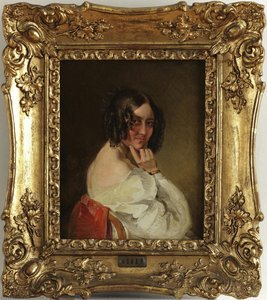
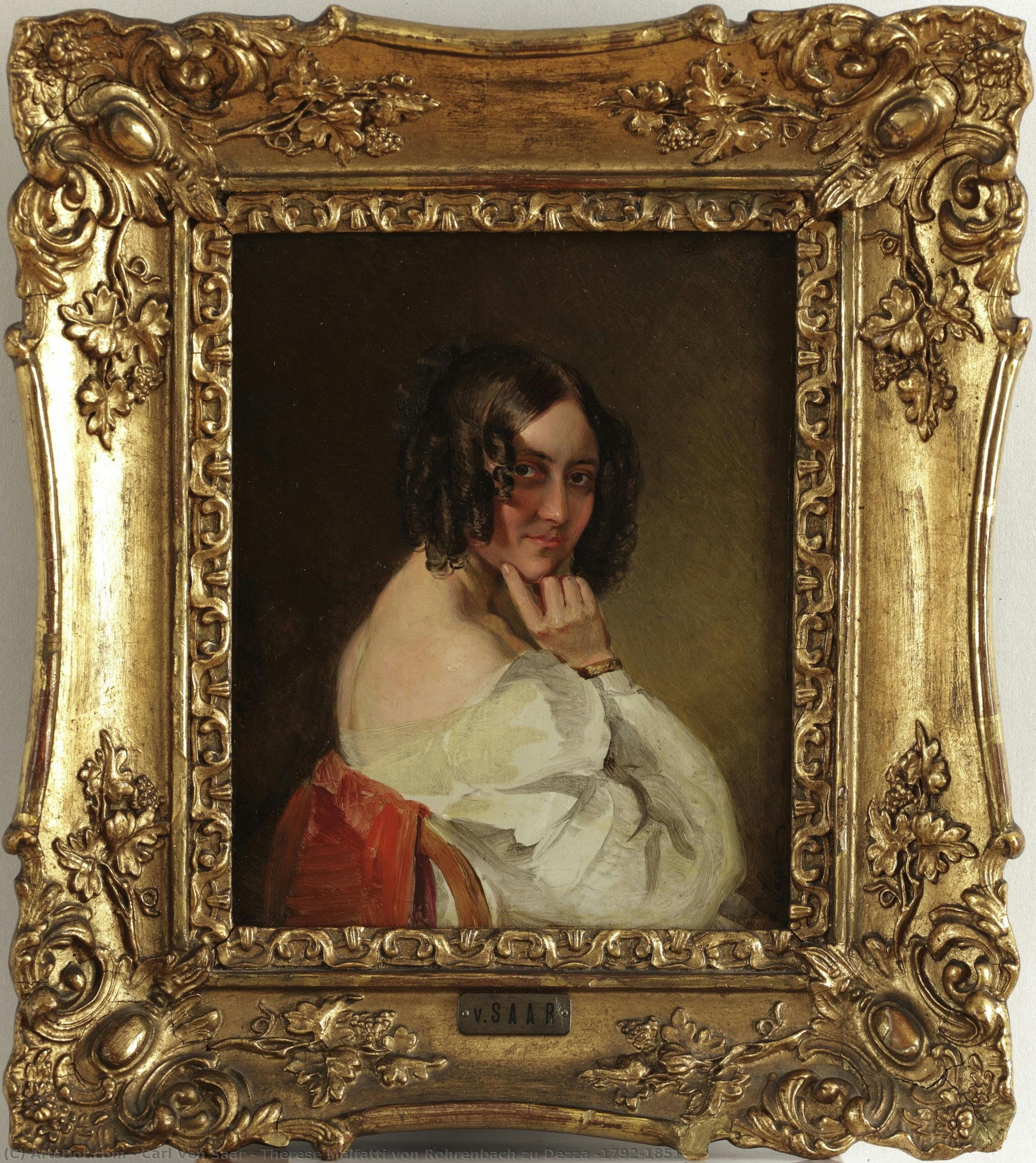
Carl von Saar’s depiction of Therese Malfatti, painted in 1834, transcends mere likeness; it embodies a poignant moment captured within the orbit of Ludwig van Beethoven's life. This exquisite miniature portrait resides at Bonn’s Beethoven Haus, offering visitors a glimpse into the artistic milieu that nurtured both composer and subject.
- Subject Matter: The painting portrays Therese Malfatti, niece to Johann Baptist Malfatti—a physician renowned for his humanitarian endeavors—and a woman deeply admired by Beethoven himself. Their friendship blossomed around 1808, fueled by shared intellectual curiosity and culminating in Beethoven’s audacious proposal of marriage.
- Style: Saar's signature style is characterized by its meticulous realism combined with an understated elegance typical of Viennese portraiture during the Romantic era. He prioritized capturing subtle nuances of expression—a downward gaze, a hint of serenity—to convey Therese’s inner state.
Technique: Saar employed oil paint on canvas, utilizing delicate brushstrokes to achieve remarkable tonal gradation and textural detail. The artist skillfully rendered the luminous quality of Therese's skin tone and the subtle sheen of her dress fabric, demonstrating mastery over chiaroscuro—the interplay between light and shadow—a technique favored by Romantic painters.
Historical Context: Painted against the backdrop of Beethoven’s turbulent personal life and artistic breakthroughs, the portrait reflects the broader cultural currents of its time. The Romantic movement championed emotion and individualism, influencing Saar's approach to portraying human subjects with sensitivity and psychological depth. It speaks to a fascination with beauty and melancholy—themes prevalent in Beethoven’s compositions.
Symbolism: Beyond capturing Therese’s physical appearance, Saar subtly imbued the painting with symbolic resonance. The downward gaze suggests introspection and contemplation, mirroring Beethoven's own preoccupation with profound philosophical questions. Furthermore, the ornate frame—featuring gilded accents—underscores the portrait’s status as a treasured heirloom, symbolizing enduring admiration and artistic legacy.
Emotional Impact: Viewing Saar’s Therese Malfatti is an exercise in empathetic observation. The painting evokes feelings of quiet grace, wistful longing, and perhaps even unspoken affection—capturing the essence of Beethovenian reverie and reminding us that art possesses the power to transcend time, conveying emotions that endure across generations.
- Provenance: Currently housed at Bonn’s Beethoven Haus, this portrait exemplifies Saar's dedication to documenting artistic circles of his era.
Saar’s Therese Malfatti stands as a testament to the Romantic ideal—a celebration of beauty intertwined with psychological insight. It invites contemplation and inspires appreciation for the enduring power of art to illuminate the human spirit.
Related Artworks


Artist Biography
Carl von Saar: Life and Legacy
Carl von Saar (1797-1853) was a renowned Austrian painter celebrated for his elegant and meticulously crafted miniatures and portraits. Though not as widely recognized today as some of his contemporaries, Saar held a respected position within the Viennese art community during his lifetime.
Early Life and Training
Details regarding Carl von Saar’s early life remain somewhat scarce. Born in Austria in 1797, he demonstrated an aptitude for painting from a young age. His formal training is not extensively documented; however, it's clear he developed significant skill in capturing realistic likenesses and refined details – hallmarks of his later work.
Artistic Style and Influences
Saar’s artistic style is characterized by its realism and attention to detail. He excelled at miniature painting, a demanding art form requiring exceptional precision and technical skill. His portraits possess an elegance and refinement that reflect the aesthetic sensibilities of the Biedermeier period. While specific influences are difficult to pinpoint definitively, it’s likely he was influenced by prevailing artistic trends in Vienna, including portraiture traditions and the emphasis on meticulous observation.
Major Achievements and Exhibitions
Saar's primary achievements lie in his consistent production of high-quality miniatures and portraits. He regularly exhibited his work at the prestigious Vienna Künstlerhaus between 1822 and 1845, gaining recognition from peers and patrons. These exhibitions provided a platform for showcasing his talent and establishing his reputation within the Austrian art scene.
Themes and Subjects
- Portraiture: The vast majority of Saar’s known works are portraits, depicting members of Viennese society.
- Miniatures: He specialized in miniature painting, creating small-scale but highly detailed representations of individuals.
- Realism: A commitment to accurately capturing the likeness and character of his subjects is evident throughout his oeuvre.
Historical Significance
Carl von Saar’s significance lies in his contribution to the tradition of realist portraiture in 19th-century Austria. His work provides valuable insights into the social customs, fashion, and artistic tastes of the period. While he may not have revolutionized painting, his dedication to technical skill and refined aesthetics ensured his place as a respected artist within his time.
Legacy
Though less known today than some of his contemporaries, Carl von Saar’s work continues to be appreciated by art enthusiasts and collectors. His miniatures and portraits offer a glimpse into the lives and appearances of individuals from 19th-century Vienna, preserving a piece of Austrian history through artistic representation.
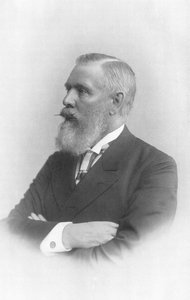
Carl von Saar
1797 - 1853 , Austria
Quick Facts
- Birth_Date: 1797
- Birth_Place: Austria
- Death_Date: 1853
- Movement: Realism, Miniature Painting
- Name: Carl von Saar
- Nationality: Austrian
- Notable_Works: Miniatures and Portraits (exhibited at Vienna Künstlerhaus)
Related Articles
Eugen von Blaas: Capturing Alpine Life & Sentiment in 19th-Century Austrian Painting
Discover the captivating world of Eugen von Blaas! Explore his exquisite 19th-century paintings capturing Venetian life & Alpine beauty. Learn about his Academic Classicism style and find museum-quality reproductions at ArtsDot.
Franz von Stuck: Symbolism, Decadence & the Pursuit of Ideal Beauty
Explore the captivating world of Franz von Stuck, a leading Symbolist painter. Discover his mythological masterpieces, decadent themes, & investment potential. Expert analysis for discerning collectors.
Carl Eduard Schuch: Bridging Realism & Symbolism in Late 19th-Century Austrian Painting
Explore the captivating landscapes & still lifes of Carl Eduard Schuch (1846-1903), a pivotal Austrian painter bridging realism and modernism. Discover his influences, unique style, and lasting legacy with ArtsDot.
Sir Hubert von Herkomer: A Life Painted with Realism, Ambition & Victorian Art
Explore the life & art of Sir Hubert von Herkomer, a pivotal Victorian realist painter. Discover his powerful portraits, social commentary & pioneering film work. Learn about his legacy and find high-quality reproductions at ArtsDot.
Hans von Aachen: Mannerism's Courtly Visionary & Imperial Portraiture
Explore the captivating world of Hans von Aachen, a leading Mannerist painter renowned for his exquisite imperial portraits & mythological scenes. Discover his legacy and influence on 16th-century European art.