 Preview
 Send
Send Share
Share
 Details

 Download
 Similars
 X-Ray
X-Ray Diaporama
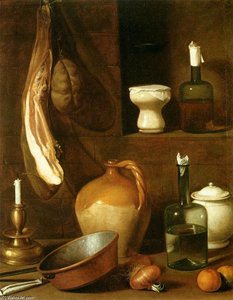
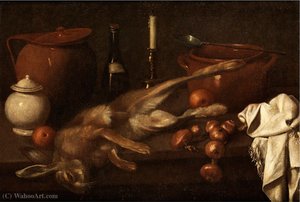
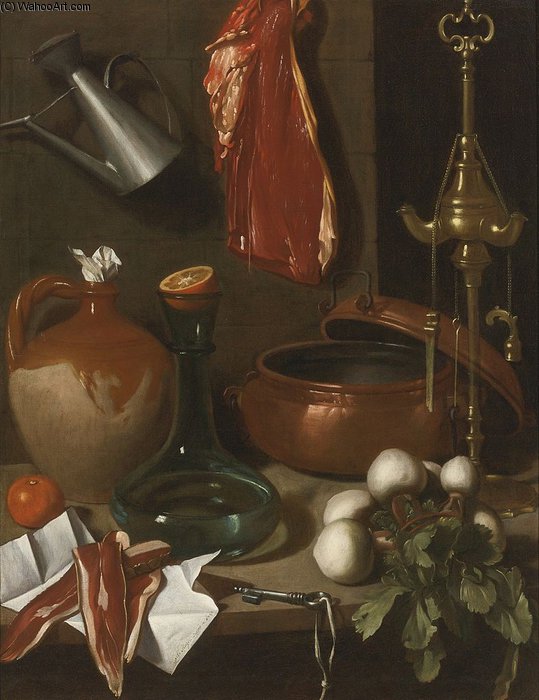
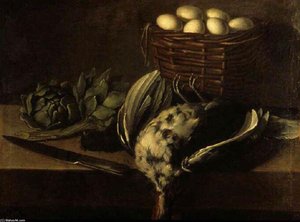
A Kitchen Still Life With Hung Meat

 Read More
Hand Made Oil Reproduction
Hand-painted oil on canvas in your size and frame, made to order by our artists. ( Buy Print Buy Image)




































Pick from our preset sizes that match the artwork's original proportions.

You may enter your own dimensions to fit a specific frame or space. If your selected size does not match the original image's proportions, we will either crop the artwork or extend the painting with additional hand-painted elements. A digital mockup will be sent for your approval before production begins.
Please note that the on-screen preview does not reflect the actual cropping or extension. Only the mockup will accurately show the final composition.
While custom sizes are available, we recommend selecting a dimension from the predefined list to preserve the original proportions.
After order, ArtsDot.com team will email client for instructions and provide a mockup preview
Worldwide Delivery () in 3/4 weeks instead of standard 5 weeks. (17 August). No compromise on quality.

Free Worldwide Express Shipping

High-Quality Linen Canvas

Full Shipping Insurance

Customs Tax Refund Guarantee

True Color Matching Guarantee

60-Day Return Policy (Defects Only)

100% Money-Back Guarantee

Bulk Discount Offer
 Glass option is only available in size under 110 CM

A Kitchen Still Life With Hung Meat
Reproduction Medium
Reproduction Size
-


Total Price
$ 263
Related Artworks
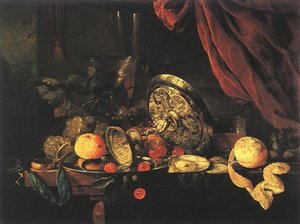
Artist Biography
Giovanni Battista Piranesi: Architect of Dreams
Born in Venice in 1720, Giovanni Battista Piranesi’s life was a fascinating confluence of artistic ambition, architectural training, and an almost obsessive fascination with the ruins of ancient Rome. More than simply an artist, he considered himself an architect, a scholar, and a visionary—a belief that profoundly shaped his unique and enduring legacy. His work, particularly his intricate etchings of Roman architecture and fantastical “prisons,” continues to captivate audiences today, offering glimpses into a mind brimming with imagination and a deep reverence for the past.
Piranesi’s early life was steeped in the traditions of Venetian craftsmanship. He received practical training in stonemasonry and building techniques from his father, a skilled builder, and later benefited from instruction in perspective construction and stage design—skills that would prove invaluable in his later artistic endeavors. Crucially, he also developed a profound appreciation for classical antiquity through his brother, who instilled within him a passion for Roman history and culture. This foundation, combined with his apprenticeship under Giuseppe Vasi, the foremost producer of etched views of Rome, provided Piranesi with both the technical expertise and the intellectual framework to embark on his extraordinary artistic journey.
The Etching Process and Architectural Visions
Piranesi’s mastery lay in his innovative use of etching—a medium he embraced not merely as a means of reproduction but as a tool for creating entirely new worlds. Unlike earlier engravers who primarily copied existing works, Piranesi used etching to explore spatial illusion, architectural fantasies, and the evocative power of atmosphere. He meticulously studied ancient Roman architecture, painstakingly documenting its details through drawings and sketches, which he then translated into intricate etchings. His process involved multiple plates, often working with a technique called “drypoint,” which produced rich, velvety lines—a characteristic that lends his prints a remarkable sense of texture and depth.
However, Piranesi’s work extended far beyond faithful reproductions. He frequently combined accurate depictions of Roman ruins with fantastical elements—creating elaborate, labyrinthine prisons (“Carceri d'invenzione”) that seemed to defy the laws of physics and logic. These imaginary spaces, filled with towering columns, crumbling arches, and echoing corridors, served as metaphors for the human condition—reflecting themes of confinement, isolation, and the enduring power of memory. His “Vedute” (views) of Rome were equally groundbreaking, capturing the city’s grandeur and decay with a dramatic intensity that set them apart from earlier topographical prints.
Key Works and Influences
Piranesi's output is vast and varied, encompassing architectural studies, fantastical prisons, and meticulously detailed depictions of Roman ruins. Among his most celebrated works are the *Carceri d’invenzione* (Prisons of Invention), a series of etchings depicting elaborate subterranean complexes—the *Le Saturne*, *Le Antiche Geminate*, and *Le Cancelli*. These prints, characterized by their claustrophobic spaces and haunting atmosphere, remain among his most enduring achievements. His *Vedute di Roma* (Views of Rome) are equally significant, offering a comprehensive visual record of the city’s architecture and landscape. His work was influenced by several sources: the classical ideals of Roman architecture, the principles of perspective developed by Renaissance artists like Brunelleschi, and the innovative techniques of Venetian printmakers such as Canaletto and Tiepolo.
Furthermore, Piranesi's fascination with antiquity stemmed from a broader intellectual movement—the Neoclassical revival that swept through Europe in the 18th century. This movement sought to emulate the art and architecture of ancient Greece and Rome, and Piranesi’s work played a crucial role in shaping European perceptions of classical civilization. His prints were widely disseminated throughout Europe, inspiring artists, architects, and scholars alike.
Legacy and Historical Significance
Giovanni Battista Piranesi died in Rome in 1778, leaving behind a remarkable body of work that continues to fascinate and inspire. Initially, his intricate etchings were not always appreciated for their artistic merit—they were often dismissed as mere curiosities or fantasies. However, in the late 19th and early 20th centuries, Piranesi’s work began to be recognized for its originality, technical brilliance, and profound psychological depth. Today, he is considered one of the most important printmakers of the 18th century—a visionary artist who transformed etching into a powerful medium for exploring themes of space, memory, and the human condition.
His influence extends far beyond the art world. Piranesi’s imaginative visions have resonated with writers, filmmakers, and architects alike, inspiring countless works that draw upon his unique blend of architectural grandeur and psychological intensity. The enduring appeal of his “prisons” speaks to a fundamental human desire for escape—a longing for realms both real and imagined.
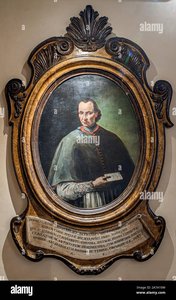
carlo magini
1720 - 1806 , Italy
Quick Facts
- Artistic Movement Or Style: Neoclassicism, Etcher
- Artists Or Movements Influenced By This Artist:
- Goethe
- Canaletto
- Artists Who Influenced This Artist:
- Giuseppe Vasi
- Tiepolo
- Date Of Birth: 4 October 1720
- Date Of Death: 9 November 1778
- Full Name: Giovanni Battista Piranesi
- Nationality: Italian
- Notable Artworks:
- Le Carceri d'Invenzione
- Vedute di Roma
- Place Of Birth: Venice, Italy
Related Articles

Baroque Masterpieces: 10 Paintings That Defined an Era |
Journey through the drama & grandeur of Baroque art! Explore 10 masterpieces by Caravaggio, Rembrandt, Rubens & more. Discover stunning oil paintings, rich colors & timeless stories. Find museum-quality reproductions at .

Baroque Drama: Bringing Opulence & Emotion into Contemporary Interiors
Explore the opulent world of Baroque interior design! Discover key elements, modern applications & how to bring dramatic elegance into your home with 's authentic reproductions.

The Dramatic Flourish: Exploring the Baroque Movement's Enduring Legacy in Art History
Explore the dramatic world of Baroque art! Discover iconic artists like Caravaggio & Rubens, defining techniques, and its lasting impact on art history. Expert insights for collectors & enthusiasts at ArtsDot.
Silent Narratives: Exploring the Enduring Appeal of Still Life Painting Across Centuries
Explore the rich history of still life painting with ArtsDot. Discover Dutch Masters, decode vanitas symbolism & learn about collecting timeless art. Expert insights and museum-quality reproductions.

Simon Vouet: A Baroque Master's Journey from Italian Influence to French Classicism
Explore the life & art of Simon Vouet, a pivotal French Baroque painter who introduced Italian styles to France. Discover his masterpieces and lasting influence on 17th-century art.