![Los Trabajos De Persiles Y Sigismunda (trans. The Trials Of Persiles And Sigismunda) (biblioteca Nacional De España)\n\n[2] — Cervantes Saavedra, Miguel](/media/artworks/images-full/26/7f/267f133b319594bc551d1a3b07da3b2c.jpg)
 Preview
 Send
Send Share
Share
 Details

 Download
 Similars
 X-Ray
X-Ray Diaporama
Los trabajos de Persiles y Sigismunda (trans. The Trials of Persiles and Sigismunda) (Biblioteca Nacional de España)\n\n[2]


 Read More
Giclée / Art Print
Museum-quality giclée or canvas print with fast production and flexible finish options. ( Buy Hand Made Painting Buy Image)




P118B $10

P118H $10

P118W $10

P438Z $10

P508JH $12

P508YH $12

P805H $10

P805Z $10

P919BZ $10

P919G $10

P919XJ $10

P959ZH $10

P968JZ $12

W106C $8

W218G $10

W218JH $8

W218Y $10

W307PJ $10

W316G $10

W316PJ $8

W316Y $10

W398PJ $8

W4111J $10

W500HY $15

W500JH $15

W692G $12

W849H $8

W940BG $15

W953PJ $8




Pick from our preset sizes that match the artwork's original proportions.

You may enter your own dimensions to fit a specific frame or space. If your selected size does not match the original image's proportions, we will either crop the artwork or extend the image with a mirrored or solid-fill edge. A digital mockup will be sent for your approval before production begins.
Please note that the on-screen preview does not reflect the actual cropping or extension. Only the mockup will accurately show the final composition.
While custom sizes are available, we recommend selecting a dimension from the predefined list to preserve the original proportions.
Worldwide Delivery () in 2 weeks instead of standard 4/5 weeks. (28 August)

Free Worldwide Express Shipping

High-Quality Linen Canvas

Full Shipping Insurance

Customs Tax Refund Guarantee

True Color Matching Guarantee

60-Day Return Policy (Defects Only)

100% Money-Back Guarantee

Bulk Discount Offer
 Glass option is only available in size under 110 CM

Los trabajos de Persiles y Sigismunda (trans. The Trials of Persiles and Sigismunda) (Biblioteca Nacional de España)\n\n[2]
Giclée / Art Print
Reproduction Size
-


Total Price
$ 63
Los Trabajos de Persiles y Sigismunda: A Window Into Cervantes’s Vision
The scanned page from “Los trabajos de Persiles y Sigismunda” by Miguel de Cervantes Saavedra isn't merely a depiction of a book; it’s a tangible fragment of Spain’s Golden Age, encapsulating the intellectual fervor and artistic ambition that defined the era. Published in 1617, just a year after Cervantes’s passing, this monumental work represents his final testament to literary innovation—a culmination of decades dedicated to crafting narratives that challenged conventions and explored the complexities of human experience. Examining its visual elements offers invaluable insight into Cervantes's artistic sensibilities and the broader cultural landscape of his time.A Detailed Examination of Composition & Imagery
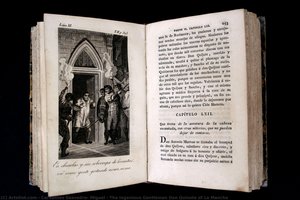
The image itself is dominated by a meticulously reproduced title page, showcasing the ornate typography characteristic of 17th-century printing. The bold lettering proclaims “Los trabajos de Persiles y Sigismunda,” immediately establishing the subject matter—a retelling of Homer’s *Odyssey* infused with Cervantes's trademark blend of realism and fantastical elements. Below the title resides a sprawling text block detailing dedications to Count Lemos and outlining the publishing circumstances, emphasizing the importance placed on disseminating Cervantes’s work. However, it is the central illustration that truly commands attention. A man and woman stand beneath a bird perched atop a branch—a motif frequently employed in Renaissance art to symbolize aspiration, divine grace, and the interconnectedness of humanity and nature. The intricate decorative border surrounding the image speaks volumes about the artistic sensibilities prevalent during Cervantes’s lifetime – a testament to the meticulous craftsmanship demanded by the printing press.Technique & Material Considerations
The artwork's aesthetic is rooted in letterpress printing—a technique renowned for its precision and durability. The paper itself bears the marks of age, exhibiting subtle creases and discoloration that underscore its history as an antique book. Dark brown ink meticulously applied to the text and illustration captures the nuances of Cervantes’s handwriting and the stylistic choices favored by his printers. Careful attention was paid to detail—the shading within the bird's plumage and the delicate rendering of the branch contribute to a palpable sense of realism, despite the fantastical narrative unfolding beneath. The texture of the paper – reminiscent of parchment – evokes the materiality of scholarly texts from Cervantes’s era.Historical Context & Literary Significance
“Los trabajos de Persiles y Sigismunda” emerged during Spain's Golden Age—a period characterized by unparalleled artistic and intellectual flourishing. Cervantes’s reimagining of Homer’s *Odyssey* wasn’t simply a retelling; it was an audacious critique of heroic ideals, presenting characters grappling with moral dilemmas and confronting the limitations of human ambition. This work solidified Cervantes’s position as the father of the modern novel—a genre that prioritizes psychological realism and explores the inner lives of its protagonists. Its influence can be traced across subsequent literary movements, cementing Cervantes's legacy as one of the most transformative figures in European literature.Symbolism & Emotional Resonance
The bird perched atop a branch serves as more than just an ornamental element; it embodies profound symbolic meaning—representing divine providence and guiding humanity towards enlightenment. The depiction of man and woman underscores the importance of companionship and mutual support, mirroring themes explored throughout Cervantes’s oeuvre. Ultimately, “Los trabajos de Persiles y Sigismunda” transcends its narrative content to convey a powerful emotional resonance—a meditation on faith, resilience, and the enduring quest for meaning in life. It remains an inspiring reminder that even amidst adversity, creativity and intellectual curiosity can illuminate the path forward.Related Artworks

![Autograph Statement Requesting That The Guarantee Provided Be Considered Sufficient (biblioteca Nacional De España)\n\n[page 1] — Cervantes Saavedra, Miguel](/media/artworks/images-thumb/be/4d/be4d8356b5c62cf26a2aac9cd48fa43b.jpg)
![Vida De Miguel De Cervantes Saavedra (life Of Miguel De Cervantes Saavedra). Book V Of The Edition Of Don Quixote (biblioteca Nacional De España)\n\n[7] — Martín Fernández De Navarrete Y Ximénez De Tejada, Academic Art](/media/artworks/images-thumb/8c/b6/8cb67a4dd450447373a546c8dd039e57.jpg)
![La Verdadera Patria De Miguel De Cervantes (miguel De Cervantes’s True Homeland) (biblioteca Nacional De España)\n\n[4][fol.1] — Pedro José García Balboa, Baroque Rococo Revival](/media/artworks/images-thumb/a6/d8/a6d842058b3ffb23732e0ff43fd89aac.jpg)
Artist Biography
Miguel de Cervantes Saavedra: The Architect of Modern Literature
Miguel de Cervantes Saavedra (1547-1616) stands as an unparalleled figure in the annals of literature, rightfully crowned as Spain’s greatest writer and arguably one of the world's most influential novelists. His magnum opus, *Don Quixote*, transcends mere storytelling; it fundamentally reshaped the genre, establishing itself as the progenitor of the modern novel and securing its place amongst the literary titans of all time—a testament lauded by authors like Tolstoy and Dickens themselves. Born in Alcalá de Henares, Spain, Cervantes’s life unfolded amidst considerable hardship and obscurity, a stark contrast to the enduring legacy he bequeathed upon humanity.- Early Life & Education: Cervantes received his initial education at Universidad Complutense, where he studied theology—a path that ultimately proved unsuccessful for him due to financial constraints. Despite facing difficulties securing stable employment, he honed his skills as a soldier and traveled extensively throughout Europe during the turbulent years of the Thirty Years’ War, experiences which would profoundly shape his worldview and fuel his imaginative prowess.
- Literary Beginnings & Early Works: Cervantes began his literary career with poems and plays—often overshadowed by his later fame—demonstrating a versatility that foreshadowed his future accomplishments. However, it was *La Novela Ejemplar* (*Concerning Notable Novels*) which garnered initial recognition, showcasing his mastery of prose style and exploring themes of chivalry and idealism. Tragically, many of these early works vanished into obscurity, leaving only fragments to tantalize scholars.
Don Quixote: A Revolution in Narrative Form
Published in two parts between 1605 and 1615, *Don Quixote* irrevocably altered the conventions of storytelling. Departing from the episodic romances prevalent at the time, Cervantes crafted a sprawling narrative characterized by psychological depth, realistic portrayal of characters, and intricate plot development—elements that would become hallmarks of the modern novel. The tale chronicles the delusional adventures of Alonso Quijano, an aging nobleman who embarks on a quest to revive chivalric ideals after indulging in fantastical tales of knights errant. Through Sancho Panza’s pragmatic foil, Cervantes deftly juxtaposes idealism and reality, prompting readers to contemplate the nature of illusion and perception.- Themes & Symbolism: *Don Quixote* delves into profound philosophical questions concerning human ambition, disillusionment, and the importance of imagination. The windmill obsession serves as a potent symbol of Quijano’s futile pursuit of unattainable goals—a motif that resonates across centuries and continues to inspire interpretations.
- Renaissance & Baroque Influences: Cervantes's work embodies both Renaissance humanist ideals and Baroque stylistic flourishes. His meticulous attention to detail, combined with vivid descriptions of landscapes and characters, reflects the Baroque fascination for grandeur and emotion—a deliberate contrast to the restrained aesthetic sensibilities of earlier periods.
Legacy & Historical Significance
Cervantes’s influence extends far beyond the literary realm. His novel established a new standard for narrative complexity and psychological realism, shaping subsequent generations of writers and cementing his position as a cornerstone of Western literature. More than simply recounting a fantastical adventure, *Don Quixote* offered a nuanced critique of societal values and explored the human condition with unparalleled sensitivity—a timeless masterpiece that continues to captivate audiences worldwide. His enduring fame is reflected in the phrase “the language of Cervantes,” signifying his indelible mark on Spanish culture and demonstrating the profound impact of his creative vision.- Influence on Subsequent Writers: Authors such as Dickens, Tolstoy, Kafka, and Márquez acknowledged Cervantes’s monumental contribution to literature, citing *Don Quixote* as a formative influence on their own artistic endeavors.
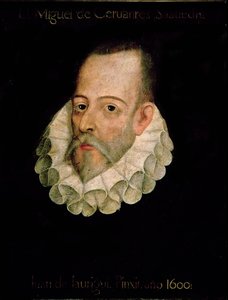
cervantes saavedra, miguel
1547 - 1616 , Spain
Quick Facts
- Artistic Movement Or Style: Renaissance & Baroque
- Artists Or Movements Influenced By This Artist: ['Romanticism']
- Artists Who Influenced This Artist: ['William Shakespeare']
- Date Of Birth: September 29, 1547
- Date Of Death: April 22, 1616
- Full Name: Miguel de Cervantes Saavedra
- Nationality: Spanish
- Notable Artworks: ['Don Quixote']
- Place Of Birth: Alcalá de Henares, Spain
Related Articles
Rafael de Penagos: A Study in Spanish Portraiture & Artistic Identity
Explore the life & art of Rafael de Penagos, a leading Spanish Art Deco illustrator. Discover his iconic 'Penagos Woman', commercial work, and lasting legacy. Learn about this pivotal figure in 20th-century Spanish art history.

The Golden Age Reforged: Dramatic Realism & Religious Zeal in Spanish Baroque Art
Explore the dramatic world of Spanish Baroque art! Discover masters like Zurbarán & the powerful influence of religious zeal on painting techniques – a guide for collectors and enthusiasts.
José Gutiérrez Solana: A Chronicle of Spanish Society Through Expressionist Vision
Explore the captivating world of José Gutiérrez Solana, a pivotal Spanish Expressionist painter. Discover his haunting depictions of early 20th-century Spain, influenced by Goya & El Greco. Learn about his key works and lasting legacy.
Manuel Benedito Vives: A Study of Light, Color & Emotional Resonance in Contemporary Spanish Painting
Explore the captivating world of Manuel Benedito Vives, a celebrated Spanish painter influenced by Sorolla. Discover his masterful portraits, luminous landscapes & enduring legacy – a favorite of the Spanish Royal Family. Art collectors will appreciate this in-depth study.

Prado Masterpieces: Explore 25 Iconic Artworks & Bring Spanish Beauty Home
Journey through 25 Prado Museum masterpieces! Explore Velázquez, Goya & El Greco's iconic Spanish art. Discover the stories behind these timeless paintings and find museum-quality reproductions for your home at ArtsDot.com.
![Los trabajos de Persiles y Sigismunda (trans. The Trials of Persiles and Sigismunda) (Biblioteca Nacional de España)\n\n[2]](/media/artworks/images-thumb/24/0d/240dd607a1820db624a8917b792ba42c.jpg)