 Preview
 Send
Send Share
Share
 Details

 Download
 Similars
 X-Ray
X-Ray Diaporama
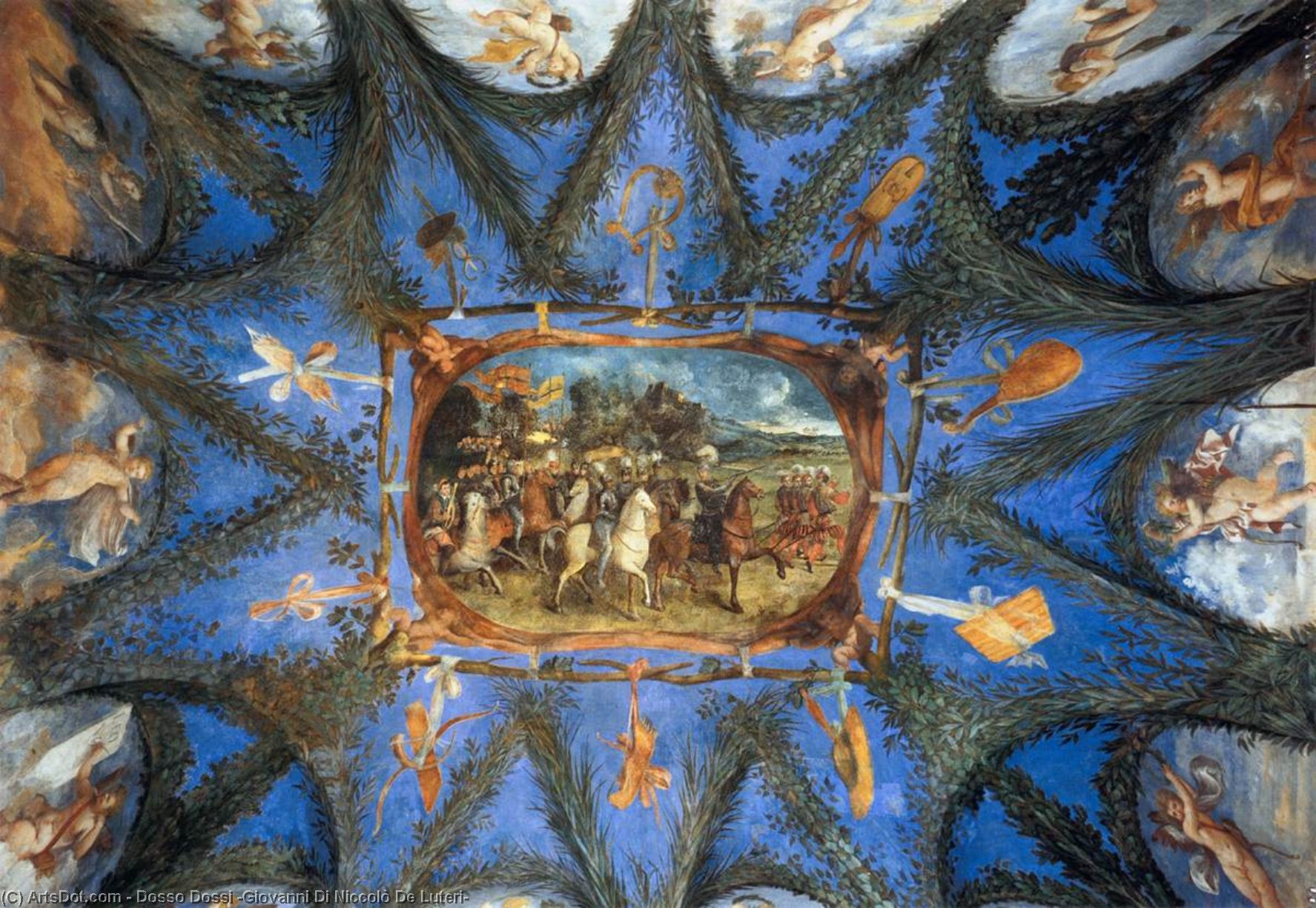
Francesco Maria della Rovere Leading His Troups

 Read More
Hand Made Oil Reproduction
Hand-painted oil on canvas in your size and frame, made to order by our artists. ( Buy Print Buy Image)




































Pick from our preset sizes that match the artwork's original proportions.

You may enter your own dimensions to fit a specific frame or space. If your selected size does not match the original image's proportions, we will either crop the artwork or extend the painting with additional hand-painted elements. A digital mockup will be sent for your approval before production begins.
Please note that the on-screen preview does not reflect the actual cropping or extension. Only the mockup will accurately show the final composition.
While custom sizes are available, we recommend selecting a dimension from the predefined list to preserve the original proportions.
After order, ArtsDot.com team will email client for instructions and provide a mockup preview
Worldwide Delivery () in 3/4 weeks instead of standard 5 weeks. (31 August). No compromise on quality.

Free Worldwide Express Shipping

High-Quality Linen Canvas

Full Shipping Insurance

Customs Tax Refund Guarantee

True Color Matching Guarantee

60-Day Return Policy (Defects Only)

100% Money-Back Guarantee

Bulk Discount Offer
 Glass option is only available in size under 110 CM

Francesco Maria della Rovere Leading His Troups
Reproduction Medium
Reproduction Size
-


Total Price
$ 363
A Grand Vision of Military Leadership: Francesco Maria della Rovere Leading His Troops
This magnificent fresco painting transports viewers to the heart of Renaissance Italy, showcasing a dynamic scene led by Francesco Maria della Rovere. The artwork’s grandeur is immediately apparent through its elaborate architectural framework and the central oval vignette depicting the military leader at the head of his troops. This isn't merely a depiction of battle; it's a celebration of power, leadership, and perhaps a victorious campaign – a visual testament to Della Rovere's authority and prowess. The upward perspective, mimicking looking up at a ceiling, further enhances the sense of awe and importance associated with the subject. The composition’s complexity, with its intertwining foliage and playful putti, speaks to the refined tastes of the era and the desire for both power and beauty within courtly settings.Renaissance Mannerism & Dosso Dossi's Signature Style
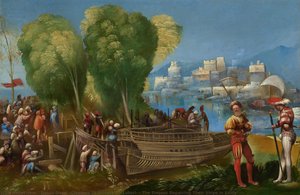
Painted by the renowned artist Dosso Dossi (Giovanni di Niccolò de Luteri), this fresco exemplifies the artistic style known as Renaissance Mannerism. Dossi, active in the vibrant cultural center of Ferrara during the 16th century, was celebrated for his distinctive approach – a blend of classical influences with a heightened sense of elegance and stylized forms. Notice how figures are elongated and imbued with a certain grace, characteristic of Mannerist aesthetics. The use of vibrant colors, particularly the dominant blues contrasted with warmer tones in the central scene, is also a hallmark of Dossi’s work. His attention to detail, evident in the rendering of foliage, clothing, and horses, elevates this fresco beyond a simple depiction into a richly textured visual experience. Comparing it to other works like "Apollo and Daphne" or "The Trojans Repairing Their Ships in Sicily" highlights his consistent focus on mythological narratives and elegant compositions.Technique & Materials: The Art of Fresco
This artwork’s enduring beauty is a testament to the fresco technique, an ancient method where pigments are applied directly onto wet plaster. This process creates a remarkably durable image that becomes integrated into the wall itself. The materials used – natural earth pigments, lime plaster, and potentially some gilding for highlights – contribute to the fresco's luminous quality and longevity. The diffused lighting characteristic of frescoes, reflecting from the ceiling, further enhances the sense of depth and grandeur within the scene. While appearing smooth at first glance, a closer examination reveals subtle variations in color and shading that create an illusion of texture on the plaster surface.Symbolism & Emotional Impact
Beyond its visual splendor, this fresco is rich with symbolic meaning. The putti (cherubic figures) scattered throughout the design represent innocence, beauty, and a divine presence – subtly reinforcing the legitimacy and righteousness of Della Rovere’s leadership. The lush foliage surrounding the central scene can be interpreted as symbolizing abundance, growth, or even protection. Emotionally, the artwork evokes a sense of grandeur, power, and celebration. The dynamic movement within the central vignette conveys action and triumph, while the ornate decoration speaks to opulence and prestige – reflecting the values and aspirations of Renaissance courtly life. This piece isn't just a historical record; it’s an embodiment of the era’s ideals of strength, beauty, and divine favor.Related Artworks




Artist Biography
The Visionary of Ferrara: The Life and Legacy of Dosso Dossi
In the golden age of the Italian Renaissance, amidst the courtly splendor of Ferrara, there emerged a painter whose brush possessed the power to weave dreams into reality. Giovanni di Niccolò de Luteri, known to history by his evocative moniker Dosso Dossi, was not merely a chronicler of myth, but a creator of entire atmospheric worlds. Born around 1489 in San Giovanni del Dosso, his very name carries the echoes of his origins, yet his artistic spirit wandered far beyond the borders of his birthplace. As a central figure of the Scuola di Ferrara, Dossi bridged the gap between the rigorous precision of the early Renaissance and the emotive, color-driven innovations that would soon define the Venetian school.
The foundations of Dossi’s mastery were laid through an apprenticeship that connected him to the giants of the previous generation. By studying under the meticulous Andrea Mantegna in Mantua, Dossi inherited a profound respect for classical structure and the complex geometry of perspective. However, where Mantegna sought clarity and sculptural permanence, Dossi pursued something far more elusive. He began to infuse his compositions with a soft, luminous quality that suggested movement and mystery, a development that would eventually see him standing alongside legends like Titian and Giorgione as a pioneer of a new, poetic visual language.
Mythological Grandeur and the Venetian Glow
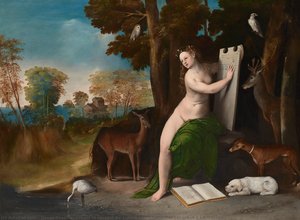
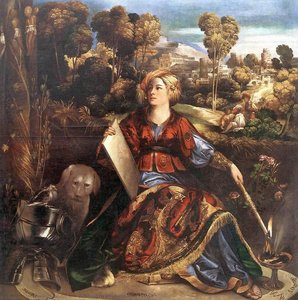
Dossi’s true brilliance flourished under the patronage of the Este court, particularly during the reign of Alfonso I d'Este. Within this sophisticated environment, he found the perfect subject matter: the complex, often eroticized, and deeply allegorical tales of classical mythology. His works, such as the enchanting Circe or Melissa, do not simply depict ancient legends; they inhabit them. He had a singular ability to blend the heroic with the supernatural, creating scenes where gods and nymphs appear to emerge from a twilight haze. This characteristic "dreamlike" quality was achieved through a masterful use of atmospheric perspective, where distant landscapes dissolve into soft blues and muted greens, pulling the viewer into a state of quiet contemplation.
The influence of Venice is unmistakable in Dossi’s mature style. He moved away from the hard outlines of his Mantuan training toward a more fluid, painterly approach characterized by rich, saturated pigments and a preoccupation with light. This Venetian influence allowed him to manipulate color to evoke mood rather than just form. In his hands, light does not merely illuminate a scene; it transforms it, casting shadows that hide secrets and highlights that suggest the divine. His ability to harmonize the structural discipline of the Ferrara school with the chromatic warmth of Venice made his oeuvre uniquely captivating and difficult to replicate.
A Lasting Impression on the Renaissance Canvas
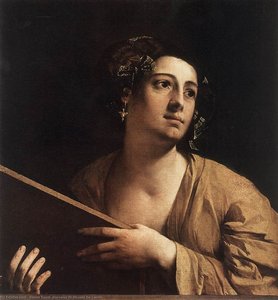
The historical significance of Dosso Dossi lies in his role as a transitional master who helped steer Italian art toward the expressive freedom of Mannerism. His works, ranging from grand frescoes like Francesco Maria della Rovere Leading His Troops to intimate, enigmatic portraits and sibyls, demonstrate a versatility that challenged the boundaries of contemporary painting. He mastered the art of the allegory, using mythological figures to communicate complex political and humanist ideas favored by the Ferrarese elite.
Though his life ended in 1542, leaving behind a legacy etched in the very fabric of the Renaissance, Dossi’s impact remains profound. His contributions can be summarized through several key artistic achievements:
- The Synthesis of Styles: Successfully merging the structural precision of Mantegna with the atmospheric lyricism of the Venetian masters.
- Atmospheric Innovation: Pioneering a use of landscape and light that prioritized emotional resonance and psychological depth over strict realism.
- Narrative Allegory: Elevating mythological painting through the creation of complex, dreamlike narratives that served both courtly prestige and humanist inquiry.
- The Ferrara Identity: Establishing the School of Ferrara as a distinct and vital force in the Italian Renaissance landscape.
Today, when we gaze upon the swirling shadows and luminous textures of a Dossi masterpiece, we are not just looking at paint on canvas; we are witnessing the enduring power of a visionary who taught the world how to see the magic hidden within the classical past.

dosso dossi (giovanni di niccolò de luteri)
1486 - 1542 , Italy
Quick Facts
- Artistic Movement Or Style: School of Ferrara
- Artists Who Influenced This Artist:
- Giorgione
- Titian
- Date Of Birth: c. 1489
- Date Of Death: 1542
- Full Name: Giovanni di Niccolò de Luteri
- Nationality: Italian
- Notable Artworks:
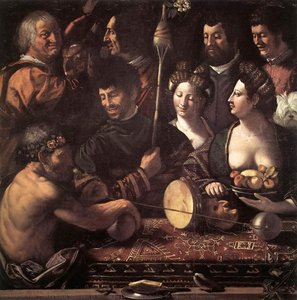
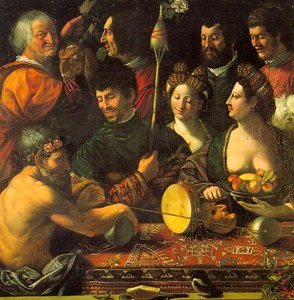
- Witchcraft (Allegory of Hercules)
- Circe (or Melissa)
- Jupiter, Mercury and the Virtue
- Place Of Birth: San Giovanni del Dosso, Italy
Related Articles

Slate Blue Masterpieces: 10 Iconic Paintings & Timeless Home Decor Ideas
Immerse yourself in the captivating world of slate blue! Explore 10 iconic paintings by Monet, Van Gogh & Renoir. Discover their stories, techniques & find museum-quality art reproductions for your home at .

The Fresco as Family Legacy: Preserving Heritage Through Wall Art
Explore the rich history & enduring legacy of fresco painting. Discover how to preserve family heritage through stunning wall art. Expert insights & restoration guidance.

Serene Blue Backgrounds: Discover Soulful Art to Transform Your Space with Timeless Elegance
Transform your home with soulful blue art. From serene Monet impressions to modern textured sculptures, discover curated masterpieces designed to inspire calm. Explore expert art consultations and bespoke hand-painted reproductions to create your personal sanctuary.

The Enduring Legacy of Fresco Painting: Techniques, History & Contemporary Relevance
Explore the rich history & enduring artistry of fresco painting – from Giotto to Michelangelo! Discover techniques, conservation efforts, & modern applications. Learn how ArtsDot brings this timeless art form to your home.

The Enduring Legacy of Fresco: Technique, History & Artistic Expression Across Cultures
Explore the rich history & enduring legacy of fresco painting! Discover ancient techniques, Giotto's masterpieces, and modern applications. Expert insights for art lovers & professionals.