 Preview
 Send
Send Share
Share
 Details

 Download
 Similars
 X-Ray
X-Ray Diaporama
Temporal Gradual (detail)
 Renaissance
 1720
1720 593.0 x 432.0 cm
 Biblioteca Statale
 Read More
Hand Made Oil Reproduction
Hand-painted oil on canvas in your size and frame, made to order by our artists. ( Buy Print Buy Image)




































Pick from our preset sizes that match the artwork's original proportions.

You may enter your own dimensions to fit a specific frame or space. If your selected size does not match the original image's proportions, we will either crop the artwork or extend the painting with additional hand-painted elements. A digital mockup will be sent for your approval before production begins.
Please note that the on-screen preview does not reflect the actual cropping or extension. Only the mockup will accurately show the final composition.
While custom sizes are available, we recommend selecting a dimension from the predefined list to preserve the original proportions.
After order, ArtsDot.com team will email client for instructions and provide a mockup preview
Worldwide Delivery () in 3/4 weeks instead of standard 5 weeks. (22 August). No compromise on quality.

Free Worldwide Express Shipping

High-Quality Linen Canvas

Full Shipping Insurance

Customs Tax Refund Guarantee

True Color Matching Guarantee

60-Day Return Policy (Defects Only)

100% Money-Back Guarantee

Bulk Discount Offer
 Glass option is only available in size under 110 CM

Temporal Gradual (detail)
Reproduction Medium
Reproduction Size
-


Total Price
$ 288
Artwork Description
The Artist and Her Work
Eufrasia Burlamacchi was born in Lucca, Italy, and became a Dominican nun at a young age. She is known for her remarkable illuminated manuscripts, which are characterized by their intricate designs, vibrant colors, and gold leaf decorations. The Temporal Gradual is one of her most notable works, created in the early 16th century.Features of the Painting
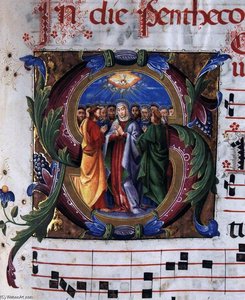
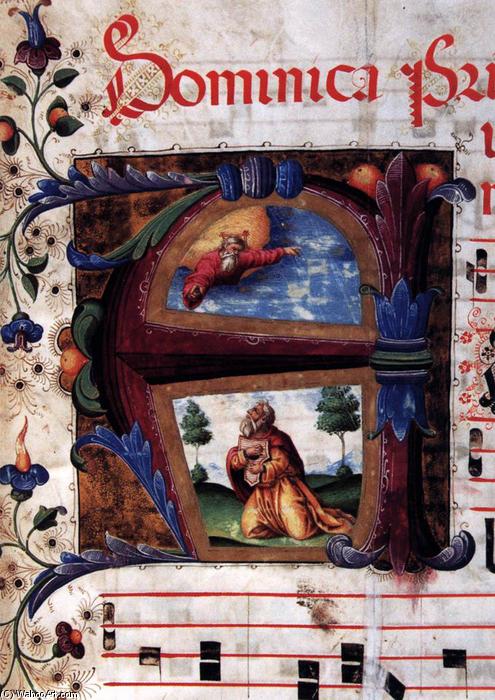
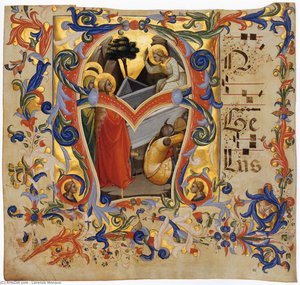
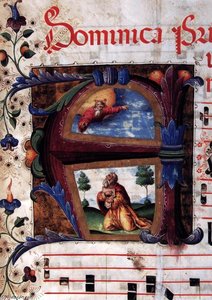
The Temporal Gradual is a large manuscript, measuring 593 x 432 cm, and is housed at the Biblioteca Statale in Lucca, Italy. The painting features a central image of three figures, including a man in red robes kneeling before an angel or saint, surrounded by intricate borders and decorations. The use of illumination techniques, such as gold leaf and vibrant colors, adds to the overall beauty and grandeur of the piece.Importance and Legacy
The Temporal Gradual is not only a masterpiece of Renaissance art but also an important example of the artistic achievements of women during this period. Eufrasia Burlamacchi's work has been recognized and admired by art historians and enthusiasts alike, and her legacy continues to inspire artists and art lovers today. For more information on Eufrasia Burlamacchi and her works, visit /art/list/?Filter=Eufrasia-Burlamacchi. To learn more about the Biblioteca Statale and its collection, see https://en.wikipedia.org/wiki/Biblioteca_Statale_di_Lucca.Some of the key features of the Temporal Gradual include:
- Intricate borders and decorations
- Use of gold leaf and vibrant colors
- Central image of three figures, including a man in red robes kneeling before an angel or saint
Related Artworks
Artist Biography
A Sacred Radiance: The Life and Art of Eufrasia Burlamacchi
In the quiet, cloistered corridors of Renaissance Italy, where the scent of incense met the meticulous scratch of quill on parchment, lived a woman whose artistry bridged the gap between the earthly and the divine. Eufrasia Burlamacchi (c. 1482–1548) was not merely a nun, but a luminous presence in the history of manuscript illumination. Born into the prestigious and wealthy Burlamacchi lineage in Lucca, her life was shaped by the profound intersection of familial duty and spiritual devotion. As a member of a family deeply embedded in the political and religious fabric of the Republic of Lucca, her transition into the Dominican Order was both a personal calling and a reflection of the era's shifting religious tides.
The early sixteenth century was a period of intense spiritual fervor, heavily influenced by the reformist zeal of Girolamo Savonarola. Following her entry into monastic life, Burlamacchi became a central figure in the Convent of San Domenico in Lucca—a sanctuary established specifically for those adhering to Savonarolan ideals. Within these walls, art was not an ornament but an act of evangelism. The convent maintained a distinguished school of illumination, a tradition where the painstaking application of gold leaf and vibrant pigments served as a visual prayer. For Burlamacchi, every stroke of color was an expression of the Dominican tenets: charity, poverty, study, and evangelism.
The Mastery of Light and Gold
Burlamacchi’s artistic development was nurtured by the rigorous traditions of her convent, yet her work possesses a singular vitality that transcends mere imitation. She specialized in the delicate art of decorating religious texts, most notably through her completion of five books of anthems between 1502 and 1515. Her technique involved a masterful command of illumination, utilizing intricate gold leaf decorations to capture and reflect candlelight, creating an ethereal glow that seemed to animate the sacred words on the page. This use of light was deeply symbolic, representing the divine presence permeating the physical world.
One of her most breathtaking achievements is the Temporal Gradual, a masterpiece of Renaissance illumination. This large-scale manuscript serves as a testament to her technical prowess and her ability to weave complex narratives through imagery. The work is characterized by:
- Intricate Borders: Elaborate decorative margins that frame sacred texts with botanical and geometric precision.
- Vibrant Color Palettes: A rich use of pigments that brought the theological themes of the liturgy to life.
- Symbolic Figures: Central imagery, such as figures in liturgical robes kneeling before celestial beings, which invited the viewer into a state of meditative contemplation.
A Legacy Written in Gold
Though much of Burlamacchi’s work has been weathered by the centuries, her historical significance remains undiminished. She stands as a rare and vital example of a female artist operating within the structured confines of the Renaissance convent system. While many women of her era were denied access to public artistic stages, the monastic scriptorium provided Burlamacchi with a unique space for intellectual and creative agency. Her work was not only used for personal devotion but was also duplicated by her fellow nuns to be shared with local communes, spreading the aesthetic and spiritual influence of Lucca far beyond the convent walls.
Today, the memory of Eufrasia Burlamacchi survives through the surviving fragments of her illuminated treasures, such as those housed in the Biblioteca Statale in Lucca. Her life reminds us that even within the most disciplined and restrictive environments, the human spirit can find a way to shine through, leaving behind a legacy of beauty that continues to illuminate the history of Western art.
Eufrasia Burlamacchi
1482 - 1548 , Italy
Quick Facts
- Artistic Movement Or Style: Renaissance Art
- Artists Or Movements Influenced By This Artist: ['Savonarola']
- Date Of Birth: ca. 1482
- Date Of Death: 1548
- Full Name: Eufrasia Burlamacchi
- Nationality: Italian
- Notable Artworks: ['Temporal Gradual']
- Place Of Birth: Lucca, Italy
Related Articles
High Medieval Art: 10 Masterpieces That Shaped an Era | ArtsDot
Journey through High Medieval Art! Explore 10 iconic masterpieces – from Giotto's frescoes to stunning Gothic cathedrals. Discover the stories behind these timeless paintings, sculptures & illuminated manuscripts. Find museum-quality art reproductions at ArtsDot.com.
Illuminating Faith & Power: A Journey Through Medieval Art (c. 500 – c. 1500)
Explore the rich history of Medieval Art (c. 500 – c. 1500) with ArtsDot. Discover Byzantine mosaics, Gothic cathedrals & Renaissance masterpieces. Expert insights & museum-quality reproductions.
Late Medieval Masterpieces: 10 Artworks That Defined an Era | ArtsDot
Journey through 10 defining Late Medieval masterpieces – from Giotto's frescoes to Jan van Eyck’s realism. Explore the stories, techniques & vibrant colors of Gothic art. Find museum-quality reproductions and elevate your home decor with ArtsDot.com! Discover all masterpieces on ArtsDot.com
Early Medieval Art: 10 Masterpieces That Shaped a New World | ArtsDot
Journey through 10 stunning Early Medieval masterpieces – from the Book of Kells to Carolingian mosaics. Explore art history, symbolism & find museum-quality reproductions for your home at ArtsDot.com. Discover all masterpieces online!
Sacred Narratives Embodied: A Comprehensive Exploration of Religious Iconography in Art History
Explore the rich history of religious iconography in art! Discover symbolism, movements & masterpieces from Byzantine to Renaissance periods. Expert insights for collectors and enthusiasts at ArtsDot.