 Preview
 Send
Send Share
Share
 Details

 Download
 Similars
 X-Ray
X-Ray Diaporama
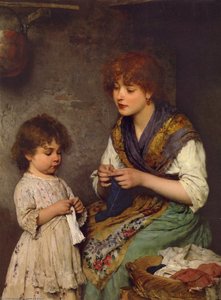
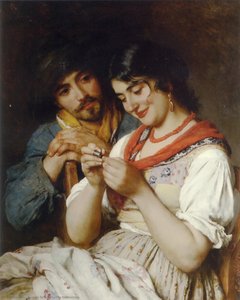
Mother's Little Helper


 Read More
Hand Made Oil Reproduction
Hand-painted oil on canvas in your size and frame, made to order by our artists. ( Buy Print Buy Image)




































Pick from our preset sizes that match the artwork's original proportions.

You may enter your own dimensions to fit a specific frame or space. If your selected size does not match the original image's proportions, we will either crop the artwork or extend the painting with additional hand-painted elements. A digital mockup will be sent for your approval before production begins.
Please note that the on-screen preview does not reflect the actual cropping or extension. Only the mockup will accurately show the final composition.
While custom sizes are available, we recommend selecting a dimension from the predefined list to preserve the original proportions.
After order, ArtsDot.com team will email client for instructions and provide a mockup preview
Worldwide Delivery () in 3/4 weeks instead of standard 5 weeks. (17 August). No compromise on quality.

Free Worldwide Express Shipping

High-Quality Linen Canvas

Full Shipping Insurance

Customs Tax Refund Guarantee

True Color Matching Guarantee

60-Day Return Policy (Defects Only)

100% Money-Back Guarantee

Bulk Discount Offer
 Glass option is only available in size under 110 CM

Mother's Little Helper
Reproduction Medium
Reproduction Size
-


Total Price
$ 338
Artwork Description
Mother's Little Helper by Eugen von Blaas: A Glimpse of Domestic Bliss
- Artist: Eugen von Blaas (1843-1932)
- Date: 1884
- Medium: Oil on panel
- Size: Unknown
Subject and Composition
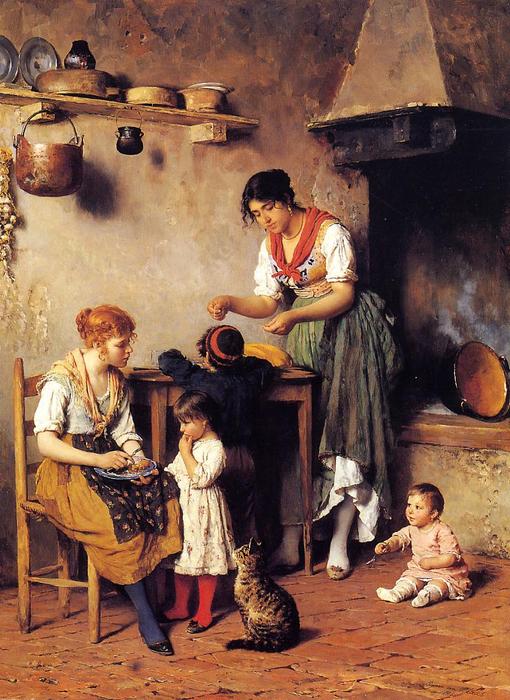
“Mother’s Little Helper,” painted in 1884 by Eugen von Blaas, offers a tender portrayal of domestic life. The artwork depicts a mother lovingly attending to her two young children within the cozy confines of a rustic kitchen. The composition is carefully structured around this central familial interaction. A triangular arrangement emphasizes the mother at the apex, with her children forming the base, drawing the viewer's eye directly to their connection. Supporting details like pots and pans artfully arranged on shelves add depth and contribute to the overall narrative of everyday life in a humble home.
Style and Technique: Academic Realism
Von Blaas’s style is firmly rooted in late 19th-century academic realism, characterized by its meticulous attention to detail and idealized representation. Drawing inspiration from Dutch Golden Age genre painting, the work focuses on capturing scenes of everyday life with a sense of authenticity and grace. The technique involves careful brushwork and subtle blending, creating a luminous quality through the likely use of glazes. The artist demonstrates mastery of light and shadow, enhancing the realism and depth of the scene. Lines are soft and blended, avoiding sharp outlines to create a gradual transition between forms.
Color Palette and Emotional Impact
The color palette is dominated by earthy tones – browns, greens, and creams – evoking a sense of warmth and tranquility. Touches of red in the mother's scarf and clothing accents provide subtle visual interest. This restrained yet harmonious use of color contributes to the painting’s rustic feel and reinforces the theme of domestic comfort. The diffused, natural lighting entering from an unseen source on the left illuminates the figures and objects within the kitchen, casting soft shadows that add depth and dimension. The overall effect is one of profound tenderness and familial love, evoking feelings of warmth, security, and contentment.
Symbolism and Historical Context
“Mother’s Little Helper” reflects a broader cultural fascination with idealized depictions of family life during the late 19th century. It portrays an image of domestic harmony and maternal devotion that resonated with Victorian values. The presence of a cat adds a touch of domesticity and charm, further enhancing the scene's appeal. The painting’s focus on everyday moments elevates the ordinary to the realm of art, celebrating the beauty and importance of family life within a humble setting.
Related Artworks


Artist Biography
Eugen von Blaas: A Venetian Master of Academic Classicism
Born in Albano, near Rome, in 1843, Eugen de Blaas (later known as Eugene von Blaas) emerged from a family steeped in artistic tradition. His father, Karl von Blaas, was himself a respected painter and professor at the Academy of Venice, providing young Eugen with an unparalleled foundation in art history, fresco techniques, and the principles of classical composition. This familial influence profoundly shaped his artistic trajectory, leading him to embrace the tenets of Academic Classicism – a style characterized by meticulous detail, idealized forms, and a reverence for historical and mythological subjects.
Eugen’s early years were spent immersed in the vibrant atmosphere of Venice, a city he would come to both paint and deeply admire. Moving with his family to the lagoon city as a child, he absorbed its unique culture, architecture, and social customs. This intimate connection to Venice became the cornerstone of his artistic output, informing his choice of subject matter and his distinctive visual language. Unlike many of his contemporaries who sought to capture fleeting moments or contemporary scenes, Blaas consistently returned to depictions of Venetian life – particularly the elegant women of its aristocratic circles – offering a carefully constructed and idealized vision of this captivating city.
The Art of Venetian Genre Scenes
Blaas’s artistic career blossomed in the late 19th century, a period marked by significant shifts in European art. While Impressionism was gaining momentum elsewhere, Blaas remained firmly rooted in Academic Classicism, producing a body of work that is both meticulously detailed and imbued with a sense of romantic nostalgia. His most celebrated works fall into the category of “genre scenes,” which capture everyday moments within Venetian society. These aren’t raw depictions of life; rather, they are carefully staged vignettes, often featuring wealthy women in elaborate costumes, engaging in leisurely activities like shopping, attending social gatherings, or simply enjoying the beauty of their surroundings.
His paintings frequently showcase a remarkable attention to detail – from the shimmering fabrics and intricate jewelry worn by his subjects to the meticulously rendered architecture and atmospheric lighting. Blaas’s use of color is particularly noteworthy; he employs rich, saturated hues to evoke the warmth and luminosity of the Venetian sun, creating scenes that are both visually stunning and emotionally resonant. He was a master of capturing the essence of aristocratic Venice, presenting an idealized image of wealth, beauty, and social grace.
Key Works and Artistic Style
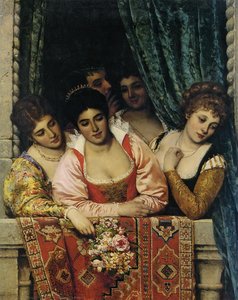
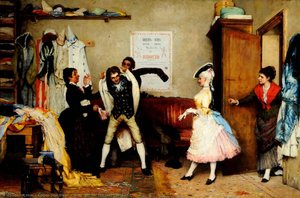
Among Blaas’s most iconic paintings are “Mother’s Little Helper” (1884), which offers a charming glimpse into a rustic Venetian kitchen scene, and “On the Balcony” (1877), a vibrant depiction of a fashionable gathering on a balcony overlooking the canals. “La forma nuziale in sacrestia” is another notable example, portraying a bridal ceremony within a church sacristy with remarkable precision and elegance. These works exemplify his signature style – characterized by its meticulous realism, balanced composition, and subtle emotional depth.
His artistic development can be traced through a progression from more overtly classical subjects to increasingly intimate depictions of Venetian life. While he continued to paint portraits throughout his career, it was his genre scenes that ultimately cemented his reputation as one of the most accomplished artists of his generation. He skillfully blended historical influences with contemporary observation, creating works that are both timeless and deeply rooted in their specific context.
Legacy and Historical Significance
Eugen von Blaas’s work represents a fascinating intersection of artistic tradition and cultural identity. His commitment to Academic Classicism provided him with the technical skills and formal training necessary to excel as a painter, while his deep affection for Venice infused his art with a unique sense of place and atmosphere. His paintings offer valuable insights into the social customs, fashion trends, and aesthetic sensibilities of 19th-century Venetian society.
Despite not achieving widespread fame during his lifetime, Blaas’s work has since been recognized for its artistic merit and historical significance. His paintings are now housed in prestigious museums and private collections around the world, serving as a testament to his enduring legacy as one of Venice's most celebrated artists. His meticulous attention to detail, coupled with his evocative depictions of Venetian life, continue to captivate audiences today.
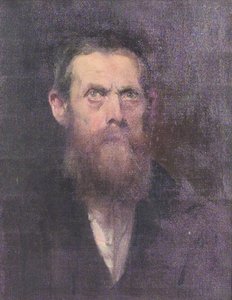
eugen von blaas
1843 - 1932 , Italy
Quick Facts
- Artistic Movement Or Style: Academic Classicism
- Artists Or Movements Influenced By This Artist: ['Academic Art']
- Artists Who Influenced This Artist: ['Karl von Blaas']
- Date Of Birth: July 24, 1843
- Date Of Death: February 10, 1931
- Full Name: Eugen von Blaas
- Nationality: Italian
- Notable Artworks:
- Mother's Little Helper
- La forma nuziale in sacrestia
- La tombola in Campiello a Venezia
- Place Of Birth: Albano Laziale, Italy
Related Articles
Eugen von Blaas: Capturing Alpine Life & Sentiment in 19th-Century Austrian Painting
Discover the captivating world of Eugen von Blaas! Explore his exquisite 19th-century paintings capturing Venetian life & Alpine beauty. Learn about his Academic Classicism style and find museum-quality reproductions at ArtsDot.
Franz von Stuck: Symbolism, Decadence & the Pursuit of Ideal Beauty
Explore the captivating world of Franz von Stuck, a leading Symbolist painter. Discover his mythological masterpieces, decadent themes, & investment potential. Expert analysis for discerning collectors.
Sir Hubert von Herkomer: A Life Painted with Realism, Ambition & Victorian Art
Explore the life & art of Sir Hubert von Herkomer, a pivotal Victorian realist painter. Discover his powerful portraits, social commentary & pioneering film work. Learn about his legacy and find high-quality reproductions at ArtsDot.
Eugène Lami: A Study in Academic Eclecticism & the Rise of 19th-Century Decorative Art
Explore the captivating world of Eugène Lami, a pivotal 19th-century French painter. Discover his eclectic style blending Romanticism & Academic traditions in history, fashion, and literary illustrations. Learn about his legacy today!

Anton von Werner: Imperial Painter, Historical Witness & Shifting German Identity
Explore the life & work of Anton von Werner, Imperial Germany's leading painter. Discover his dramatic depictions of war, unification, and court life – a fascinating insight into 19th-century German history & art.