 Preview
 Send
Send Share
Share
 Details

 Download
 Similars
 X-Ray
X-Ray Diaporama
Geography of Plants near Ecuador


 Read More
Hand Made Oil Reproduction
Hand-painted oil on canvas in your size and frame, made to order by our artists. ( Buy Print Buy Image)




P118B $10

P118H $10

P118W $10

P438Z $10

P508JH $12

P508YH $12

P805H $10

P805Z $10

P919BZ $10

P919G $10

P919XJ $10

P959ZH $10

P968JZ $12

W106C $8

W218G $10

W218JH $8

W218Y $10

W307PJ $10

W316G $10

W316PJ $8

W316Y $10

W398PJ $8

W4111J $10

W500HY $15

W500JH $15

W692G $12

W849H $8

W940BG $15

W953PJ $8




Pick from our preset sizes that match the artwork's original proportions.

You may enter your own dimensions to fit a specific frame or space. If your selected size does not match the original image's proportions, we will either crop the artwork or extend the painting with additional hand-painted elements. A digital mockup will be sent for your approval before production begins.
Please note that the on-screen preview does not reflect the actual cropping or extension. Only the mockup will accurately show the final composition.
While custom sizes are available, we recommend selecting a dimension from the predefined list to preserve the original proportions.
After order, ArtsDot.com team will email client for instructions and provide a mockup preview
Worldwide Delivery () in 3/4 weeks instead of standard 5 weeks. (5 September). No compromise on quality.

Free Worldwide Express Shipping

High-Quality Linen Canvas

Full Shipping Insurance

Customs Tax Refund Guarantee

True Color Matching Guarantee

60-Day Return Policy (Defects Only)

100% Money-Back Guarantee

Bulk Discount Offer
 Glass option is only available in size under 110 CM

Geography of Plants near Ecuador
Reproduction Medium
Reproduction Size
-


Total Price
$ 263
A Vision of the Andean Wilderness
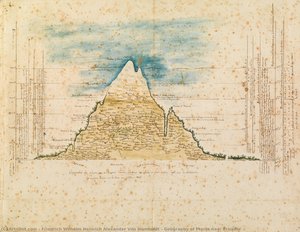
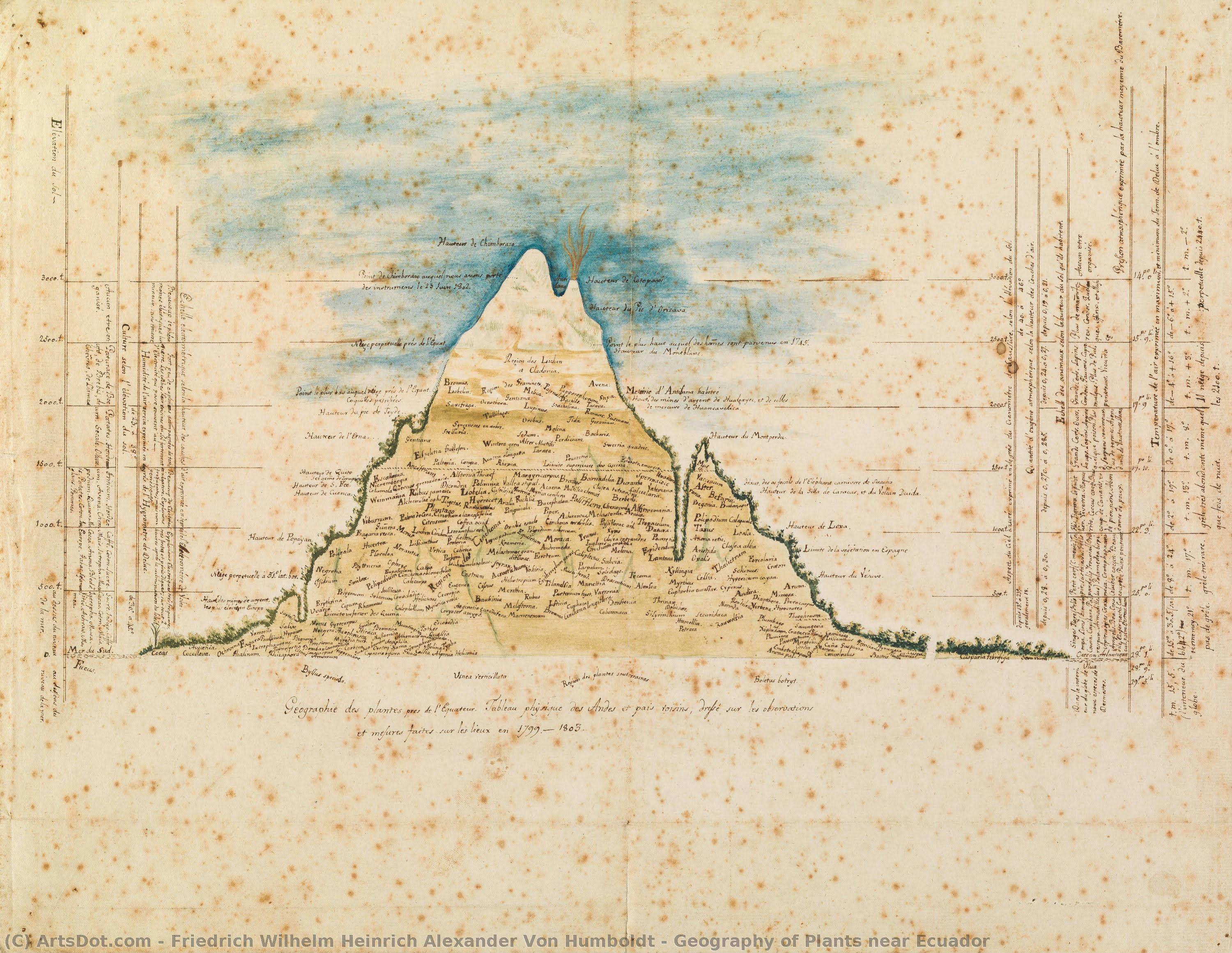
In the delicate, translucent layers of "Geography of Plants near Ecuador," we are transported back to the dawn of the nineteenth century, specifically to the year 1803. This exquisite watercolor, a product of the scientific and exploratory spirit of Friedrich Wilhelm Heinrich Alexander von Humboldt, serves as more than just a landscape; it is a window into a world where science and art were inextricably linked. The composition centers upon a majestic, towering mountain peak that dominates the horizon, its presence commanding respect and awe. Surrounding this central giant are undulating ridges and smaller peaks, creating a sense of profound depth and geological scale. Scattered throughout this rugged terrain are various trees and botanical elements, rendered with a precision that speaks to Humboldt’s legendary dedication to natural observation. The painting captures the raw, untamed essence of the Ecuadorian landscape, inviting the viewer to wander through a prehistoric wilderness where every leaf and stone tells a story of ecological interconnectedness.
The technique employed in this work is a masterclass in the subtle use of watercolor. Unlike the heavy, opaque strokes of oil painting, the medium here allows for a luminous quality, where light seems to filter through the very atmosphere of the Andes. The artist utilizes soft washes of color to build the misty, ethereal layers of distant mountains, creating an atmospheric perspective that pulls the eye deep into the heart of the range. There is a rhythmic flow to the brushwork, particularly in the way the foliage is depicted; it is not merely decorative but serves to ground the viewer within the specific biological reality of the region. For the discerning collector or interior designer, this piece offers a sophisticated balance of structural strength and delicate grace, making it an ideal focal point for spaces that celebrate natural elegance and intellectual curiosity.
Beyond its aesthetic beauty, "Geography of Plants near Ecuador" carries a deep historical and symbolic weight. Created during an era of great scientific discovery, the work embodies the Enlightenment ideal of documenting the world to understand our place within it. While Humboldt is primarily celebrated as a polymath and geographer, his ability to translate complex ecological data into evocative visual narratives has left an indelible mark on the history of landscape art. The painting symbolizes the harmony of the natural order—the way flora clings to the slopes and how topography dictates life. To possess a reproduction of this work is to hold a piece of scientific history; it is an invitation to contemplate the enduring majesty of our planet and the timeless human desire to map, name, and admire the wonders of the earth.
Related Artworks
Artist Biography
A Life Dedicated to Understanding the Interconnected World
Friedrich Wilhelm Heinrich Alexander von Humboldt, a name resonating with the spirit of scientific exploration and holistic understanding, was far more than simply a geographer or naturalist. Born in Berlin in 1769 into a family steeped in Prussian nobility and intellectual pursuit, Humboldt’s life became an extraordinary testament to the power of observation, meticulous documentation, and a profound belief in the interconnectedness of all things. He wasn't an artist wielding brushstrokes on canvas, yet his legacy is indelibly linked to visual representation – not through creation, but through inspiring it. His detailed maps, botanical illustrations born from exhaustive fieldwork, and evocative descriptions of landscapes fundamentally altered how we perceive and interact with the natural world.
Humboldt’s early life was shaped by a rigorous education orchestrated by his ambitious mother following the death of his father. Though initially steered towards a career in civil service, young Alexander's insatiable curiosity quickly led him down a different path. Mentored by figures like Marcus Herz, who instilled Enlightenment ideals, and Carl Ludwig Willdenow, who ignited a passion for botany, Humboldt developed an early penchant for collecting and classifying natural specimens – earning the endearing nickname “the little apothecary.” This youthful fascination foreshadowed a lifetime dedicated to unraveling the complexities of nature.
The American Journey: A Foundation for Modern Science
The pivotal moment in Humboldt’s career arrived with his ambitious expedition to Spanish America, undertaken between 1799 and 1804 alongside botanist Aimé Bonpland. This wasn't merely a voyage of discovery; it was a scientific undertaking of unprecedented scope and rigor. Traversing present-day Venezuela, Colombia, Cuba, and Mexico, Humboldt didn’t simply *describe* the landscapes he encountered – he meticulously *measured* them. He recorded altitude, temperature, magnetic declination, botanical distribution, and countless other data points with an accuracy previously unseen in scientific exploration.
This quantitative approach challenged prevailing scientific paradigms. Humboldt demonstrated how plant life wasn’t randomly distributed but intimately linked to environmental factors like altitude and climate – a cornerstone of what would become biogeography. He pioneered systematic methods for long-term observation of geomagnetic and meteorological phenomena, laying the groundwork for modern Earth sciences. His innovative use of isothermal lines on maps provided a visual language for understanding temperature distribution, transforming geographical representation.
Beyond Observation: A Holistic Vision of *Kosmos*
Humboldt’s influence extends far beyond specific discoveries. He championed a unified view of science, rejecting the compartmentalization of knowledge and emphasizing the interconnectedness of all natural phenomena. This holistic perspective culminated in his magnum opus, *Kosmos*, a five-volume work that sought to synthesize scientific understanding with artistic sensibility. He resurrected the ancient Greek term “cosmos” to describe the universe not as a collection of disparate parts, but as an interacting entity – a concept profoundly influential on subsequent ecological thought.
While not a painter himself, Humboldt understood the power of visual representation in communicating complex scientific ideas. His *Geography of Plants near Ecuador*, for example, is a striking artistic depiction born directly from his meticulous field observations. He commissioned artists to create illustrations that accurately reflected his findings, recognizing that art could be a powerful tool for both scientific dissemination and aesthetic appreciation.
A Lasting Legacy: The Father of Ecology and Environmentalism
Alexander von Humboldt’s impact resonated throughout the 19th century and continues to shape our understanding of the world today. He is rightfully considered “the father of ecology” and “the father of environmentalism” for his early recognition of human impacts on the environment and his advocacy for a more sustainable relationship with nature. His work inspired generations of scientists, explorers, artists, and thinkers – including Charles Darwin, whose own groundbreaking research was deeply influenced by Humboldt’s meticulous methodology and holistic worldview.
Humboldt's legacy isn’t confined to scientific circles. He fostered a greater appreciation for the diversity and fragility of our planet, laying the intellectual foundations for modern conservation efforts. His emphasis on interconnectedness reminds us that we are not separate from nature but an integral part of it – a lesson profoundly relevant in our current era of environmental challenges. His life stands as a powerful example of how scientific rigor, artistic sensibility, and a deep sense of wonder can converge to illuminate the complexities of the world around us.
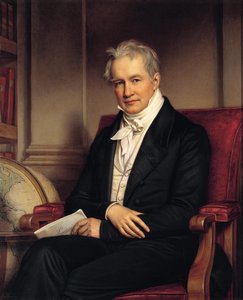
friedrich wilhelm heinrich alexander von humboldt
1769 - 1859 , Germany
Quick Facts
- Artistic Movement Or Style: Romanticism, Science
- Artists Or Movements Influenced By This Artist:
- Darwin
- Ecology movement
- Artists Who Influenced This Artist:
- Immanuel Kant
- Georg Forster
- Date Of Birth: 1769
- Date Of Death: 1859
- Full Name: Alexander von Humboldt
- Nationality: German
- Notable Artworks:
- Geography of Plants near Ecuador
- Portrait Medallion
- Place Of Birth: Berlin, Germany
Related Articles
Watercolor Wonders: 10 Masterpieces That Redefined Art History | ArtsDot
Journey through 10 legendary watercolor masterpieces by Sargent, Turner & Homer! Explore iconic landscapes, portraits & floral art that redefined history. Find museum-quality reproductions and curated decor ideas at ArtsDot.com.

Ephemeral Visions: Exploring the Artistic Legacy & Contemporary Practice of Watercolor Painting
Explore the captivating world of watercolor painting! Discover its rich history, essential techniques, influential artists & collecting tips. A comprehensive guide for art enthusiasts from ArtsDot.

Ephemeral Visions: Exploring the History & Emotional Resonance of Watercolor Painting
Explore the captivating history of watercolor painting, from ancient techniques to modern masters like Kandinsky & Blake. Discover essential artists, collecting tips & the emotional power of this luminous medium. Expert insights for art enthusiasts.
Ephemeral Visions: Exploring the Artistic Legacy & Nuances of Watercolor Painting
Explore the captivating world of watercolor painting! Discover its rich history, essential techniques, influential artists & collecting tips from art experts. A comprehensive guide for enthusiasts.
Ephemeral Echoes: Exploring the Aesthetic & Historical Significance of Vintage Watercolor Painting
Explore the captivating world of vintage watercolor painting! Discover its rich history, techniques, influential artists & collecting tips. Expert insights for enthusiasts and collectors at ArtsDot.