 Preview
 Send
Send Share
Share
 Details

 Download
 Similars
 X-Ray
X-Ray Diaporama
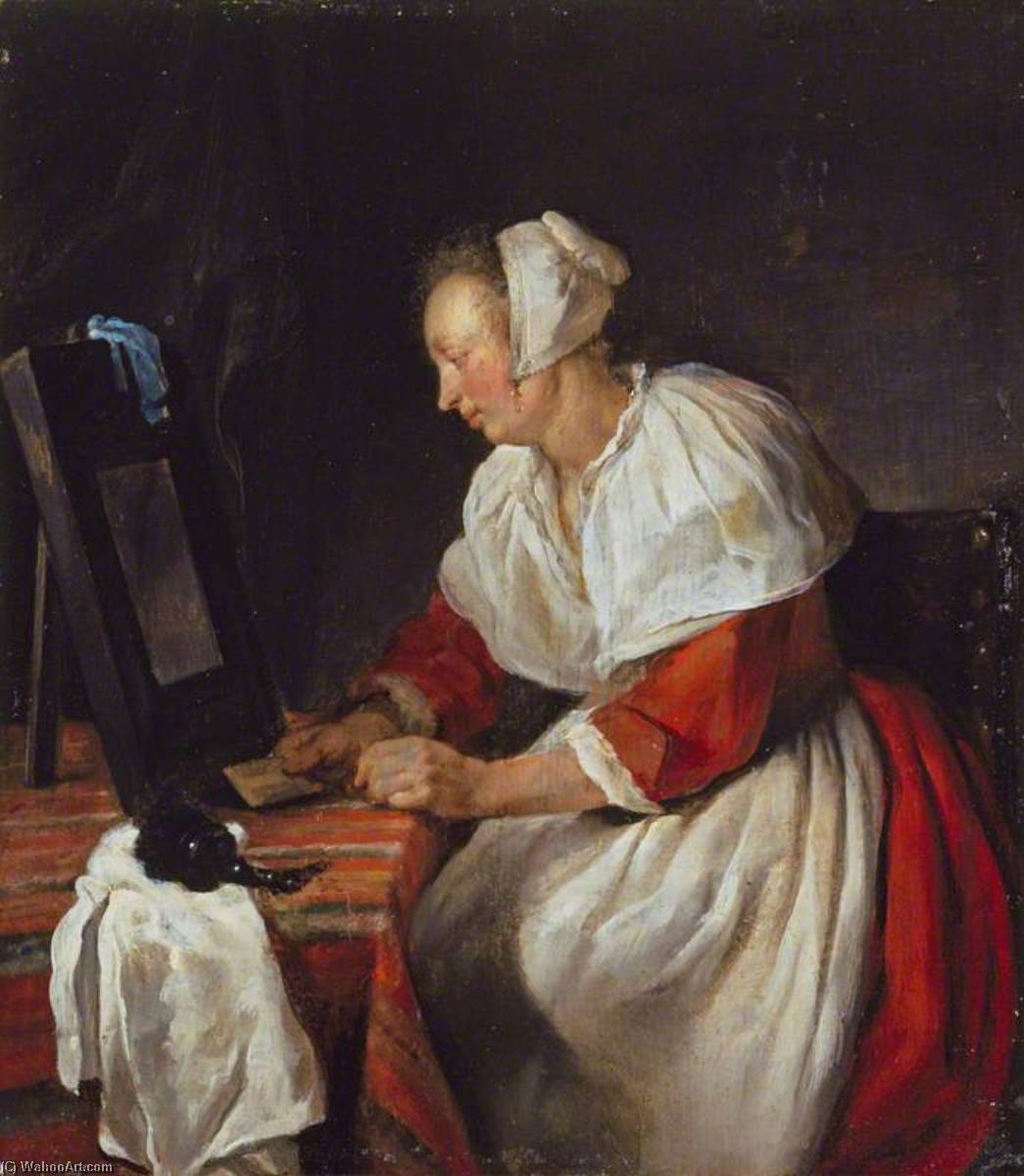
A Woman at Her Mirror
 Danish Golden Age
 1662
1662 19.0 x 17.0 cm
 The Wallace Collection
 Read More
Giclée / Art Print
Museum-quality giclée or canvas print with fast production and flexible finish options. ( Buy Hand Made Painting Buy Image)




P118B $10

P118H $10

P118W $10

P438Z $10

P508JH $12

P508YH $12

P805H $10

P805Z $10

P919BZ $10

P919G $10

P919XJ $10

P959ZH $10

P968JZ $12

W106C $8

W218G $10

W218JH $8

W218Y $10

W307PJ $10

W316G $10

W316PJ $8

W316Y $10

W398PJ $8

W4111J $10

W500HY $15

W500JH $15

W692G $12

W849H $8

W940BG $15

W953PJ $8




Pick from our preset sizes that match the artwork's original proportions.

You may enter your own dimensions to fit a specific frame or space. If your selected size does not match the original image's proportions, we will either crop the artwork or extend the image with a mirrored or solid-fill edge. A digital mockup will be sent for your approval before production begins.
Please note that the on-screen preview does not reflect the actual cropping or extension. Only the mockup will accurately show the final composition.
While custom sizes are available, we recommend selecting a dimension from the predefined list to preserve the original proportions.
Worldwide Delivery () in 2 weeks instead of standard 4/5 weeks. (17 August)

Free Worldwide Express Shipping

High-Quality Linen Canvas

Full Shipping Insurance

Customs Tax Refund Guarantee

True Color Matching Guarantee

60-Day Return Policy (Defects Only)

100% Money-Back Guarantee

Bulk Discount Offer
 Glass option is only available in size under 110 CM

A Woman at Her Mirror
Giclée / Art Print
Reproduction Size
-


Total Price
$ 63
Collectible Description
The Intimate World of Gabriel Metsu: A Study in Reflection and Quietude
Gabriel Metsu’s “A Woman at Her Mirror,” painted circa 1657-1662, isn't merely a portrait; it’s a carefully constructed tableau of domesticity, introspection, and the subtle dance between appearance and reality. Within the confines of a modestly sized panel, Metsu masterfully captures a fleeting moment – a woman lost in contemplation before her reflection, a scene brimming with quiet dignity and an undercurrent of melancholy. This painting, housed within the Wallace Collection in London, offers a rare glimpse into the private world of a 17th-century Dutch household, revealing a depth of observation rarely found in his contemporaries.
Metsu’s style defies easy categorization. He wasn't bound by the rigid conventions of the Dutch Golden Age, instead favoring an eclectic approach that blended elements of realism with a delicate sensitivity to light and shadow. His figures are rendered with remarkable precision, yet imbued with a palpable sense of humanity – a quality particularly evident in the woman’s posture and expression. Unlike the grand historical scenes favored by Rembrandt or Rubens, Metsu focused on intimate genre paintings, capturing everyday moments with an almost photographic eye. This intimacy is further emphasized by his use of a limited palette—muted browns, creams, and subtle greens—that evokes a sense of stillness and understated elegance.
Decoding the Symbolism: Mirrors, Identity, and the Female Gaze
The mirror itself is undeniably central to the painting’s meaning. It's not simply a reflective surface; it acts as a portal into another realm – a space where the woman confronts her own image, inviting us to consider the complexities of self-perception. Metsu cleverly utilizes the reflection to subtly shift our perspective, presenting both the woman’s back and her face simultaneously. This creates a disorienting effect, forcing us to question what we see and how we interpret it. The slight turn of her head, directed downwards towards the table, suggests a moment of quiet contemplation, perhaps even a subtle dissatisfaction with her reflection.
The inclusion of small details—the dressing table, the box, the earring—adds layers of symbolic significance. The box likely contains cosmetics or personal adornments, hinting at the woman’s efforts to maintain an idealized appearance. The earring, gleaming in the mirror's light, represents vanity and perhaps a desire for social acceptance. These seemingly minor elements contribute to a richer narrative, suggesting that the painting is not just about a single moment but about the broader themes of beauty, identity, and the pressures faced by women within 17th-century society.
Technique and Light: A Masterclass in Atmospheric Realism
Metsu’s technical skill is evident in his masterful manipulation of light and shadow. He employs a subtle chiaroscuro technique—a dramatic contrast between light and dark—to create a sense of depth and volume, drawing the viewer's eye to key elements within the composition. The diffused light filtering through the window casts soft shadows across the room, lending it an intimate and atmospheric quality. Notice how Metsu carefully renders the texture of the fabrics, the sheen of the mirror, and the delicate details of the woman’s hair – each element meticulously observed and rendered with remarkable precision.
The painting's composition is deceptively simple yet profoundly effective. The placement of the figure within the room, the diagonal lines created by the furniture, and the strategic use of negative space all contribute to a sense of balance and harmony. Metsu’s ability to capture such subtle nuances of light, shadow, and form speaks volumes about his artistic talent and his deep understanding of human psychology. “A Woman at Her Mirror” remains a testament to Metsu's quiet genius—a poignant meditation on the complexities of self-awareness and the enduring allure of reflection.
Related Artworks


Artist Biography
**a life of artistic exploration**
gabriël metsu, a dutch painter from the netherlands, lived a life marked by artistic exploration and innovation. born in 1629, metsu's work embodied the spirit of the dutch golden age, a period renowned for its prolific artistic output. this biography delves into the life and works of this enigmatic figure, whose contributions to the art world continue to fascinate.**early life and influences**
metsu was born in 1629, the son of jacques metsu, a tapestry worker and painter originally from hainault. this eclectic background likely influenced gabriel's early interest in diverse artistic techniques. the family's move to leiden, where metsu grew up, exposed him to various cultural influences.**artistic career**
metsu's career was marked by an adherence to no single style or technique, earning him the title of "a highly eclectic artist." his work spanned history paintings, still lifes, portraits, and genre works. notably, only 14 of his 133 works are dated, leaving much to be discovered about his creative process.- rembrandt van rijn's influence on metsu's early work is evident, particularly in his use of light and color.
- metsu's move to amsterdam in 1655 marked a significant shift in his style, with more emphasis on domestic interiors and genre scenes.
- his training of michiel van musscher and joost van geel reflects his commitment to the artistic community.
**notable works and legacy**
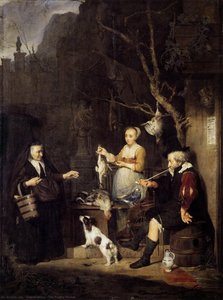
metsu's paintings often featured young women, market scenes, and old people, drawing from popular emblems. a notable example is the poultry seller, which showcases his use of symbolism. key works:- the sick child (c. 1664), reflecting metsu's admiration for vermeer's work.
- portrait of the family hinlopen, a masterpiece that blends genre and portrait painting.
**museums and collections**
metsu's works can be found in various museums, including the rijksmuseum in amsterdam. for more information on his art and to explore other dutch golden age painters, visit /en/art/show/art-d3c627-en/ for a comprehensive overview. **conclusion:** gabriel metsu's life and art are a testament to the innovative spirit of the dutch golden age. his eclectic style, though sometimes enigmatic, has left an indelible mark on the world of art. as we continue to uncover more about his life and works, we are reminded of the profound impact he had on the development of western art.- for a deeper understanding of the dutch golden age, refer to [https://en.wikipedia.org/wiki/dutch_golden_age_painting](https://en.wikipedia.org/wiki/dutch_golden_age_painting).
- explore more of metsu's works and those of his contemporaries at [https://ArtsDot.com/@/gabriel-metsu](https://ArtsDot.com/@/gabriel-metsu).
**references:**
- the house of orange-nassau historic collection trust (the hague, netherlands), [https://ArtsDot.com/@@/a@d3ccx5](https://ArtsDot.com/@@/a@d3ccx5).
- van gogh museum (netherlands) - a haven for art lovers, [https://ArtsDot.com/@@/a@d3c8x3](https://ArtsDot.com/@@/a@d3c8x3).
- dutch golden age painting, [https://en.wikipedia.org/wiki/dutch_golden_age_painting](https://en.wikipedia.org/wiki/dutch_golden_age_painting).
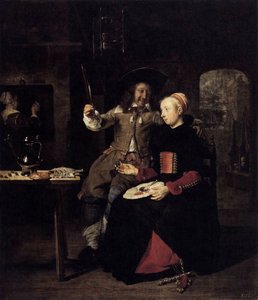
Gabriel Metsu
1629 - 1667 , Netherlands
Quick Facts
- Artistic Movement Or Style: Dutch Golden Age painting
- Artists Or Movements Influenced By This Artist:
- Michiel van Musscher
- Joost van Geel
- Artists Who Influenced This Artist:
- Rembrandt van Rijn
- Johannes Vermeer
- Date Of Birth: 1629
- Date Of Death: 1667
- Full Name: Gabriel Metsu
- Nationality: Dutch
- Notable Artworks:
- The Sick Child
- Poultry Seller
- Portrait of the Hinlopen Family
- Place Of Birth: Leiden, Netherlands
Related Articles
Dante Gabriel Rossetti's 25 Masterpieces: A Journey Through Victorian Art & Symbolism | ArtsDot
Explore 25 iconic artworks by Dante Gabriel Rossetti, a leading Pre-Raphaelite artist. Discover the stories behind masterpieces like 'Proserpine' & 'Beata Beatrix'. Find museum-quality art reproductions and elevate your home decor with ArtsDot.com.

Dutch Masters: 10 Golden Age Paintings That Still Inspire |
Journey into the Dutch Golden Age! Explore 10 iconic paintings by Rembrandt, Vermeer & Hals. Discover the stories behind these Baroque masterpieces and find museum-quality art reproductions to elevate your home decor on .
Gabriel Metsu: Illuminating Dutch Daily Life with Exquisite Detail
Explore the captivating world of Gabriel Metsu, a leading Dutch Golden Age painter. Discover his exquisite genre scenes, masterful realism, and insightful social commentary. Learn about key works & his lasting legacy.

Illuminating Innovation: Exploring the Dutch Golden Age of Painting
Explore the Dutch Golden Age of painting with ArtsDot. Discover Rembrandt, Vermeer & other Masters. Learn about key characteristics, iconic artworks, and lasting influence. Expert insights for collectors & enthusiasts.

Golden Age Reflections: Dutch Baroque Painting & Cultural Innovation
Explore the Dutch Golden Age of painting! Discover key artists like Vermeer & ter Borch, their innovative techniques, and the rich cultural context behind these Baroque masterpieces. Learn about collecting & appreciating this iconic art period.