 Preview
 Send
Send Share
Share
 Details

 Download
 Similars
 X-Ray
X-Ray Diaporama
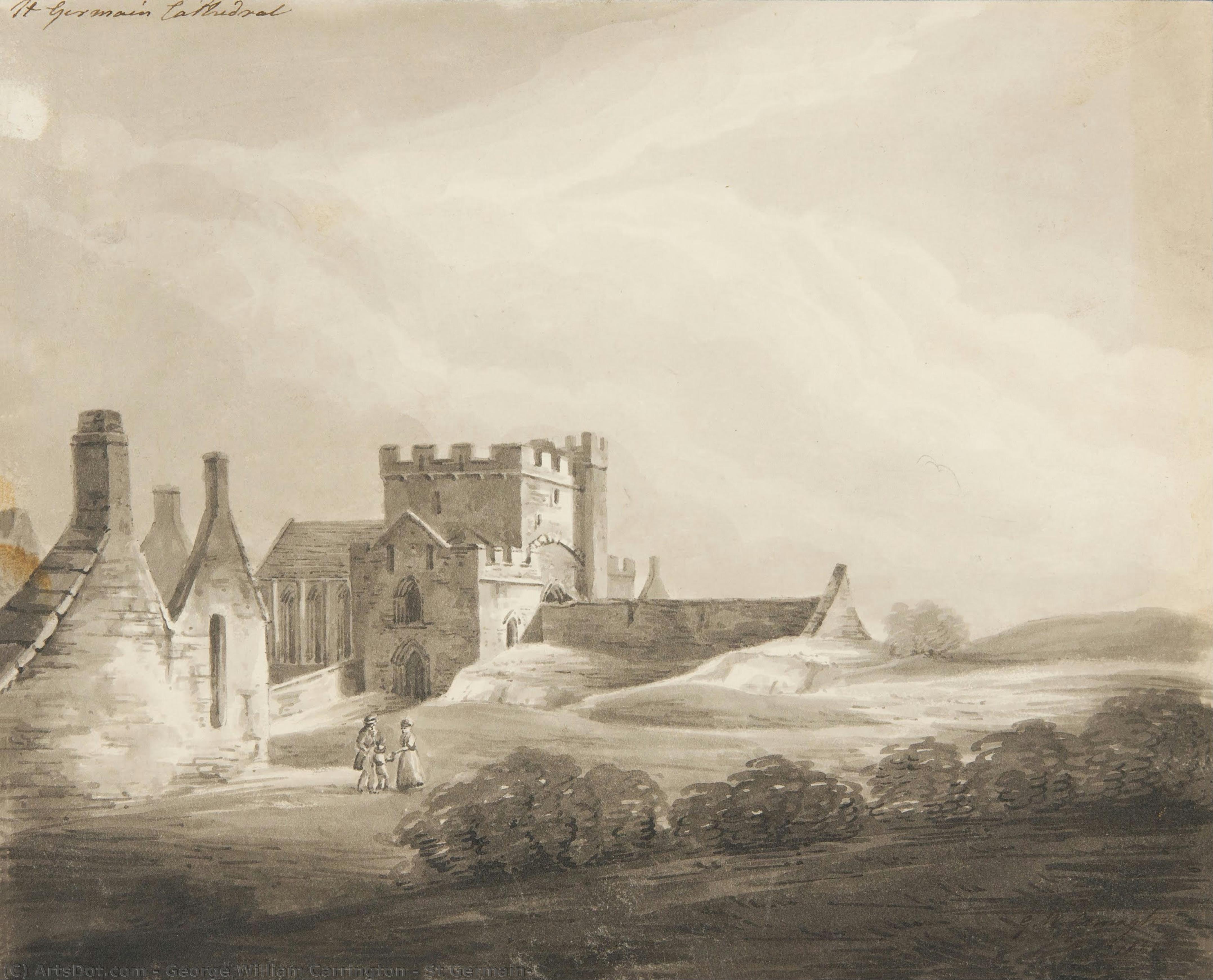
St Germain
 Watercolor
- WallArt
- Landscape Realism
 1800
1800- 19th Century
 21.0 x 25.0 cm
 Manx National Heritage
 Read More
Hand Made Oil Reproduction
Hand-painted oil on canvas in your size and frame, made to order by our artists. ( Buy Print Buy Image)




P118B $10

P118H $10

P118W $10

P438Z $10

P508JH $12

P508YH $12

P805H $10

P805Z $10

P919BZ $10

P919G $10

P919XJ $10

P959ZH $10

P968JZ $12

W106C $8

W218G $10

W218JH $8

W218Y $10

W307PJ $10

W316G $10

W316PJ $8

W316Y $10

W398PJ $8

W4111J $10

W500HY $15

W500JH $15

W692G $12

W849H $8

W940BG $15

W953PJ $8




Pick from our preset sizes that match the artwork's original proportions.

You may enter your own dimensions to fit a specific frame or space. If your selected size does not match the original image's proportions, we will either crop the artwork or extend the painting with additional hand-painted elements. A digital mockup will be sent for your approval before production begins.
Please note that the on-screen preview does not reflect the actual cropping or extension. Only the mockup will accurately show the final composition.
While custom sizes are available, we recommend selecting a dimension from the predefined list to preserve the original proportions.
After order, ArtsDot.com team will email client for instructions and provide a mockup preview
Worldwide Delivery () in 3/4 weeks instead of standard 5 weeks. (16 August). No compromise on quality.

Free Worldwide Express Shipping

High-Quality Linen Canvas

Full Shipping Insurance

Customs Tax Refund Guarantee

True Color Matching Guarantee

60-Day Return Policy (Defects Only)

100% Money-Back Guarantee

Bulk Discount Offer
 Glass option is only available in size under 110 CM

St Germain
Reproduction Medium
Reproduction Size
-


Total Price
$ 263
Artwork Description
A Window into Serenity: The Enchanted Realm of St Germain
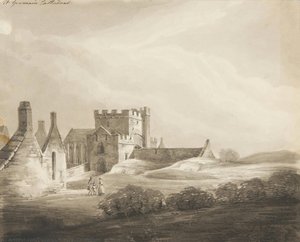
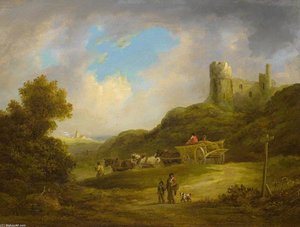
In the delicate, translucent layers of George William Carrington’s St Germain, we are invited to step into a world where time seems to have paused in a state of perpetual grace. This exquisite watercolor, dating from the turn of the nineteenth century, captures more than just a landscape; it captures a mood of profound tranquility. The scene unfolds before the viewer as a romantic vision of a fortified castle, its majestic central tower rising proudly above a protective moat. Surrounded by a lush tapestry of verdant trees, the architecture of the castle feels less like a cold fortress and more like an organic extension of the earth itself. Through Carrington’s masterful use of light and soft washes, the painting evokes the gentle atmosphere of a summer afternoon, where the air is still and the only movement is the quiet wandering of figures near the water's edge.
The technique employed in this piece showcases the artist's profound command over the watercolor medium. Carrington utilizes the inherent fluidity of the pigment to create a sense of atmospheric depth, allowing the edges of the foliage to bleed softly into the sky, suggesting a misty, dreamlike quality. The subtle interplay of light and shadow across the castle walls provides a structural weight that anchors the composition, preventing the ethereal washes from feeling unsubstantial. A charming detail—a lone horse grazing towards the right periphery—adds a touch of pastoral life, grounding the grand architecture in the humble, rhythmic beauty of nature. This balance between the monumental and the mundane is what gives the work its enduring charm.
Historical Resonance and Artistic Legacy
To understand St Germain, one must look to the lineage of George William Carrington. Born into an artistic household in Gloucester, Carrington was a student of both his father’s disciplined surveying eye and the romantic sensibilities of the British landscape tradition. His training allowed him to capture the topographical accuracy of a scene while imbuing it with the emotional resonance required by the Royal Academy standards of his era. This particular work reflects the nineteenth-century fascination with historical landmarks and the romanticized view of the past, where ruins and castles served as symbols of continuity and the enduring spirit of heritage.
For the discerning collector or interior designer, this reproduction offers a sophisticated focal point that brings a sense of classical elegance to any space. The soft palette of greens, blues, and earthy tones is remarkably versatile, capable of complementing both traditional period rooms and contemporary minimalist settings. Because the painting focuses on a peaceful, pastoral narrative, it possesses a unique ability to soothe the visual environment, making it an ideal selection for libraries, study areas, or quiet sitting rooms where one seeks to cultivate an atmosphere of contemplation and historical depth.
Related Artworks
Artist Biography
The Legacy of George William Carrington
Born in the historic city of Gloucester in 1855, George William Carrington emerged from a lineage deeply rooted in the observation of the natural world. His artistic journey began not in a formal academy alone, but under the watchful and expert eye of his father, a skilled landscape artist and surveyor. This unique dual education provided Carrington with more than just technical proficiency; it instilled in him a surveyor's precision and an artist's soul, allowing him to map the contours of the earth with both scientific accuracy and poetic grace. His early years were defined by this intimate connection to the land, developing a foundational mastery of light, shadow, and composition that would become the hallmark of his mature style.
As his career flourished, Carrington became most celebrated for his evocative depictions of the Isle of Man. He possessed a rare ability to translate the atmospheric nuances of the Irish Sea and the rugged coastal beauty of the island into breathtaking landscapes and seascapes. His work is characterized by an exquisite sensitivity to the shifting qualities of light—the way a sudden sunbeam pierces through heavy clouds or how the sea reflects the muted tones of a twilight sky. Through his brush, the Isle of Man was transformed into a realm of serene beauty and rhythmic motion, capturing the very essence of the maritime environment.
Artistic Recognition and Mastery
The significance of Carrington's contribution to British art is cemented by his prestigious affiliations and exhibition history. His talent earned him membership in the Royal Society of British Artists, a testament to his standing among his contemporaries. Furthermore, his works were frequently showcased at the Royal Academy, the pinnacle of the British art establishment during his era. These exhibitions allowed his vision to reach the most discerning collectors and critics of the late 19th and early 20th centuries, establishing him as a master of the landscape genre.
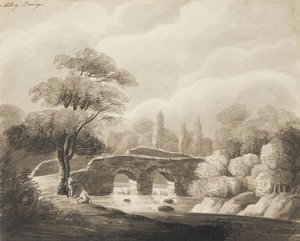
Beyond his grander oil compositions, Carrington demonstrated remarkable versatility in watercolor, a medium that demands both spontaneity and control. His piece Abbey Bridge serves as a poignant example of this skill, showcasing his ability to capture delicate textures and the ephemeral beauty of natural settings. The breadth of his repertoire, ranging from sweeping coastal vistas to intimate architectural studies, highlights a lifelong dedication to documenting the splendor of the British Isles.
A Lasting Impression on Art History
Though he passed away in 1940, the artistic spirit of George William Carrington continues to resonate across the globe. His legacy is not merely found in museum archives but lives on through the enduring appeal of his imagery. The geographical reach of his influence is vast, with his original works held in esteemed collections throughout New Zealand, Australia, and the United Kingdom. This international presence speaks to the universal language of his art—a language of light, nature, and tranquility that transcends borders.
Today, collectors and enthusiasts can continue to experience the magic of his vision through high-quality archival reproductions. His ability to freeze a moment of natural perfection ensures that his depictions of the Isle of Man and beyond remain as vibrant and moving today as they were during his lifetime. Carrington remains a vital figure for anyone seeking to understand the golden age of British landscape painting, offering a window into a world where nature is celebrated with profound reverence and unmatched skill.
George William Carrington
1855 - 1940 , United Kingdom
Quick Facts
- Artistic Movement Or Style: Landscape Art
- Date Of Birth: 1855
- Date Of Death: 1940
- Full Name: George William Carrington
- Nationality: British
- Notable Artworks:
- Abbey Bridge
- Landscapes and Seascapes of the Isle of Man
- Place Of Birth: Gloucester, United Kingdom
Related Articles

Watercolor Wonders: 10 Masterpieces That Redefined Art History | ArtsDot
Journey through 10 legendary watercolor masterpieces by Sargent, Turner & Homer! Explore iconic landscapes, portraits & floral art that redefined history. Find museum-quality reproductions and curated decor ideas at ArtsDot.com.

John Constable's Masterpieces: Explore 25 Iconic Landscapes for Your Home
Journey through John Constable's 25 most celebrated landscapes. Explore Romanticism, Dedham Vale & his masterful use of light in iconic paintings like 'Hay Wain'. Find museum-quality art reproductions and elevate your home decor on ArtsDot.com.

Ephemeral Visions: Exploring the Artistic Legacy & Contemporary Practice of Watercolor Painting
Explore the captivating world of watercolor painting! Discover its rich history, essential techniques, influential artists & collecting tips. A comprehensive guide for art enthusiasts from ArtsDot.

Ephemeral Visions: Exploring the History & Emotional Resonance of Watercolor Painting
Explore the captivating history of watercolor painting, from ancient techniques to modern masters like Kandinsky & Blake. Discover essential artists, collecting tips & the emotional power of this luminous medium. Expert insights for art enthusiasts.

Beyond the Horizon: 10 Landscape Masterpieces for Your Home Decor
Journey through 10 breathtaking landscape paintings by Monet, Van Gogh & more! Explore iconic artworks, artistic techniques & find inspiration for your home decor. Museum-quality reproductions at ArtsDot.com. Discover all masterpieces on ArtsDot.com