 Preview
 Send
Send Share
Share
 Details

 Download
 Similars
 X-Ray
X-Ray Diaporama
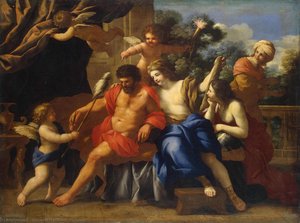
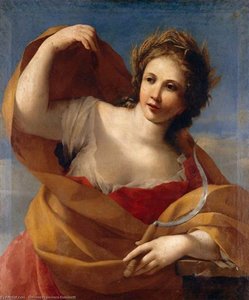
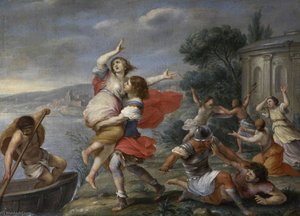
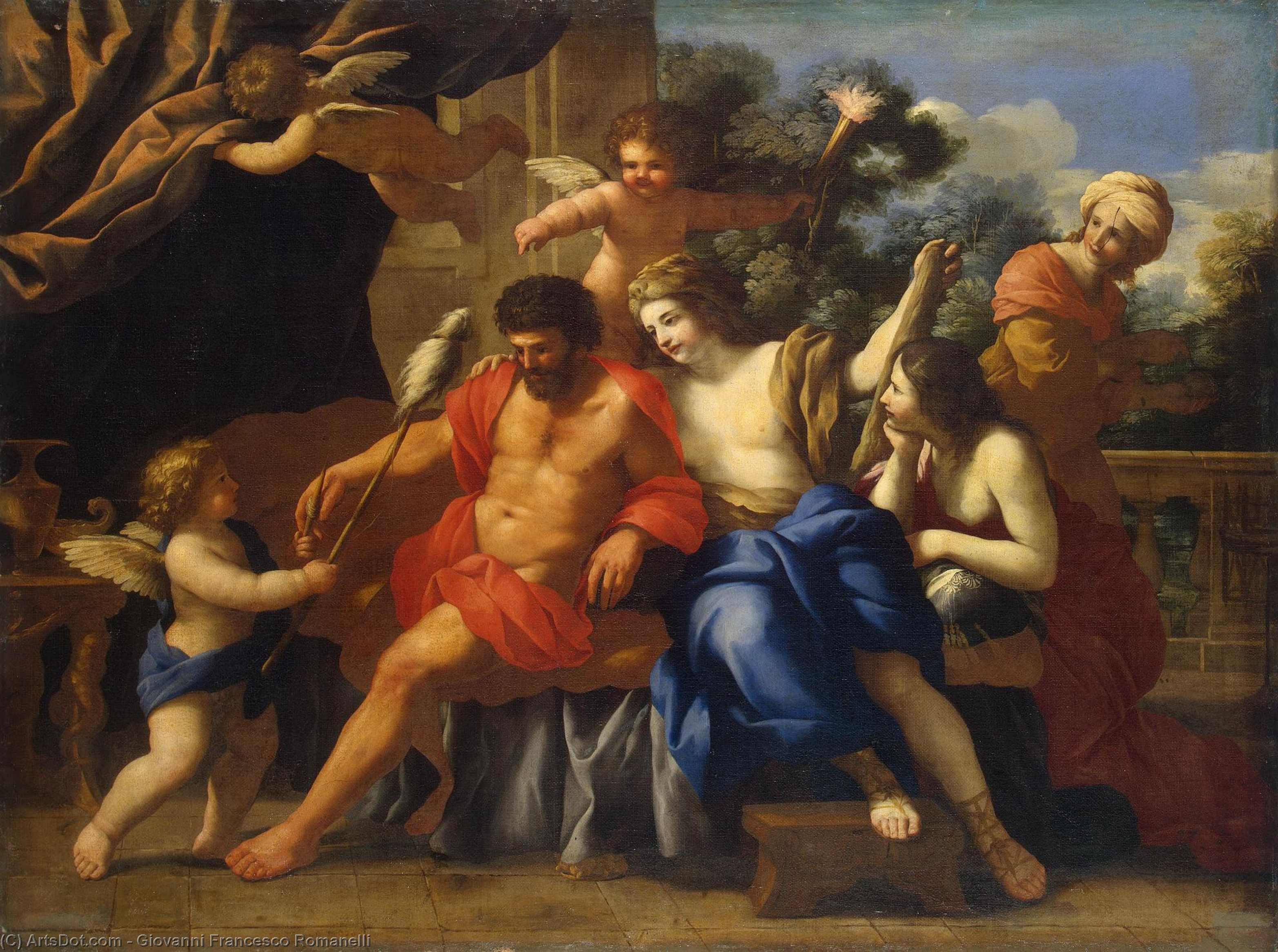
Hercules and Omphale
 Oil On Canvas
- WallArt
- Baroque
 1650
1650- Early Modern
 100.0 x 133.0 cm
 Hermitage Museum
 Read More
Giclée / Art Print
Museum-quality giclée or canvas print with fast production and flexible finish options. ( Buy Hand Made Painting Buy Image)




P118B $10

P118H $10

P118W $10

P438Z $10

P508JH $12

P508YH $12

P805H $10

P805Z $10

P919BZ $10

P919G $10

P919XJ $10

P959ZH $10

P968JZ $12

W106C $8

W218G $10

W218JH $8

W218Y $10

W307PJ $10

W316G $10

W316PJ $8

W316Y $10

W398PJ $8

W4111J $10

W500HY $15

W500JH $15

W692G $12

W849H $8

W940BG $15

W953PJ $8




Pick from our preset sizes that match the artwork's original proportions.

You may enter your own dimensions to fit a specific frame or space. If your selected size does not match the original image's proportions, we will either crop the artwork or extend the image with a mirrored or solid-fill edge. A digital mockup will be sent for your approval before production begins.
Please note that the on-screen preview does not reflect the actual cropping or extension. Only the mockup will accurately show the final composition.
While custom sizes are available, we recommend selecting a dimension from the predefined list to preserve the original proportions.
Worldwide Delivery () in 2 weeks instead of standard 4/5 weeks. (23 August)

Free Worldwide Express Shipping

High-Quality Linen Canvas

Full Shipping Insurance

Customs Tax Refund Guarantee

True Color Matching Guarantee

60-Day Return Policy (Defects Only)

100% Money-Back Guarantee

Bulk Discount Offer
 Glass option is only available in size under 110 CM

Hercules and Omphale
Giclée / Art Print
Reproduction Size
-


Total Price
$ 63
Collectible Description
A Masterpiece of Baroque Subversion
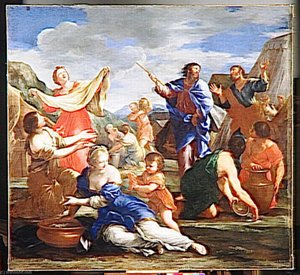
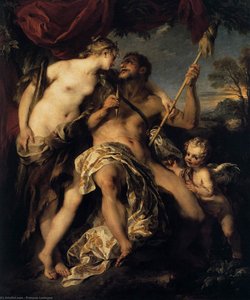
In the grand theater of the Italian Baroque, few scenes capture the tension between power and vulnerability as poignantly as Giovanni Francesco Romanelli’s “Hercules and Omphale.” Completed around 1650, this monumental oil on canvas is far more than a mere mythological illustration; it is a psychological drama rendered in light and shadow. The painting transports viewers to the opulent court of Lydia, where the legendary strength of Hercules meets the cunning intellect of Queen Omphale. Romanelli masterfully captures the moment of profound role reversal, where the world's most formidable hero finds himself stripped of his weapons and dignity, compelled by ransom to adopt the feminine attire of his captor. It is a narrative that breathes with the subversive energy of the 17th century, challenging traditional notions of gender and dominance through a lens of exquisite theatricality.
The technical brilliance of Romanelli lies in his ability to marry the dramatic intensity of tenebrismo—the high-contrast lighting popularized by Caravaggio—with a luminous, classical grace. As one gazes upon the canvas, the eye is immediately drawn to the interplay of light across the figures' musculature and the heavy, luxurious folds of their drapery. Romanelli employs bold, sweeping brushstrokes that lend a palpable sense of movement to the scene, making the stillness of the spinning task feel charged with underlying tension. The artist’s command over texture is nothing short of extraordinary; one can almost feel the weight of the embroidered fabrics and the smoothness of skin illuminated by a single, dramatic light source that seems to descend from an unseen celestial height.
Symbolism and the Baroque Soul
Beyond its visual splendor, “Hercules and Omphale” serves as a complex tapestry of symbolic meaning. The reversal of roles—Hercules spinning yarn while Omphale holds the symbols of his heroism—acts as a potent commentary on the fragility of status and the transformative power of desire. This period of the Counter-Reformation often utilized such mythological allegories to explore deeper spiritual and societal truths, using the physical struggle of heroes to mirror the internal struggles of the human soul. The composition itself is a marvel of Baroque design, utilizing overlapping planes and organic shapes to create an immersive depth that pulls the collector into the very heart of the Lydian palace.
For the discerning art lover or interior designer, this work offers an unparalleled sense of drama and historical weight. It is a piece that demands attention, serving as a sophisticated focal point in any curated collection. Whether placed in a grand hall or a private study, the painting’s rich palette and emotive power evoke a sense of timeless romance and melancholic grandeur. To possess a high-quality reproduction of this masterpiece is to bring a fragment of the Baroque era's most captivating psychological explorations into the modern space, offering an enduring source of inspiration and conversation.
Related Artworks

Artist Biography
Michelangelo Merisi da Caravaggio: A Revolutionary of Light and Shadow
Michelangelo Merisi, more famously known as Caravaggio, remains one of the most intensely debated and profoundly influential figures in art history. Born in Milan in 1571, his life was a whirlwind of dramatic events – marked by both extraordinary artistic talent and a volatile temperament that ultimately led to exile and premature death in 1610. His brief but explosive career irrevocably altered the course of painting, establishing a new visual language characterized by intense realism, dramatic lighting, and an unprecedented engagement with contemporary life. Caravaggio’s legacy continues to resonate today, inspiring artists and captivating audiences alike.Early Years and Artistic Training
Caravaggio's early life remains somewhat shrouded in mystery. He was born into a family of modest means in Milan, the son of Rosso Merisi, a court painter for Vincenzo I Gonzaga, Duke of Marsica. This provided him with an initial introduction to the world of art, though he received no formal training. He spent his youth in various Italian cities – Cremona, Bologna, and Venice – honing his skills as a draughtsman and preparing himself for a career in painting. It was in 1592 that he moved to Rome, the vibrant heart of the artistic world, seeking opportunities and hoping to establish himself. Initially struggling to find commissions, he began by specializing in still lifes—scenes of fruits and flowers – a common practice at the time, selling his works on the streets to make ends meet. This early work, though modest, demonstrated an innate ability to capture the textures and colors of natural objects with remarkable accuracy.The Breakthrough: Dramatic Realism and Theatrical Lighting
Caravaggio’s breakthrough came in 1596 with a commission from Cardinal Francesco Maria del Monte, a prominent patron known for his discerning eye and support of emerging artists. Through the cardinal's connections, Caravaggio secured his first major public commissions – the *Calling of Saint Matthew* and *The Martyrdom of Saint Matthew*, paintings that would cement his reputation almost overnight. These works were revolutionary in their approach to religious painting. Rather than depicting saints as idealized figures removed from earthly concerns, Caravaggio presented them as ordinary people caught in dramatic moments. He employed a technique known as “tenebrism,” characterized by stark contrasts between light and shadow – plunging figures into darkness while highlighting key elements with intense illumination. This created a powerful sense of immediacy and drama, drawing the viewer directly into the scene. As Keith Christiansen notes in *Caravaggio (Michelangelo Merisi) (1571–1610) and His Followers*, Caravaggio “pushed the figures up against the picture plane and used light to enhance the dramatic impact and give the figures a quality of immediacy.”Controversy, Violence, and Exile
Caravaggio’s innovative style was not without its detractors. His depictions of ordinary people, often with unflattering features and dressed in contemporary clothing, challenged traditional artistic conventions. He was also known for his volatile temper and a penchant for brawling – incidents that included slashing the cloak of an adversary, throwing a plate of artichokes at a waiter, and engaging in violent altercations with police officers. In 1606, his life took a tragic turn when he became embroiled in a dispute with a young man, resulting in a fatal stabbing. Rather than face justice, Caravaggio fled Rome, seeking refuge in Naples, Malta, and Sicily. His travels were punctuated by further incidents of violence and legal troubles, culminating in his expulsion from Malta after another brawl.Later Years and Legacy
Despite his turbulent life, Caravaggio continued to paint throughout his exile, producing a series of works that demonstrate the evolution of his style. In Naples, he experimented with color and composition, while in Sicily, he focused on dramatic scenes of martyrdom and sacrifice. His final years were marked by a severe disfigurement resulting from a bar fight – an injury that ultimately contributed to his declining health. Caravaggio died in Porto Ercole, Italy, in 1610 at the age of 39. Despite his short life, Caravaggio’s impact on art was immense. His innovations in lighting, composition, and subject matter profoundly influenced generations of painters who followed, including Rembrandt, Velázquez, and Gentileschi. His use of tenebrism continues to be studied and emulated today, and his paintings remain among the most celebrated and emotionally resonant works in Western art history. As The National Gallery notes, “Caravaggio’s paintings were controversial, popular, and hugely influential on succeeding generations of painters all over Europe.” His legacy endures as a testament to the power of artistic vision and the enduring fascination with the dramatic interplay between light and shadow.
giovanni francesco romanelli
1610 - 1662 , Italy
Quick Facts
- Artistic Movement Or Style: Caravaggism
- Artists Or Movements Influenced By This Artist: ['Baroque']
- Artists Who Influenced This Artist:
- Leonardo da Vinci
- Michelangelo
- Date Of Birth: 1571
- Date Of Death: 1610
- Full Name: Michelangelo Merisi da Caravaggio
- Nationality: Italian
- Notable Artworks:
- The Calling of Saint Matthew
- Supper at Emmaus
- David and Goliath
- Death of the Virgin
- Place Of Birth: Milan, Lombardy
Related Articles
Decoding Baroque Grandeur: A Guide to the Drama and Emotion of 17th-Century Art
Explore the breathtaking drama of 17th-century Baroque art. Our expert guide decodes the use of chiaroscuro, emotional intensity, and historical grandeur to help you appreciate and curate timeless masterpieces for your collection.
Baroque Classicism: Reconciling Drama & Order in 17th-Century Art
Explore the captivating world of Baroque Classicism! Discover its history, key artists like Caravaggio & Rubens, and defining characteristics. Expert insights & high-quality reproductions at ArtsDot.

The Visceral Stage: Exploring Dramatic Narratives & Emotional Intensity in Baroque Art
Explore the dramatic world of Baroque art! Discover iconic masters like Caravaggio & Rembrandt, their techniques, and the movement's lasting impact. Expert insights for collectors & enthusiasts at ArtsDot.

Baroque Drama: Bringing Opulence & Emotion into Contemporary Interiors
Explore the opulent world of Baroque interior design! Discover key elements, modern applications & how to bring dramatic elegance into your home with 's authentic reproductions.

The Dramatic Flourish: Exploring the Baroque Movement's Enduring Legacy in Art History
Explore the dramatic world of Baroque art! Discover iconic artists like Caravaggio & Rubens, defining techniques, and its lasting impact on art history. Expert insights for collectors & enthusiasts at ArtsDot.