Preview
 Send
Send Share
Share
 Details

 Download
 Similars
 X-Ray
X-Ray Diaporama
Market in Piazza del Municipio
 Oil On Canvas
- WallArt
- Baroque
 Early Modern
 115.0 x 65.0 cm
 Palazzo Madama
 Read More
Giclée / Art Print
Museum-quality giclée or canvas print with fast production and flexible finish options. ( Buy Hand Made Painting Buy Image)




P118B $10

P118H $10

P118W $10

P438Z $10

P508JH $12

P508YH $12

P805H $10

P805Z $10

P919BZ $10

P919G $10

P919XJ $10

P959ZH $10

P968JZ $12

W106C $8

W218G $10

W218JH $8

W218Y $10

W307PJ $10

W316G $10

W316PJ $8

W316Y $10

W398PJ $8

W4111J $10

W500HY $15

W500JH $15

W692G $12

W849H $8

W940BG $15

W953PJ $8




Pick from our preset sizes that match the artwork's original proportions.

You may enter your own dimensions to fit a specific frame or space. If your selected size does not match the original image's proportions, we will either crop the artwork or extend the image with a mirrored or solid-fill edge. A digital mockup will be sent for your approval before production begins.
Please note that the on-screen preview does not reflect the actual cropping or extension. Only the mockup will accurately show the final composition.
While custom sizes are available, we recommend selecting a dimension from the predefined list to preserve the original proportions.
Worldwide Delivery () in 2 weeks instead of standard 4/5 weeks. (28 August)

Free Worldwide Express Shipping

High-Quality Linen Canvas

Full Shipping Insurance

Customs Tax Refund Guarantee

True Color Matching Guarantee

60-Day Return Policy (Defects Only)

100% Money-Back Guarantee

Bulk Discount Offer
 Glass option is only available in size under 110 CM

Market in Piazza del Municipio
Giclée / Art Print
Reproduction Size
-


Total Price
$ 63
A Spectacle of Chaos and Consequence
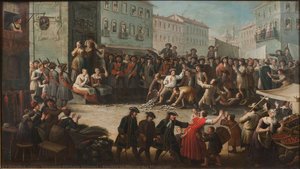
In the heart of a bustling Italian square, Giovanni Michele Graneri captures a moment of profound social drama in his evocative masterpiece, Market in Piazza del Municipio. This large-scale oil on canvas does not merely depict a marketplace; it stages a theatrical confrontation between law and the common folk. The scene unfolds with a visceral intensity, centered on the public punishment of women accused of deceptive trade practices. As rotten eggs—the very evidence of their crime—are hurled at them by outraged citizens, the painting vibrates with the energy of a community in revolt. Graneri masterfully orchestrates a crowded composition where the boundaries between a daily market and a public execution blur, inviting the viewer to step into the heat and noise of 18th-century Turin.
The artist’s technique is nothing short of extraordinary, showcasing his mastery of the bamboccio style—a genre dedicated to the detailed, often gritty, depiction of everyday life. Graneri employs a meticulous approach to light and texture, allowing the sunlight to dance across the various surfaces of the piazza, from the rough fabrics of the vendors' clothing to the polished stone of the surrounding architecture. His ability to render human figures with a heightened sense of sentimentality sets this work apart from his more clinical genre studies. Every face in the crowd tells a story: the grim determination of the guards maintaining order, the indignant fury of the bystanders, and the detached curiosity of the aristocrats watching from their elevated balconies, treating the unfolding scandal as if it were a performance at the opera.
The Art of Detail and Historical Resonance
Beyond the immediate drama, the painting serves as a rich historical document, layered with subtle symbols and personal signatures. Graneri was an artist who found beauty in the mundane and significance in the social hierarchy. The composition is meticulously structured to guide the eye through the layers of society; while the central conflict occupies the lower plane, the upper reaches of the canvas reveal the watchful eyes of the elite, creating a poignant commentary on class dynamics and public surveillance. For the discerning collector or interior designer, this piece offers more than just visual splendor; it provides a window into the social fabric of the 1700s, where the marketplace was both a site of commerce and a stage for moral judgment.
For those seeking to infuse a space with character and narrative depth, a high-quality reproduction of this work offers an unparalleled opportunity. The painting’s complex palette and dynamic movement make it a commanding centerpiece for any sophisticated interior, whether placed in a grand gallery or a curated study. It possesses the rare ability to spark conversation, drawing the eye toward its intricate details—such as the artist's clever inclusion of his initials within a shop sign—and holding the viewer captive with its timeless exploration of human emotion, justice, and the vibrant, often chaotic, pulse of urban life.
Related Artworks


Artist Biography
The Vibrant Chronicles of Giovanni Michele Graneri
In the heart of eighteenth-century Turin, a period defined by both aristocratic elegance and the burgeoning pulse of urban life, Giovanni Michele Graneri emerged as a master of the intimate and the everyday. Born in 1708, Graneri was a painter who found his true calling not in the grand, idealized allegories of the high Baroque, but in the rhythmic, unscripted movements of the common people. As a dedicated pupil of the esteemed Domenico Olivieri, Graneri inherited a technical precision that he would eventually bend toward the bamboccio style—a genre characterized by its charming, often gritty, depictions of street life, markets, and public gatherings.
Graneri’s artistic development was deeply rooted in his ability to observe. His training under Olivieri provided him with a sophisticated command of oil on canvas, yet it was his fascination with the spontaneous energy of the Piedmontese landscape that truly defined his hand. He possessed a rare gift for capturing the "essence of the crowd," transforming bustling squares into theatrical stages where every figure contributed to a larger narrative of human connection. Whether depicting the organized chaos of a lottery drawing at Piazza del Erbe or the rhythmic commerce of the market at Piazza San Carlo, his work breathes with an unmistakable vitality that invites the viewer to step directly into the historical moment.
A Master of Genre and Detail
The brilliance of Graneri’s oeuvre lies in his meticulous attention to detail and his ability to elevate the mundane to the level of fine art. His paintings serve as visual documents of a bygone era, preserving the textures of fabrics, the light filtering through public arcades, and the expressive gestures of merchants and travelers alike. This dedication to accuracy is perhaps most evident in works such as Market in Piazza del Municipio, where the sheer density of life is rendered with such clarity that one can almost hear the clamor of the marketplace.
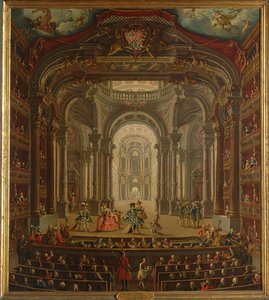
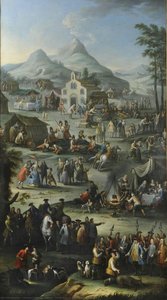
< p>Beyond the urban centers of Turin, Graneri’s artistic reach extended to the evocative landscapes and cultural traditions of Sardinia. In works like Festivities at a Sardinian Sanctuary, he demonstrates an ability to blend his mastery of genre painting with a sense of regional soul, capturing the unique spiritual and social atmosphere of the island. His versatility allowed him to navigate between the grand architectural splendor of spaces like the Interior of the Teatro Regio and the humble, sun-drenched corners of rural life, always maintaining a consistent focus on the human element.Legacy and Artistic Significance
The historical significance of Giovanni Michele Graneri resides in his role as a chronicler of the human condition during the mid-1700s. While much of the art of his era sought to glorify the divine or the monarchical, Graneri looked toward the streets. His influence resonated through the works of contemporary artists like Giacomo Grosso, who similarly embraced the nuances of genre scenes. By finding beauty in the ordinary, Graneri helped expand the emotional vocabulary of Italian painting.
Today, his legacy is preserved within the hallowed halls of prestigious institutions, ensuring that his vivid snapshots of history remain accessible to all. His contributions can be admired in:
- Palazzo Madama in Turin, where his works reflect the cultural heritage of the Piedmont region.
- Galleria Civica di Arte Moderna e Contemporanea Torino, a testament to his lasting impact on the evolution of Italian art.
Through his brush, the 18th century is not merely a period of dates and treaties, but a living, breathing tapestry of light, shadow, and the enduring spirit of the people.
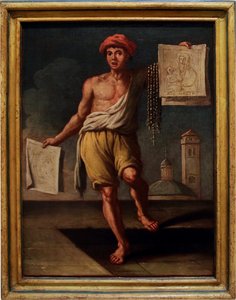
Giovanni Michele Graneri
1708 - 1762 , Italy
Quick Facts
- Artistic Movement Or Style: Genre/Bamboccio scenes
- Artists Or Movements Influenced By This Artist: Giacomo Grosso
- Artists Who Influenced This Artist: Domenico Olivieri
- Date Of Birth: 1708, Turin, Italy
- Date Of Death: 1762, Turin, Italy
- Full Name: Giovanni Michele Graneri
- Nationality: Italian
- Notable Artworks:
- Lottery at Piazza del Erbe
- Market at Piazza San Carlo
- Festivities Sardinian Sanctuary
- Interior Teatro Regio
- Place Of Birth: Turin, Italy
Related Articles
Andrea del Sarto: Florentine Grace, Technical Mastery & Artistic Ambition
Explore the life & art of Andrea del Sarto, a Florentine Renaissance master renowned for harmonious compositions & technical brilliance. Discover his frescoes, portraits, and lasting influence on art history.
Scenes of Daily Life: A Comprehensive Exploration of Genre Painting Through History
Explore the rich history of genre painting! Discover Dutch Masters & European artists who captured everyday life with stunning realism. Learn about symbolism, techniques & lasting influence.
Cecco del Caravaggio: Rediscovering the Shadowy Genius of Francesco Buoneri
Explore the captivating world of Cecco del Caravaggio (Francesco Buoneri), a pivotal Baroque artist. Discover his dramatic realism, mysterious life, and lasting legacy with ArtsDot's expert analysis.
Giuseppe Maria Crespi: Pioneering Genre Painting & the Bolognese Baroque
Explore the life & art of Giuseppe Maria Crespi, a pivotal Bolognese Baroque painter. Discover his groundbreaking genre scenes, religious works, and lasting influence on Italian art history. Learn more at ArtsDot.
The Poetics of the Mundane: Everyday Life in Art History
Explore the captivating world of genre painting! Discover how artists throughout history have found beauty & meaning in everyday life. Learn about Dutch Masters, key characteristics, and its lasting influence on art.