 Preview
 Send
Send Share
Share
 Details

 Download
 Similars
 X-Ray
X-Ray Diaporama
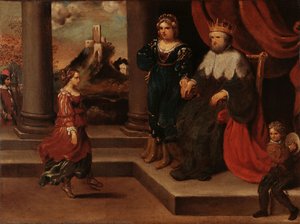
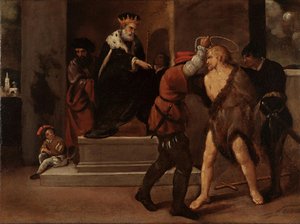
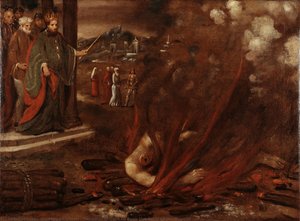
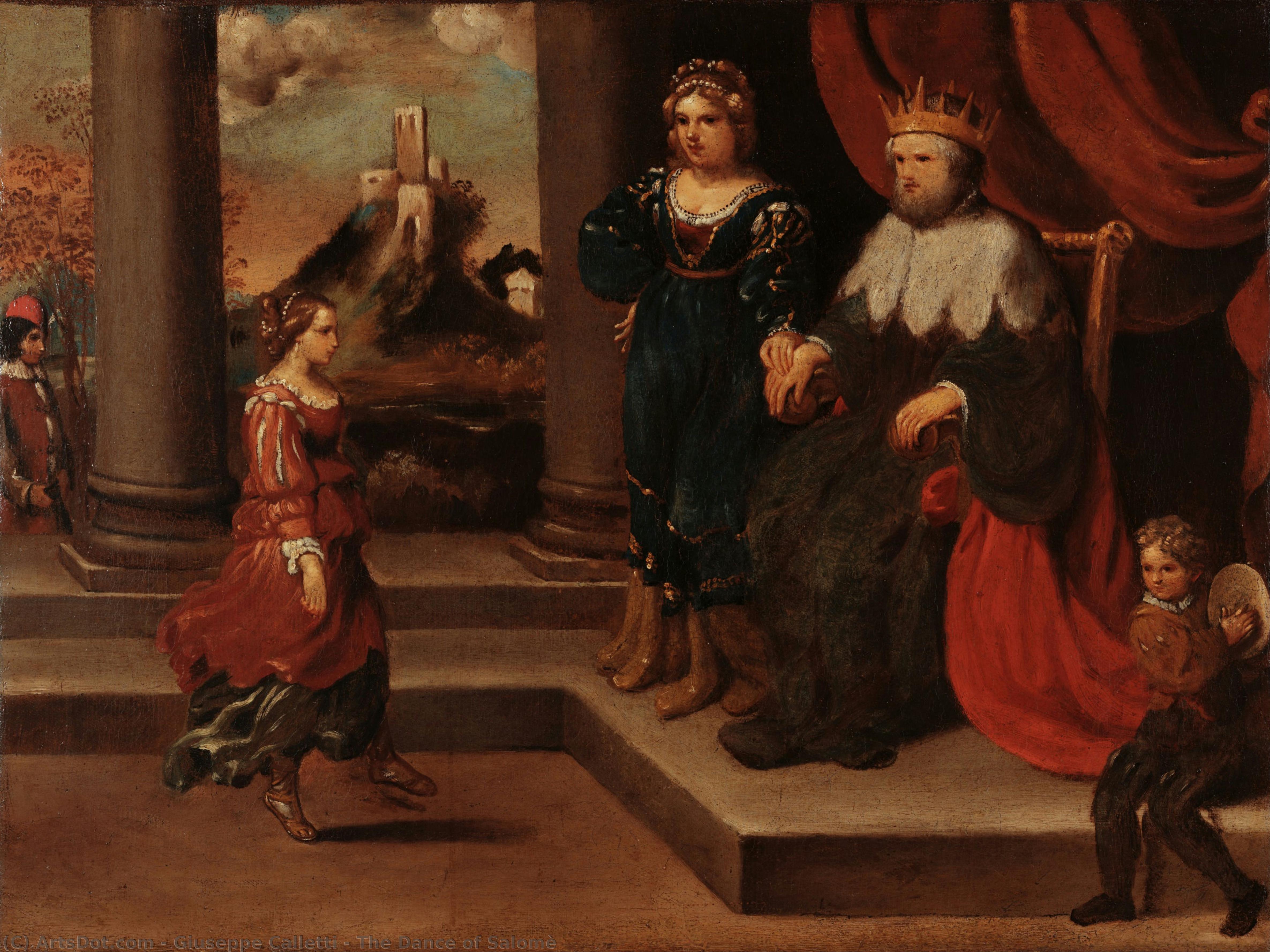
The Dance of Salomè
 Oil On Canvas
- WallArt
- Baroque
 Early Modern
 51.0 x 68.0 cm
 Musei Civici di Arte Antica e Museo Riminaldi
 Read More
Hand Made Oil Reproduction
Hand-painted oil on canvas in your size and frame, made to order by our artists. ( Buy Print Buy Image)




P118B $10

P118H $10

P118W $10

P438Z $10

P508JH $12

P508YH $12

P805H $10

P805Z $10

P919BZ $10

P919G $10

P919XJ $10

P959ZH $10

P968JZ $12

W106C $8

W218G $10

W218JH $8

W218Y $10

W307PJ $10

W316G $10

W316PJ $8

W316Y $10

W398PJ $8

W4111J $10

W500HY $15

W500JH $15

W692G $12

W849H $8

W940BG $15

W953PJ $8




Pick from our preset sizes that match the artwork's original proportions.

You may enter your own dimensions to fit a specific frame or space. If your selected size does not match the original image's proportions, we will either crop the artwork or extend the painting with additional hand-painted elements. A digital mockup will be sent for your approval before production begins.
Please note that the on-screen preview does not reflect the actual cropping or extension. Only the mockup will accurately show the final composition.
While custom sizes are available, we recommend selecting a dimension from the predefined list to preserve the original proportions.
After order, ArtsDot.com team will email client for instructions and provide a mockup preview
Worldwide Delivery () in 3/4 weeks instead of standard 5 weeks. (17 August). No compromise on quality.

Free Worldwide Express Shipping

High-Quality Linen Canvas

Full Shipping Insurance

Customs Tax Refund Guarantee

True Color Matching Guarantee

60-Day Return Policy (Defects Only)

100% Money-Back Guarantee

Bulk Discount Offer
 Glass option is only available in size under 110 CM

The Dance of Salomè
Reproduction Medium
Reproduction Size
-


Total Price
$ 338
Artwork Description
A Baroque Spectacle of Power and Grace
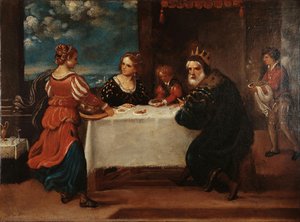
In the evocative masterpiece The Dance of Salomè, the Italian Baroque master Giuseppe Calletti invites viewers into a world where the boundaries between royal opulence and dramatic tension dissolve. This captivating oil painting serves as a profound narrative window, capturing a moment of high drama set within an atmospheric, sun-drenched courtyard. At the heart of the composition, a seated king and queen preside over the scene, their presence anchored by the weight of authority and the richness of their attire. Flanked by the delicate presence of a young boy and a kneeling girl, the figures create a complex social tapestry that speaks to the intersection of innocence and the heavy hand of destiny. Calletti, often celebrated for his ability to blend realistic genre details with fantastical settings, utilizes this scene to explore the theatricality inherent in the Baroque era, making every gaze and gesture feel like a pivotal moment in an unfolding historical drama.
The technical brilliance of the work lies in Calletti’s masterful command of chiaroscuro. Through the deliberate use of strong contrasts between deep, velvety shadows and brilliant, piercing light, the artist breathes life into the textures of the canvas. One can almost feel the heavy weight of the embroidered silks, the cool smoothness of the stone columns, and the soft, organic folds of the drapery that cascade around the central figures. This interplay of light does more than just define form; it directs the eye through a carefully constructed sense of depth, using atmospheric perspective to push the distant architectural elements into a soft, hazy background. The result is a painting that possesses a remarkable three-dimensional quality, offering a sense of solidity and grandeur that makes the scene feel tangibly present.
Beyond its visual splendor, The Dance of Salomè is steeped in symbolic resonance. The encounter between the royal family and the young woman suggests a profound meeting of power and vulnerability, perhaps hinting at the biblical themes of judgment and revelation that often permeated the works of the period. The composition itself—a balance of geometric architectural stability and the fluid, organic shapes of the human form—mirrors the tension between established order and the unpredictable nature of human emotion. For the discerning collector or interior designer, this piece offers more than mere decoration; it provides a sophisticated focal point that commands attention through its emotional intensity and historical depth. Whether placed in a grand gallery or a curated private study, Calletti’s vision continues to inspire awe, offering a timeless window into the dramatic soul of the Italian Baroque.
Related Artworks




Artist Biography
The Visionary of Cremona: The Life and Legacy of Giuseppe Calletti
Giuseppe Calletti, often referred to by the evocative moniker il Cremonese, remains one of the most intriguing figures of the Italian Baroque era. Born in the historic city of Cremona around 1600, his life was a complex tapestry woven with threads of immense artistic brilliance and profound personal turbulence. As a painter and engraver active primarily in Ferrara and Cremona, Calletti did not merely record the religious fervor of the 17th century; he reimagined it through a lens of dramatic realism and fantastical landscapes. His work serves as a bridge between the structured traditions of the Lombardy school and the boundless, theatrical imagination that defined the Baroque movement.
The foundations of Calletti’s talent were likely laid within his native Cremona, where he was born into an artistic lineage that provided him with early access to the masters of his time. While historical records regarding his formal apprenticeship remain somewhat elusive due to his famously restless and erratic temperament, his stylistic evolution reveals a deep connection to the giants of the previous century. One can trace the rhythmic energy and muscularity of his compositions back to Pordenone and Romanino, while the luminous, atmospheric qualities of his work echo the profound influence of Titian and the whimsical, dreamlike landscapes of Dosso Dossi. This synthesis allowed him to create works that felt both grounded in human emotion and elevated by divine mystery.
A Mastery of Light, Drama, and Narrative
What distinguishes Calletti from his contemporaries was his refusal to settle for purely idealized religious iconography. Instead, he embraced a style characterized by genre-like realism, where sacred events were placed within settings that felt startlingly tangible yet strangely otherworldly. He possessed a singular ability to blend the grit of everyday life with the grandeur of the divine. In his masterpieces, such as The Dance of Salomè, the viewer is not merely an observer of a biblical scene but a witness to a theatrical spectacle. Through the masterful use of chiaroscuro—the dramatic interplay of light and shadow—he imbued his figures with a palpable sense of weight, texture, and psychological depth.
His technical prowess extended beyond the brush to the precision of engraving, allowing him to explore complex narratives through fine lines and intricate details. This versatility is evident in several of his most celebrated themes:
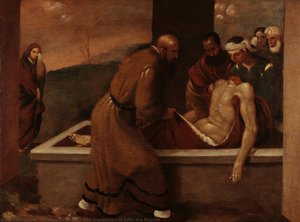
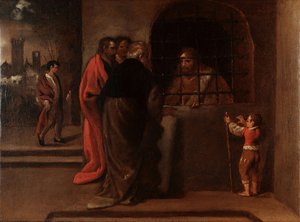
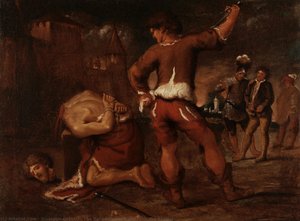
- The Deposition of John the Baptist: A profound exploration of grief and faith, where the heavy textures of fabric and the somber lighting evoke a deep sense of mourning.
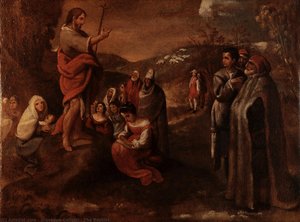
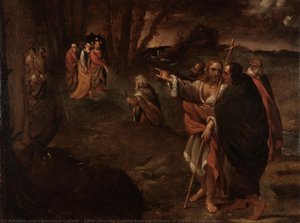
- The Baptism of Jesus: A dynamic composition that utilizes light to symbolize divine grace, capturing the movement of water and the spiritual transformation of the subject.
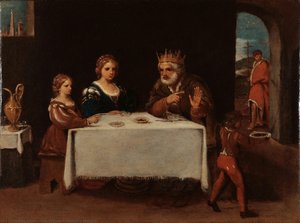
- Narrative Grandeur: His ability to populate large-scale canvases with both royal figures and humble onlookers, creating a sense of a living, breathing historical moment.
Historical Significance and Artistic Impression
The significance of Giuseppe Calletti lies in his role as a storyteller of the Baroque spirit. He captured the era's obsession with movement, emotion, and the sublime. While his personal life was often marked by instability, his artistic output provided a sense of stability to the religious narratives of his time, offering the faithful a vision of the sacred that was both accessible and awe-inspiring. His landscapes, often filled with fantastic elements, invited viewers to wander through realms that existed on the periphery of reality, making him a precursor to the more imaginative landscape traditions that would follow.
Today, Calletti’s work stands as a testament to the transformative power of the Baroque style. He remains a pivotal figure for scholars and art enthusiasts alike, representing a moment in history when the boundaries between the real and the imagined were beautifully blurred. Through his dramatic compositions and his unique ability to marry the earthly with the eternal, il Cremonese ensured that his name would endure alongside the great masters of the Italian Renaissance and Baroque periods.
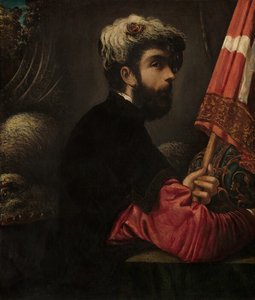
giuseppe calletti
Italy
Quick Facts
- Artistic Movement Or Style: Baroque
- Artists Or Movements Influenced By This Artist: ['Guercino']
- Artists Who Influenced This Artist:
- Titian
- Dosso Dossi
- Date Of Birth: c. 1600
- Date Of Death: c. 1660
- Full Name: Giuseppe Calletti
- Nationality: Italian
- Notable Artworks:
- Saint John the Baptist
- Baptism of Jesus
- Deposition of John
- Dance of Salomè
- Place Of Birth: Cremona, Italy
Related Articles

The Grandeur of Baroque Portraiture: Power, Emotion & Artistic Innovation
Explore the grandeur of Baroque portraiture! Discover Rubens, Van Dyck & the masters of 17th-century art. Uncover symbolism, techniques & lasting influence. Expert insights for collectors and enthusiasts.

Baroque Masterpieces: 10 Paintings That Defined an Era |
Journey through the drama & grandeur of Baroque art! Explore 10 masterpieces by Caravaggio, Rembrandt, Rubens & more. Discover stunning oil paintings, rich colors & timeless stories. Find museum-quality reproductions at .

The Dramatic Flourish: Exploring the Baroque Movement's Enduring Legacy in Art History
Explore the dramatic world of Baroque art! Discover iconic artists like Caravaggio & Rubens, defining techniques, and its lasting impact on art history. Expert insights for collectors & enthusiasts at ArtsDot.

Baroque Drama: Bringing Opulence & Emotion into Contemporary Interiors
Explore the opulent world of Baroque interior design! Discover key elements, modern applications & how to bring dramatic elegance into your home with 's authentic reproductions.
Baroque Classicism: Reconciling Drama & Order in 17th-Century Art
Explore the captivating world of Baroque Classicism! Discover its history, key artists like Caravaggio & Rubens, and defining characteristics. Expert insights & high-quality reproductions at ArtsDot.