 Preview
 Send
Send Share
Share
 Details

 Download
 Similars
 X-Ray
X-Ray Diaporama
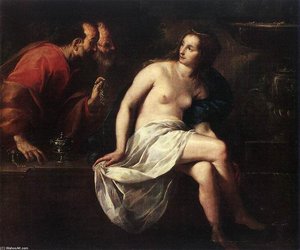
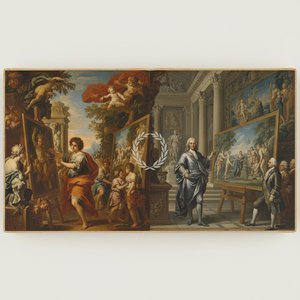
Susanna and the Elders
 Oil On Canvas
- WallArt
- Baroque
 144.0 x 173.0 cm
 Hermitage Museum
 Read More
Hand Made Oil Reproduction
Hand-painted oil on canvas in your size and frame, made to order by our artists. ( Buy Print Buy Image)




P118B $10

P118H $10

P118W $10

P438Z $10

P508JH $12

P508YH $12

P805H $10

P805Z $10

P919BZ $10

P919G $10

P919XJ $10

P959ZH $10

P968JZ $12

W106C $8

W218G $10

W218JH $8

W218Y $10

W307PJ $10

W316G $10

W316PJ $8

W316Y $10

W398PJ $8

W4111J $10

W500HY $15

W500JH $15

W692G $12

W849H $8

W940BG $15

W953PJ $8




Pick from our preset sizes that match the artwork's original proportions.

You may enter your own dimensions to fit a specific frame or space. If your selected size does not match the original image's proportions, we will either crop the artwork or extend the painting with additional hand-painted elements. A digital mockup will be sent for your approval before production begins.
Please note that the on-screen preview does not reflect the actual cropping or extension. Only the mockup will accurately show the final composition.
While custom sizes are available, we recommend selecting a dimension from the predefined list to preserve the original proportions.
After order, ArtsDot.com team will email client for instructions and provide a mockup preview
Worldwide Delivery () in 3/4 weeks instead of standard 5 weeks. (16 August). No compromise on quality.

Free Worldwide Express Shipping

High-Quality Linen Canvas

Full Shipping Insurance

Customs Tax Refund Guarantee

True Color Matching Guarantee

60-Day Return Policy (Defects Only)

100% Money-Back Guarantee

Bulk Discount Offer
 Glass option is only available in size under 110 CM

Susanna and the Elders
Reproduction Medium
Reproduction Size
-


Total Price
$ 263
Artwork Description
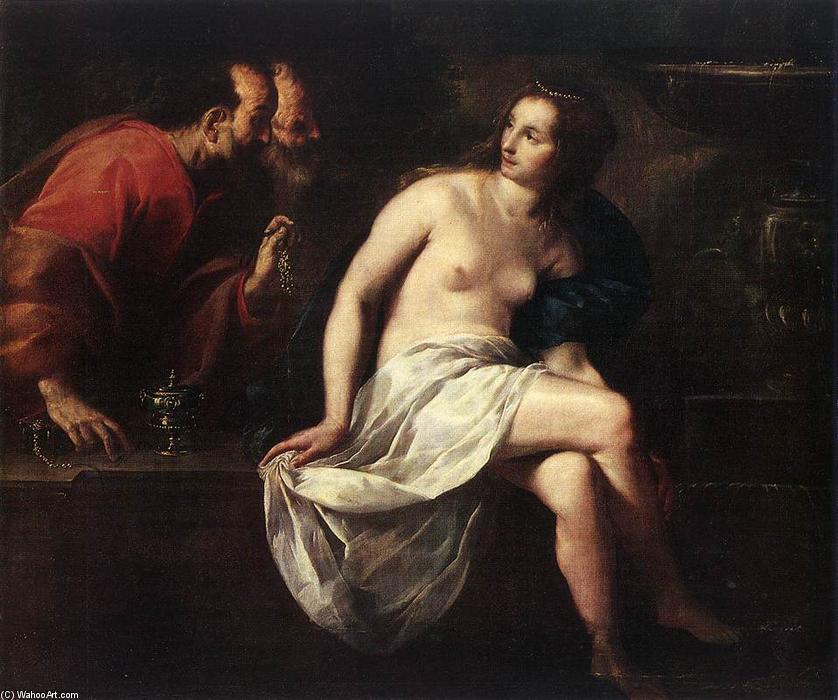
The Enigmatic Scene: Guido Cagnacci’s Susanna and the Elders
Guido Cagnacci's “Susanna and the Elders” is not merely a depiction of a biblical narrative; it’s an immersion into the sensual drama and psychological tension that defined the height of the Bolognese Baroque. Painted around 1627-1630, this arresting work resides within the hallowed halls of The Hermitage Museum in St. Petersburg, Russia, yet its power transcends geographical boundaries, captivating viewers with a masterful blend of classical restraint and intensely felt emotion. Cagnacci, born in Sant'Arcangelo di Romagna, skillfully inherited and expanded upon the traditions of his predecessors – Reni, Carracci – while forging a distinctly personal style characterized by rich color palettes, dramatic chiaroscuro, and an uncanny ability to capture the fleeting expressions of human desire.
A Story of Deception and Virtue
The narrative unfolds with a quiet intensity, centered around Susanna, a young woman renowned for her beauty and virtue. She is depicted in a moment of vulnerability – seated on a simple bench within a private garden, bathed in the diffused light of an unseen window. Her gaze, direct and unwavering, draws the viewer into the scene, creating an immediate connection between subject and observer. Behind her, two elderly men, figures of authority and presumed wisdom, lurk in shadow, their faces etched with lustful intent. The Elders, driven by a desperate desire for Susanna, have falsely accused her of adultery, threatening to expose her shame to the community. This isn’t a grand, operatic drama; it's a slow-burning revelation of deceit and the struggle between innocence and corruption.
Cagnacci masterfully utilizes composition to heighten this tension. The diagonal lines created by Susanna’s posture and the placement of the Elders draw our eye across the canvas, emphasizing their proximity and the potential danger she faces. The mirror reflecting her image adds a layer of self-awareness, suggesting that even in her vulnerability, Susanna retains a sense of dignity and control.
Technique and Artistic Flourishes
Cagnacci’s technical prowess is immediately apparent in the painting's rich textures and luminous colors. He employs a masterful use of chiaroscuro – the dramatic contrast between light and shadow – to sculpt Susanna’s form and create a sense of depth within the intimate setting. The warm hues of her dress and skin stand in stark opposition to the cool, shadowed figures of the Elders, further emphasizing their moral corruption. The brushwork is remarkably smooth and refined, indicative of Cagnacci's meticulous attention to detail. Note particularly the delicate rendering of the fabric folds, the subtle nuances of expression on Susanna’s face, and the atmospheric quality of the background – a dark, suggestive space that hints at both danger and mystery.
The painting is executed in oil on canvas, measuring 144 x 173 cm. The scale allows for a remarkable level of detail and intimacy, drawing the viewer into the heart of the drama. The artist’s choice to depict Susanna partially clothed – seated on a bench with only her dress covering her body – is deliberate, inviting contemplation about themes of modesty, virtue, and the vulnerability of women in a patriarchal society.
Symbolism and Enduring Resonance
Beyond its biblical subject matter, “Susanna and the Elders” resonates with broader themes of justice, deception, and the triumph of truth. The painting serves as a potent allegory for the dangers of false accusations and the importance of upholding moral integrity. The mirror reflects not only Susanna’s image but also the viewer's own reflection, prompting us to consider our own roles in witnessing and challenging injustice. Cagnacci’s work continues to hold relevance today, reminding us of the timeless struggle between virtue and vice, and the enduring power of art to illuminate the complexities of human experience.
Related Artworks
Artist Biography
Early Life and Artistic Beginnings
Guido Cagnacci, born on January 19, 1601, in the modest city of Sant'Angelo in Romagna, emerged from a family of artisans—his father, Matteo Cagnacci, was a tanner and furrier. While his origins remain somewhat shrouded in mystery, with speculation pointing to possible roots in Castel Durante or Rimini, it is clear that young Guido possessed an innate artistic talent. Unlike many artists of the era who underwent rigorous formal apprenticeships from childhood, Cagnacci appears largely self-taught, described by eighteenth-century biographer Giovan Battista Costa as having been “given such marvelous talent from nature” that he embarked on his artistic journey with minimal guidance. This precocious ability led his father to seek more structured training for him, initially in Bologna around 1618 and subsequently with two sojourns in Rome. Though the precise identity of his mentors remains debated, it is widely believed that Ludovico Carracci and Guido Reni profoundly influenced his early development within the Bolognese School. These formative experiences laid the groundwork for a style that would eventually distinguish him as a unique voice within the Baroque landscape.A Developing Style: Bologna, Rome, and Regional Influences
Cagnacci’s artistic education was not confined to a single studio or city. His time in Bologna exposed him to the classical ideals and polished techniques of the Carracci family, while his travels to Rome brought him into contact with the dramatic intensity of Guercino and the refined elegance of Guido Reni. He also encountered the French painter Simon Vouet during his Roman periods, further broadening his stylistic horizons. This confluence of influences is evident in his early works, which often feature devotional subjects executed with a growing mastery of chiaroscuro—the dramatic interplay of light and shadow that became a hallmark of Baroque painting. However, Cagnacci wasn’t merely an imitator; he began to infuse his compositions with a distinctive sensuality and psychological depth. After periods in Bologna and Rome, he established himself as a working artist in Rimini from 1627 to 1642, before relocating to Forlì. His time in Forlì proved particularly significant, allowing him to study the works of Melozzo da Forlì, whose innovative use of perspective and dynamic compositions further shaped his artistic vision.Mature Works: Sensuality, Drama, and Controversy
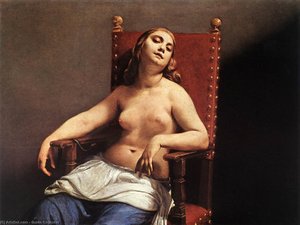
The mature phase of Cagnacci’s career, spanning roughly from the 1640s until his death in 1663, is characterized by a bold exploration of sensual subjects and an increasingly sophisticated use of chiaroscuro. He became renowned for his depictions of *Mary Magdalene*, often portrayed as a beautiful, repentant woman lost in ecstatic contemplation, and his interpretations of classical myths, particularly those featuring *Cleopatra*. These paintings are not simply exercises in technical skill; they possess a remarkable psychological intensity and an almost unsettling realism. Cagnacci’s figures are imbued with a palpable physicality and emotional vulnerability that captivated—and sometimes scandalized—his contemporaries. His work often pushed the boundaries of acceptable decorum, leading to accusations of indecency and challenging prevailing artistic conventions. The artist's intimate portraits also gained recognition for their ability to capture not only physical likeness but also the inner life of his sitters.Rediscovery and Historical Significance
Despite achieving considerable success during his lifetime—he enjoyed patronage from prominent noble families in Romagna and beyond—Guido Cagnacci’s reputation waned after his death. His works fell into relative obscurity for centuries, largely forgotten by art historians and the wider public. It wasn't until the 20th century that a concerted effort was made to rediscover and re-evaluate his oeuvre. Scholars began to recognize the unique qualities of his style—the masterful chiaroscuro, the sensual realism, and the psychological depth—and to appreciate his contribution to the Baroque tradition. Today, Cagnacci is celebrated as an important figure in Italian Baroque painting, a bridge between the classical ideals of the Bolognese School and the more dramatic, emotionally charged styles that emerged later in the century. His paintings offer a fascinating glimpse into the artistic sensibilities of his time, challenging us to reconsider our understanding of beauty, sensuality, and the power of representation. His legacy lies not only in his technical virtuosity but also in his willingness to explore complex themes and push the boundaries of artistic expression. Cagnacci’s work continues to resonate with contemporary audiences, reminding us of the enduring power of art to provoke, inspire, and challenge our perceptions.
guido cagnacci
1601 - 1663 , Italy
Quick Facts
- Artistic Movement Or Style: Baroque
- Artists Who Influenced This Artist:
- Ludovico Carracci
- Guido Reni
- Guercino
- Date Of Birth: January 19, 1601
- Date Of Death: 1663
- Full Name: Guido Cagnacci
- Nationality: Italian
- Notable Artworks:
- Mary Magdalene
- Cleopatra paintings
- Place Of Birth: Santarcangelo di Romagna, Italy
Related Articles

Baroque Drama: Bringing Opulence & Emotion into Contemporary Interiors
Explore the opulent world of Baroque interior design! Discover key elements, modern applications & how to bring dramatic elegance into your home with 's authentic reproductions.

Baroque Masterpieces: 10 Paintings That Defined an Era |
Journey through the drama & grandeur of Baroque art! Explore 10 masterpieces by Caravaggio, Rembrandt, Rubens & more. Discover stunning oil paintings, rich colors & timeless stories. Find museum-quality reproductions at .

The Visceral Stage: Exploring Dramatic Narratives & Emotional Intensity in Baroque Art
Explore the dramatic world of Baroque art! Discover iconic masters like Caravaggio & Rembrandt, their techniques, and the movement's lasting impact. Expert insights for collectors & enthusiasts at ArtsDot.
Simon Vouet: A Baroque Master's Journey from Italian Influence to French Classicism
Explore the life & art of Simon Vouet, a pivotal French Baroque painter who introduced Italian styles to France. Discover his masterpieces and lasting influence on 17th-century art.

The Enduring Power of Painting: A Historical & Contemporary Exploration of Form and Emotion
Explore the rich history & enduring techniques of oil painting with ArtsDot. Discover masterpieces, learn about art collecting, and find authentic handmade reproductions crafted by skilled artists.