 Preview
 Send
Send Share
Share
 Details

 Download
 Similars
 X-Ray
X-Ray Diaporama
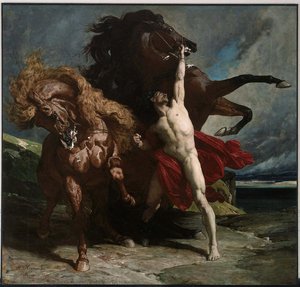
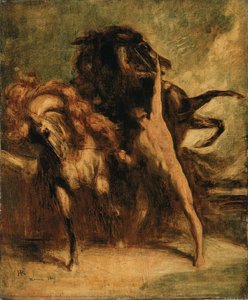
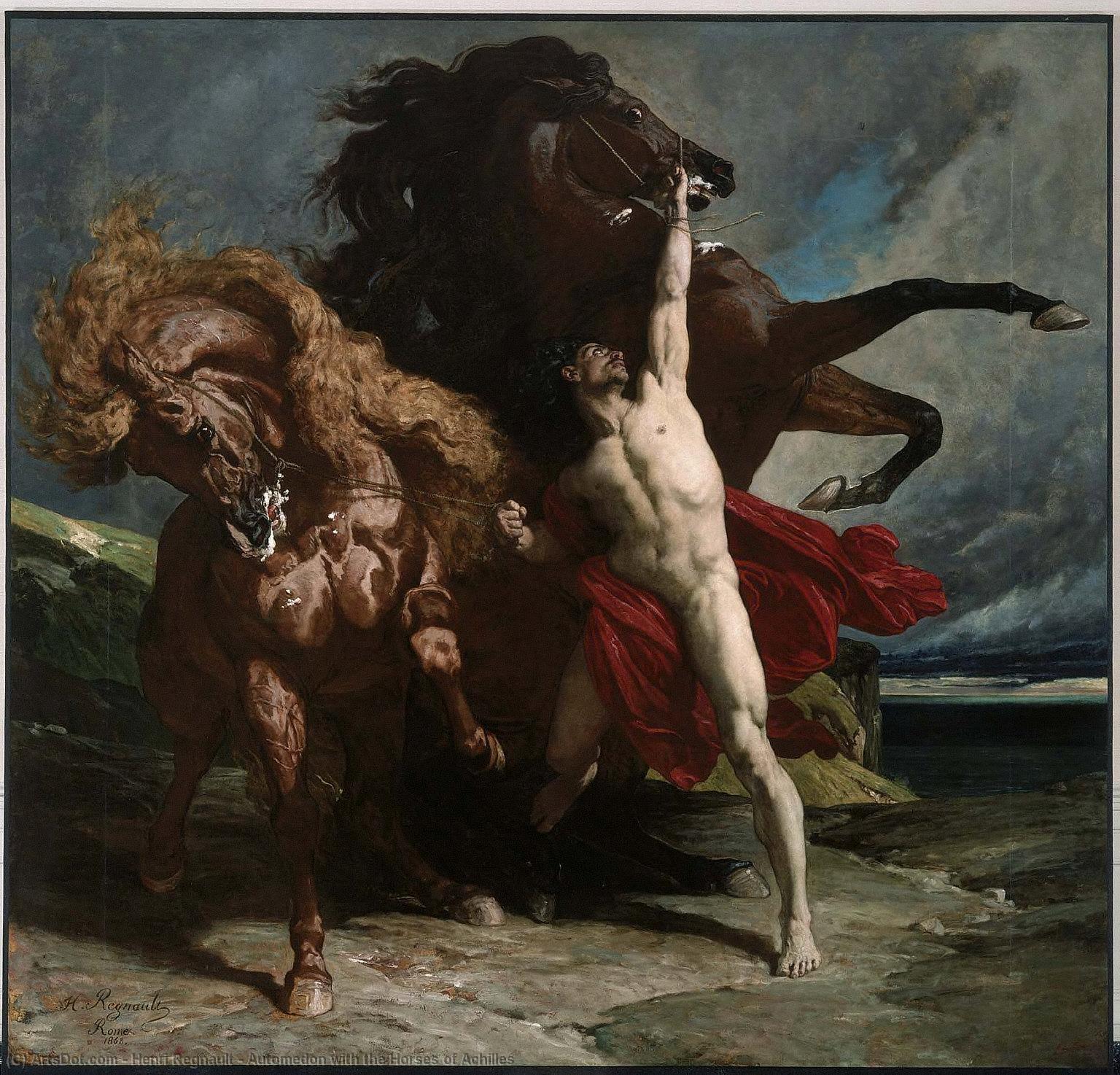
Automedon with the Horses of Achilles
 Oil On Canvas
- WallArt
- Academic Romanticism
 1868
1868 315.0 x 329.0 cm
 Museum of Fine Arts
 Read More
Hand Made Oil Reproduction
Hand-painted oil on canvas in your size and frame, made to order by our artists. ( Buy Print Buy Image)




P118B $10

P118H $10

P118W $10

P438Z $10

P508JH $12

P508YH $12

P805H $10

P805Z $10

P919BZ $10

P919G $10

P919XJ $10

P959ZH $10

P968JZ $12

W106C $8

W218G $10

W218JH $8

W218Y $10

W307PJ $10

W316G $10

W316PJ $8

W316Y $10

W398PJ $8

W4111J $10

W500HY $15

W500JH $15

W692G $12

W849H $8

W940BG $15

W953PJ $8




Pick from our preset sizes that match the artwork's original proportions.

You may enter your own dimensions to fit a specific frame or space. If your selected size does not match the original image's proportions, we will either crop the artwork or extend the painting with additional hand-painted elements. A digital mockup will be sent for your approval before production begins.
Please note that the on-screen preview does not reflect the actual cropping or extension. Only the mockup will accurately show the final composition.
While custom sizes are available, we recommend selecting a dimension from the predefined list to preserve the original proportions.
After order, ArtsDot.com team will email client for instructions and provide a mockup preview
Worldwide Delivery () in 3/4 weeks instead of standard 5 weeks. (16 August). No compromise on quality.

Free Worldwide Express Shipping

High-Quality Linen Canvas

Full Shipping Insurance

Customs Tax Refund Guarantee

True Color Matching Guarantee

60-Day Return Policy (Defects Only)

100% Money-Back Guarantee

Bulk Discount Offer
 Glass option is only available in size under 110 CM

Automedon with the Horses of Achilles
Reproduction Medium
Reproduction Size
-


Total Price
$ 263
Artwork Description
Henri Regnault’s “Automedon with the Horses of Achilles”: A Triumph of Romantic Idealism
The painting "Automedon with the Horses of Achilles," executed by Henri Regnault in 1868, stands as a monumental achievement of French Romantic art—a breathtaking spectacle that captures not merely visual beauty but also profound philosophical contemplation. More than just a depiction of mythic grandeur, it embodies the spirit of an era grappling with scientific advancement alongside lingering fascination for classical tradition and heroic narratives.Subject Matter and Narrative
At its core, Regnault’s masterpiece portrays Automedon, a legendary physician credited with reviving Achilles after his fatal wound in Homer's Iliad. Shown wrestling valiantly against two magnificent horses—representing Zeus and Poseidon—Achilles is depicted as a figure of unwavering determination battling divine forces. The scene unfolds on a sun-drenched beach, meticulously rendered to convey both the physicality of the struggle and the ethereal quality of the mythological realm. Regnault’s careful composition directs the viewer's gaze upwards towards the celestial bodies, subtly reinforcing the overarching theme of cosmic power versus human resilience.Style and Technique: Romantic Grandeur Embodied
Regnault’s artistic vision firmly rooted in the Romantic movement—a reaction against Enlightenment rationalism—is evident throughout “Automedon.” The painting utilizes a masterful blend of realism and idealized beauty, characteristic of the period's dominant aesthetic sensibilities. Employing oil paint on canvas with painstaking detail, Regnault achieved an astonishing level of luminosity and textural richness. He skillfully captured the shimmering surface of the water, the muscular contours of Achilles’ body, and the flowing mane of the horses—creating a sensory experience that transports the viewer to the heart of the mythological drama. The artist's meticulous attention to light and shadow contributes significantly to the painting’s dramatic impact, enhancing its emotional resonance.Historical Context: Bridging Classical Legacy and Scientific Curiosity
Painted during a time of significant intellectual upheaval—the burgeoning Victorian era saw advancements in science alongside renewed interest in classical art and literature—Regnault's work reflects this duality. The revival of Greek mythology served as inspiration for artists seeking to explore themes of heroism, fate, and the sublime—concepts deeply intertwined with Romantic thought. Simultaneously, Regnault’s technical prowess demonstrated the potential of scientific observation to illuminate artistic expression. He meticulously studied anatomy and optics, incorporating these insights into his depiction of human musculature and atmospheric perspective.Symbolism: Triumph Over Adversity and Divine Influence
“Automedon” is laden with symbolic significance. The horses represent Zeus and Poseidon—powerful deities who embody both divine authority and unpredictable forces of nature. Automedon’s struggle symbolizes humanity's confrontation with overwhelming challenges, highlighting the importance of courage and perseverance in overcoming obstacles. Furthermore, the beach setting evokes notions of purity and renewal—suggesting that even amidst chaos and suffering, beauty and vitality endure. The painting serves as a powerful reminder of the enduring human spirit’s capacity for resilience and wonder.Emotional Impact: A Vision of Sublime Beauty
Ultimately, Regnault's “Automedon with the Horses of Achilles” transcends mere visual representation; it aspires to evoke profound emotional responses in the viewer. The painting’s grandeur—both physical and conceptual—commands attention and inspires awe—capturing the sublime—a term popularized by Edmund Burke that describes experiences of terror and beauty simultaneously. It is a testament to Regnault's artistic genius, securing his place as one of the foremost painters of his time and continuing to captivate audiences today with its breathtaking artistry and timeless message of fortitude.Related Artworks
Artist Biography
A Brilliant Light Extinguished: The Life and Legacy of Henri Regnault
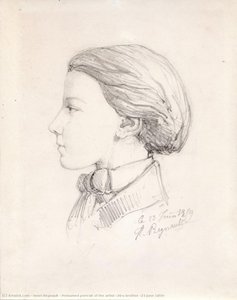
The history of nineteenth-century French art is often told through the lens of enduring movements, yet few figures embody the tragic intersection of immense promise and sudden loss as poignantly as Henri Regnault. Born in Paris in 1843 to the esteemed physicist Henri Victor Regnault, the young artist was raised within an atmosphere of intellectual rigor and scientific curiosity. This foundation of precision would later manifest in his breathtaking command over anatomical detail and light. His journey through the prestigious studios of Antoine Montfort, Louis Lamothe, and the celebrated Alexandre Cabanel provided him with a formidable academic toolkit, yet Regnault was never merely a student of tradition. He possessed an innate restlessness, a desire to push beyond the rigid boundaries of the École des Beaux-Arts to capture the visceral energy of the world around him.
Regnault’s ascent in the Parisian art world was nothing short of meteoric. The turning point of his early career arrived in 1866, when he secured the prestigious Prix de Rome. This triumph, achieved with his monumental work Thetis Bringing Vulcan’s Arms to Achilles, signaled the arrival of a master capable of blending classical grandeur with an unprecedented sense of movement and sculptural depth. While the award traditionally directed winners toward the study of antiquity in Italy, Regnault’s time in Rome and his travels through Spain and North Africa served to broaden his aesthetic horizons far beyond the classical canon. He found himself increasingly drawn to the Hispanophone-Italian school, a style that favored the materiality of life and the evocative power of capturing fleeting, everyday moments.
Mastery of the Dramatic and the Orientalist Vision
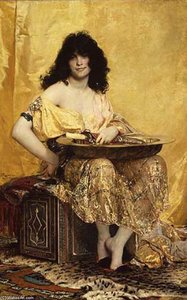
As his technique matured, Regnault’s work began to bridge the gap between academic precision and a burgeoning fascination with Orientalism and Spanish realism. He possessed a rare ability to infuse historical and biblical narratives with a contemporary, almost cinematic intensity. Nowhere is this more evident than in his most famous masterpiece, Salomé. Originally conceived as a portrait of an Italian model in Rome, the canvas underwent a dramatic transformation as Regnault expanded its scope, eventually completing it amidst the vibrant atmosphere of Tangier. The resulting painting is a sensory triumph; through disheveled hair, flowing drapery, and a palpable sense of tension, he captures the biblical temptress at the height of her seductive power, leaving viewers breathless with the sheer vitality of the brushwork.
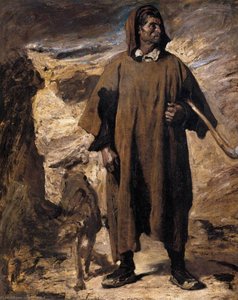
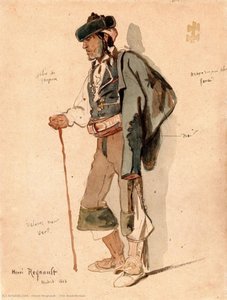
His repertoire was remarkably diverse, reflecting a deep engagement with both the mythic and the mundane. His ability to oscillate between the epic scale of Greek mythology—seen in works like Automedon with the Horses of Achilles—and the intimate, atmospheric studies of Spanish shepherds demonstrates an artist who refused to be pigeonholed. Regnault’s eye was uniquely attuned to the dynamism of urban centers and the rugged beauty of foreign landscapes, seeking to portray humanity not as static figures in a vacuum, but as living beings caught within the swirling currents of their era. His work often featured:
- Anatomical Precision: A profound understanding of the human form, inherited from his classical training.
- Luminous Color Palettes: An ability to use light to create depth and emotional resonance.
- Narrative Tension: The capacity to freeze a moment of high drama, making the mythological feel immediate and real.
A Tragic End and Lasting Significance
The trajectory of Regnault’s life was violently interrupted by the onset of the Franco-Prussian War. In a final, tragic act of devotion to his country, the artist laid down his brushes to take up arms. He fell on the field of battle in January 1871, at the tender age of twenty-seven. His death sent shockwaves through the Parisian art community, marking the loss of a talent that many believed would lead the next generation of French painters into a new era of brilliance.
Despite his short life, Regnault’s impact remains indelible. He stands as a pivotal figure who navigated the delicate transition between the structured traditions of the past and the expressive freedoms of the modern age. His works continue to captivate audiences in institutions such as The Metropolitan Museum of Art, serving as enduring testaments to a spirit that was as much about the pursuit of truth as it was about the pursuit of beauty. In the annals of art history, Henri Regnault remains a luminous star—a painter whose brief, intense flame left behind a glow that continues to illuminate the complexities of 19th-century realism and Orientalism.
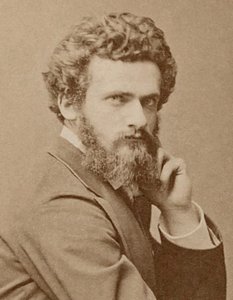
Henri Regnault
1843 - 1871 , France
Quick Facts
- Artistic Movement Or Style: Orientalism
- Artists Or Movements Influenced By This Artist: ['Spanish School']
- Artists Who Influenced This Artist:
- Jean-Auguste Dominique Ingres
- Gustave Courbet
- Date Of Birth: Paris, France (1843)
- Date Of Death: 1871
- Full Name: Henri Regnault
- Nationality: French
- Notable Artworks:
- Salomé
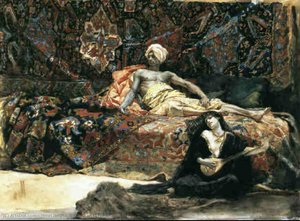
- Hassan Et Namouna
- The madrilenian
- Place Of Birth: Paris
Related Articles
Henri Matisse's Masterpieces: Explore 25 Iconic Paintings & Art Decor Ideas
Journey through Henri Matisse's 25 most iconic paintings! Explore Fauvism, vibrant colors & the stories behind masterpieces like 'The Dance'. Find museum-quality art reproductions and curated decor ideas to elevate your space. Discover all masterpieces on ArtsDot.com.
Echoes of Olympus: Mythological Narratives in Western Art Through the Ages
Explore the captivating history of mythological narratives in Western art! From ancient Greece to modern masterpieces, discover iconic artworks & symbolism. Expert analysis and high-quality reproductions at ArtsDot.
The Noble Steed on Canvas: A Historical & Artistic Exploration of Horse Painting Across Cultures
Explore the rich history of horse painting! Discover masterpieces from Stubbs to Munnings & learn about symbolism, techniques & artists. Find museum-quality reproductions at ArtsDot.
The Noble Steed: A Historical and Artistic Exploration of Horses in Fine Art
Explore the rich history of horses in fine art! From ancient depictions to Renaissance masterpieces & beyond, discover iconic artworks and artists. Learn about symbolism, techniques, and find museum-quality reproductions at ArtsDot.

The Equine Muse: A Historical & Artistic Exploration of Horses in Painting
Explore the captivating history of horses in painting! Discover Renaissance masterpieces, Baroque grandeur & expert insights for collecting equestrian art. Learn about symbolism, techniques & lasting value with ArtsDot.