Preview
 Send
Send Share
Share
 Details

 Download
 Similars
 X-Ray
X-Ray Diaporama
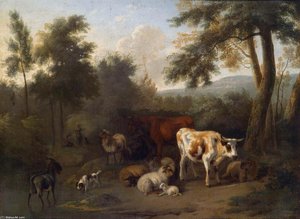
Wooded Landscape
 Romanticism
 49.0 x 65.0 cm
 Read More
Giclée / Art Print
Museum-quality giclée or canvas print with fast production and flexible finish options. ( Buy Hand Made Painting Buy Image)




































Pick from our preset sizes that match the artwork's original proportions.

You may enter your own dimensions to fit a specific frame or space. If your selected size does not match the original image's proportions, we will either crop the artwork or extend the image with a mirrored or solid-fill edge. A digital mockup will be sent for your approval before production begins.
Please note that the on-screen preview does not reflect the actual cropping or extension. Only the mockup will accurately show the final composition.
While custom sizes are available, we recommend selecting a dimension from the predefined list to preserve the original proportions.
Worldwide Delivery () in 2 weeks instead of standard 4/5 weeks. (26 August)

Free Worldwide Express Shipping

High-Quality Linen Canvas

Full Shipping Insurance

Customs Tax Refund Guarantee

True Color Matching Guarantee

60-Day Return Policy (Defects Only)

100% Money-Back Guarantee

Bulk Discount Offer
 Glass option is only available in size under 110 CM

Wooded Landscape
Giclée / Art Print
Reproduction Size
-


Total Price
$ 63
Related Artworks
Artist Biography
A Legacy of Landscapes: The Life and Art of Jan van der Meer the Younger
Jan van der Meer the Younger, a name perhaps less instantly recognizable than some of his Golden Age contemporaries, nevertheless occupies an important niche in the history of Dutch landscape painting. Born in Haarlem in 1656, he inherited a rich artistic tradition from his father, Jan Vermeer van Haarlem the Elder, and blossomed into a skilled interpreter of Italianate scenes imbued with a distinctly Northern sensibility. While biographical details remain somewhat sparse, we can piece together a portrait of an artist deeply connected to his family, his guild, and the evolving tastes of 17th-century Holland. Baptized on November 29, 1656, young Jan received his initial training from his father, laying the foundation for a career dedicated to capturing the beauty of both Dutch and imagined Italian landscapes. This familial influence would prove pivotal in shaping his artistic trajectory.Following in His Father’s Footsteps: Early Influences and Training
The elder Vermeer van Haarlem was already an established landscape painter, known for his verdant, often dramatic compositions. Jan the Younger initially absorbed his father's style—a heavy emphasis on green and yellow tonalities characterized these early works. However, he didn’t simply replicate his progenitor’s vision. A crucial turning point came with his embrace of the artistic principles espoused by Nicolaes Berchem. Berchem, celebrated for his idyllic pastoral scenes featuring shepherds, flocks, and classical ruins, exerted a profound influence on Jan van der Meer II's subject matter and overall aesthetic. This mentorship led to a shift towards more Italianate settings, populated with figures reminiscent of Berchem’s signature style. The artist’s brother, Isaac Vermeer, also pursued a painting career, further embedding art within the family dynamic. His marriage in 1681 to the sister of Cornelis Dusart, another Haarlem painter, solidified his connections within the local artistic community and signaled a period of professional stability.Guild Membership and Artistic Practice
In 1681-1683, Jan van der Meer II joined the prestigious Haarlem Guild of St. Luke, a significant step in establishing his credentials as a master painter. This affiliation provided access to commissions, networks, and opportunities for professional advancement. While he appears to have spent some time in Amsterdam, he consistently returned to Haarlem, where he built his career. His paintings typically depict shepherds tending their flocks amidst rolling hills, sun-dappled meadows, and distant mountains—scenes that evoke a sense of tranquility and harmony. He signed his works “J v der meer de jonge” (Jan van der Meer the Younger), distinguishing himself from his father while acknowledging his lineage. His drawings, often executed in red or black chalk with watercolor accents, reveal a meticulous attention to detail and a keen observational skill.A Dilution of Style? Van der Meer’s Place within the Dutch Landscape Tradition
Art historians have sometimes characterized Jan van der Meer II's work as a “dilution” rather than a true development of Berchem’s style. This assessment isn’t necessarily negative; it suggests that he skillfully adapted and refined existing conventions, creating paintings that were pleasing to contemporary audiences but perhaps lacked the groundbreaking originality of his mentor. He wasn’t striving for radical innovation, but rather for a harmonious blend of Dutch realism and Italianate romanticism. His landscapes possess a quiet charm and technical proficiency, appealing to collectors who favored idyllic scenes over more dramatic or challenging compositions. The Art Institute of Chicago holds examples of his work, including “Bull Grazing and Three Sheep,” which exemplifies his characteristic style—a peaceful pastoral scene rendered with delicate brushwork and subtle color variations. His association with artists like Simon van der Does and Dirk van Bergen further illustrates his position within a broader circle of painters who embraced and adapted Berchem’s aesthetic.Historical Significance and Enduring Appeal
Jan van der Meer the Younger died in Haarlem in 1705, leaving behind a body of work that offers valuable insights into the tastes and artistic practices of the Dutch Golden Age. While he may not be as widely celebrated as some of his peers, his paintings continue to captivate viewers with their serene beauty and technical skill. His landscapes provide a window into a world where nature is idealized, harmony reigns supreme, and the simple pleasures of rural life are celebrated. His work serves as a reminder that artistic influence isn’t always about revolution; sometimes it's about skillful adaptation, refinement, and the creation of paintings that resonate with the sensibilities of their time. His legacy lies in his ability to seamlessly blend the traditions of his father with the idyllic visions of Berchem, creating landscapes that continue to evoke a sense of peace and tranquility centuries later.
jan the younger vermeer van haarlem
1656 - 1705 , Netherlands
Quick Facts
- Artistic Movement Or Style: Dutch Golden Age landscape
- Artists Who Influenced This Artist:
- Jan Vermeer van Haarlem the Elder
- Nicolaes Berchem
- Date Of Birth: 1656
- Date Of Death: 1705
- Full Name: Jan van der Meer II
- Nationality: Dutch
- Place Of Birth: Haarlem, Netherlands
Related Articles
Jan van Goyen: Master of Dutch Landscape & Atmospheric Perspective
Discover Jan van Goyen, the master of Dutch landscape painting. Explore his subtle technique, atmospheric realism & lasting influence on art history. Learn about this 17th-century pioneer at ArtsDot.

Early Netherlandish Masters: 10 Paintings That Revolutionized Art & Decor
Journey into the Early Netherlandish Renaissance! Explore 10 iconic paintings by Jan van Eyck, Rogier van der Weyden & more. Discover stunning detail, symbolism, and oil painting techniques. Find museum-quality art reproductions for your home at ArtsDot.com.

Early Netherlandish Masters: 10 Paintings That Revolutionized Art & Decor
Journey into the world of Early Netherlandish painting! Explore 10 masterpieces by Jan van Eyck, Rogier van der Weyden & more. Discover stunning detail, symbolism & Renaissance art for your home decor. Find museum-quality reproductions on ArtsDot.com
Cornelis van Poelenburch: Bridging Mannerism & the Dutch Baroque Landscape
Discover Cornelis van Poelenburch, a pivotal Dutch Baroque landscape painter bridging Mannerism & Italianate styles. Explore his life, key works, and lasting influence on 17th-century art with ArtsDot.

Rembrandt's Masterpieces: Explore 25 Iconic Paintings & Prints | ArtsDot
Journey through Rembrandt van Rijn's 25 most iconic paintings & etchings. Explore Dutch Golden Age masterpieces, dramatic chiaroscuro, and timeless portraits. Find museum-quality art reproductions to elevate your home decor on ArtsDot.com.