 Preview
 Send
Send Share
Share
 Details

 Download
 Similars
 X-Ray
X-Ray Diaporama
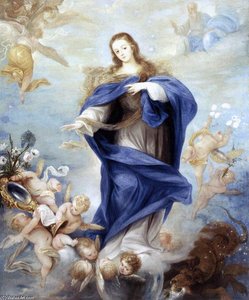
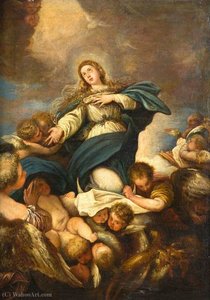
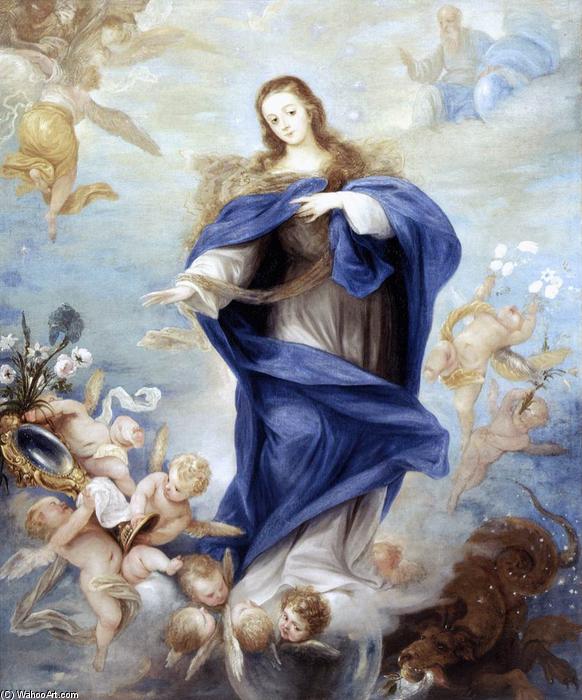
Immaculate Conception
 Baroque
 1663
1663 206.0 x 173.0 cm
 Szépmûvészeti Múzeum
 Read More
Hand Made Oil Reproduction
Hand-painted oil on canvas in your size and frame, made to order by our artists. ( Buy Print Buy Image)




P118B $10

P118H $10

P118W $10

P438Z $10

P508JH $12

P508YH $12

P805H $10

P805Z $10

P919BZ $10

P919G $10

P919XJ $10

P959ZH $10

P968JZ $12

W106C $8

W218G $10

W218JH $8

W218Y $10

W307PJ $10

W316G $10

W316PJ $8

W316Y $10

W398PJ $8

W4111J $10

W500HY $15

W500JH $15

W692G $12

W849H $8

W940BG $15

W953PJ $8




Pick from our preset sizes that match the artwork's original proportions.

You may enter your own dimensions to fit a specific frame or space. If your selected size does not match the original image's proportions, we will either crop the artwork or extend the painting with additional hand-painted elements. A digital mockup will be sent for your approval before production begins.
Please note that the on-screen preview does not reflect the actual cropping or extension. Only the mockup will accurately show the final composition.
While custom sizes are available, we recommend selecting a dimension from the predefined list to preserve the original proportions.
After order, ArtsDot.com team will email client for instructions and provide a mockup preview
Worldwide Delivery () in 3/4 weeks instead of standard 5 weeks. (17 August). No compromise on quality.

Free Worldwide Express Shipping

High-Quality Linen Canvas

Full Shipping Insurance

Customs Tax Refund Guarantee

True Color Matching Guarantee

60-Day Return Policy (Defects Only)

100% Money-Back Guarantee

Bulk Discount Offer
 Glass option is only available in size under 110 CM

Immaculate Conception
Reproduction Medium
Reproduction Size
-


Total Price
$ 263
Artwork Description
Artistic Style and Symbolism
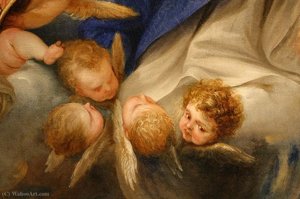
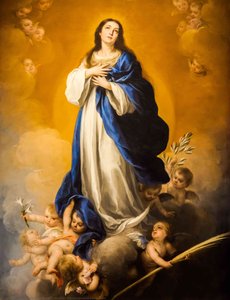
The Immaculate Conception depicts the Virgin Mary as she is conceived without original sin, surrounded by various figures that are likely angels or cherubs. The central figure of Mary is shown with a serene expression, adorned with a blue cloak, which is often associated with purity and divinity in religious iconography. The background of the painting features a soft, ethereal sky filled with clouds, suggesting a heavenly setting. Key Features of the painting include:- The use of light and shadow to create a sense of depth and three-dimensionality
- The intricate details on the angels' wings and clothing, adding a sense of realism and texture to the work
- The dramatic use of color, with rich hues and subtle shading
Artist and Museum
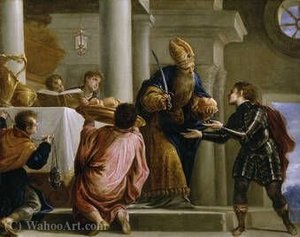
The painting is signed by Juan Antonio Frias Y Escalante, indicating the name of the artist who created this piece. The Szépmûvészeti Múzeum in Budapest, Hungary, is home to an impressive collection of art, including works by other notable artists such as Gerbrand Van Den Eeckhout and Luis Tristán De Escamilla. For more information on these artists and their works, visit /art/list/?Filter=8XZE96-Gerbrand-Van-Den-Eeckhout-Prophet-Eliseus-and-the-Woman-of-Sunem-(detail) and /art/list/?Filter=8Y3KFY-Luis-Tristan-De-Escamilla-The-Adoration-of-the-Magi.The Immaculate Conception is a remarkable example of 17th-century art, showcasing the skill and craftsmanship of Juan Antonio Frias Y Escalante. To learn more about this painting and other works by the artist, visit /art/list/?Filter=8Y39FD-Juan-Antonio-Frias-Y-Escalante-Immaculate-Conception.
Related Artworks
Artist Biography
A Brief but Brilliant Flame: The Life of Juan Antonio Frias y Escalante
The history of the Spanish Baroque is often told through the lens of long-lived masters, yet the legacy of Juan Antonio Frias y Escalante serves as a poignant reminder of how profound impact can be achieved even within a tragically short lifetime. Born in the historic city of Córdoba in 1633, Frias y Escalante was destined for the upper echelons of Spanish society, possessing an aristocratic lineage that provided him with early access to the most prestigious artistic circles. His journey took him from the heart of Andalusia to the vibrant, bustling court of Madrid, where he sought to refine his craft under the guidance of Francisco Ricci. This formative period in Madrid was crucial, as it allowed him to integrate the rigorous discipline of disegno—the Italian emphasis on anatomical precision and structural clarity—with the burgeoning theatricality of the Spanish Golden Age.
Tragically, the same vitality that fueled his creative output was cut short by tuberculosis, claiming his life in 1669 at the tender age of thirty-six. Despite this brevity, the period between his training and his untimely death represents a concentrated burst of artistic evolution. His work does not merely reflect the Spanish tradition; rather, it acts as a bridge where the solemnity of Spanish piety meets the luminous, sweeping grandeur of the Venetian school. Through his brush, the heavy shadows of the Baroque were infused with a new, rhythmic light, creating a visual language that felt both deeply local and cosmopolitally sophisticated.
Venetian Echoes and the Mastery of Light
What distinguishes Frias y Escalante from many of his contemporaries was his profound fascination with the masters of Venice. He did not simply observe the works of Tintoretto and Veronese; he internalized their very essence. By studying the monumental compositions of Veronese, particularly the complex orchestration of figures in large-scale narrative scenes, Frias y Escalante learned to manipulate perspective and color to create a sense of immersive depth. His canvases often feature a masterful use of chiaroscuro, where dramatic shifts between light and shadow serve not just as aesthetic tools, but as emotional conductors that guide the viewer's eye through complex biblical narratives.
This Venetian influence allowed him to move beyond static portraiture or simple devotional images toward a more theatrical style of storytelling. In his hands, the canvas became a stage where light acts as a divine protagonist. His ability to blend the meticulous anatomical accuracy learned from Ricci with the atmospheric, painterly textures of the Italian masters resulted in works that possessed a unique, shimmering quality. This synthesis of styles allowed him to capture the monumental scale of religious events while maintaining an intimate, palpable sense of human emotion.
Devotion in Paint: Religious Themes and Lasting Legacy
The heart of Frias y Escalante’s oeuvre lies in his unwavering commitment to religious iconography, a reflection of the intense spiritual climate of 17th-century Spain. His paintings were designed to evoke awe, piety, and a direct connection to the divine. This is perhaps most evident in his treatment of Marian themes and the lives of the saints, where he utilized his technical prowess to render the miraculous as something both breathtaking and tangibly real.
Several of his works stand as pillars of his artistic achievement:
- The Immaculate Conception: A 1663 masterpiece that showcases his ability to weave intricate detail with a sense of celestial grace, embodying the height of Baroque devotional art.
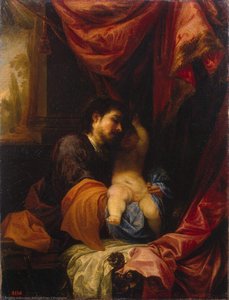
- St. Joseph and the Infant Christ: A work that highlights his capacity for tenderness, stripping away the grandiosity of the era to focus on the quiet, profound intimacy of the Holy Family.
- The Conversion of St. Paul: An exhibition of his dramatic skill, where he employs sweeping movement and intense light to capture one of the most pivotal moments in Christian history.
Though his career was cut short, the historical significance of Juan Antonio Frias y Escalante remains undiminished. He stands as a vital link in the evolution of Spanish painting, proving that the infusion of foreign stylistic elements—specifically the Venetian approach to color and light—could enrich the traditional Spanish focus on spiritual intensity. His work continues to resonate as a testament to a life lived with immense passion, leaving behind a visual record of beauty, drama, and enduring faith.
Juan Antonio Frias y Escalante
1633 - 1669 , Spain
Quick Facts
- Artistic Movement Or Style: Baroque
- Artists Or Movements Influenced By This Artist: ['Venetian Painting']
- Artists Who Influenced This Artist:
- Tintoretto
- Veronese
- Date Of Birth: 1633
- Full Name: Juan Antonio de Frías y Escalante
- Nationality: Spanish
- Notable Artworks: ['Immaculate Conception']
- Place Of Birth: Cordoba, Spain
Related Articles
Juan de Valdés Leal: Baroque Realism, Memento Mori & Theatricality of Spanish Grief
Explore the powerful Baroque realism of Juan de Valdés Leal (1622-1690). Discover his somber masterpieces, iconic 'In Ictu Oculi', and profound explorations of mortality. Museum-quality reproductions available at ArtsDot.
The Golden Age Reforged: Dramatic Realism & Religious Zeal in Spanish Baroque Art
Explore the dramatic world of Spanish Baroque art! Discover masters like Zurbarán & the powerful influence of religious zeal on painting techniques – a guide for collectors and enthusiasts.

The Dramatic Flourish: Exploring the Baroque Movement's Enduring Legacy in Art History
Explore the dramatic world of Baroque art! Discover iconic artists like Caravaggio & Rubens, defining techniques, and its lasting impact on art history. Expert insights for collectors & enthusiasts at ArtsDot.

Baroque Masterpieces: 10 Paintings That Defined an Era |
Journey through the drama & grandeur of Baroque art! Explore 10 masterpieces by Caravaggio, Rembrandt, Rubens & more. Discover stunning oil paintings, rich colors & timeless stories. Find museum-quality reproductions at .

Baroque Drama: Bringing Opulence & Emotion into Contemporary Interiors
Explore the opulent world of Baroque interior design! Discover key elements, modern applications & how to bring dramatic elegance into your home with 's authentic reproductions.