 Preview
 Send
Send Share
Share
 Details

 Download
 Similars
 X-Ray
X-Ray Diaporama
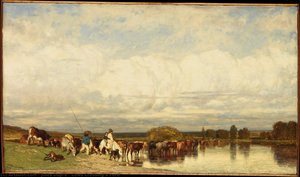
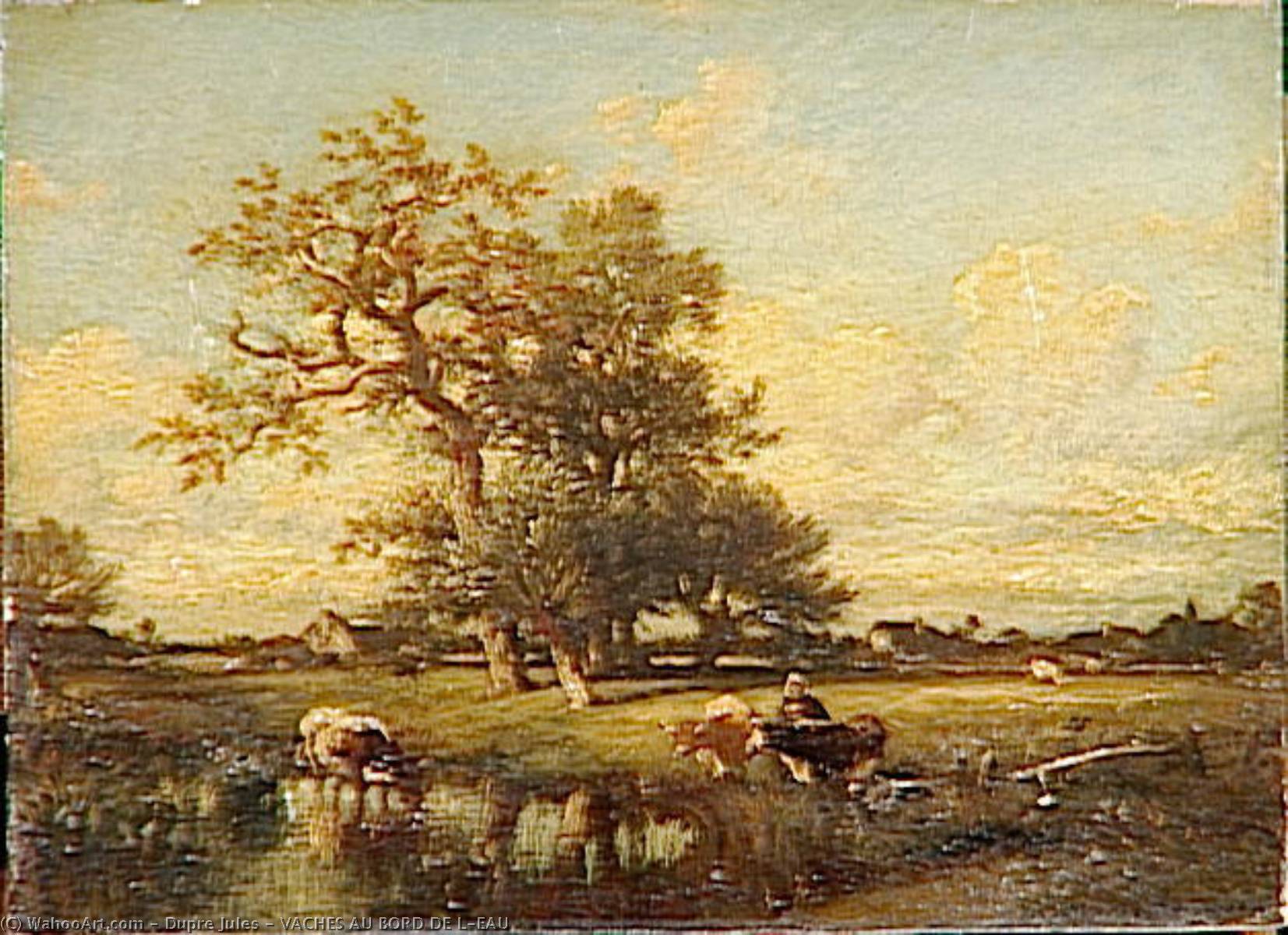
VACHES AU BORD DE L'EAU


 Read More
Hand Made Oil Reproduction
Hand-painted oil on canvas in your size and frame, made to order by our artists. ( Buy Print Buy Image)




P118B $10

P118H $10

P118W $10

P438Z $10

P508JH $12

P508YH $12

P805H $10

P805Z $10

P919BZ $10

P919G $10

P919XJ $10

P959ZH $10

P968JZ $12

W106C $8

W218G $10

W218JH $8

W218Y $10

W307PJ $10

W316G $10

W316PJ $8

W316Y $10

W398PJ $8

W4111J $10

W500HY $15

W500JH $15

W692G $12

W849H $8

W940BG $15

W953PJ $8




Pick from our preset sizes that match the artwork's original proportions.

You may enter your own dimensions to fit a specific frame or space. If your selected size does not match the original image's proportions, we will either crop the artwork or extend the painting with additional hand-painted elements. A digital mockup will be sent for your approval before production begins.
Please note that the on-screen preview does not reflect the actual cropping or extension. Only the mockup will accurately show the final composition.
While custom sizes are available, we recommend selecting a dimension from the predefined list to preserve the original proportions.
After order, ArtsDot.com team will email client for instructions and provide a mockup preview
Worldwide Delivery () in 3/4 weeks instead of standard 5 weeks. (17 August). No compromise on quality.

Free Worldwide Express Shipping

High-Quality Linen Canvas

Full Shipping Insurance

Customs Tax Refund Guarantee

True Color Matching Guarantee

60-Day Return Policy (Defects Only)

100% Money-Back Guarantee

Bulk Discount Offer
 Glass option is only available in size under 110 CM

VACHES AU BORD DE L'EAU
Reproduction Medium
Reproduction Size
-


Total Price
$ 263
Artwork Description
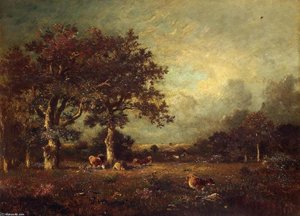
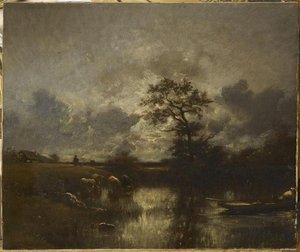
A Tempestuous Vision of Pastoral Tranquility: Exploring Jules Dupré’s “Vaches au Bord de l'Eau”
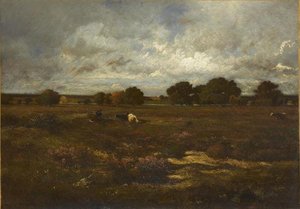
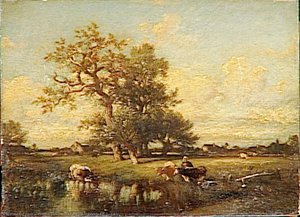
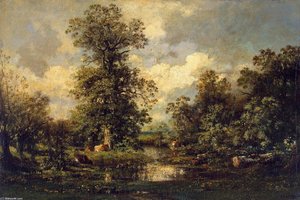
Jules Dupré’s “Vaches au Bord de l’Eau,” painted in 1875, stands as a remarkable testament to the Barbizon School’s distinctive approach to landscape art—a radical departure from the idealized beauty championed by many of his contemporaries. More than simply depicting cows grazing peacefully beside a pond; Dupré confronts us with an unsettling grandeur, capturing not serenity but the palpable drama of impending storm. This juxtaposition is precisely what elevates “Vaches au Bord de l’Eau” beyond mere visual representation and into a profound meditation on the sublime—that elusive state of awe and terror induced by confronting forces far greater than human comprehension.The Barbizon Spirit: Raw Observation and Emotional Depth
The Barbizon School, emerging in France during the mid-19th century, rejected academic conventions favoring meticulous detail and polished surfaces. Instead, artists like Dupré prioritized direct observation of nature—spending countless hours outdoors sketching and painting en plein air—to convey genuine emotion. This commitment to authenticity is immediately apparent in “Vaches au Bord de l’Eau,” where the brushstrokes are bold and expressive, capturing the turbulent energy of the approaching storm clouds with remarkable accuracy. Unlike Corot's softer landscapes, Dupré sought to evoke a visceral response from the viewer, mirroring his own internal struggles with the overwhelming power of the natural world.Composition and Technique: Mastering Atmospheric Perspective
Dupré’s masterful compositional choices contribute significantly to the painting’s dramatic impact. The central tree dominates the scene, serving as an anchor for the eye while simultaneously symbolizing resilience against adversity—a motif prevalent throughout Barbizon art. Horizontal lines delineate the water's edge and horizon, establishing a sense of stability amidst the swirling chaos above. However, Dupré skillfully employs atmospheric perspective—reducing color intensity and detail in distant objects—to create depth and heighten the feeling of isolation. This technique is particularly effective in portraying the misty hills receding into the background, reinforcing the painting’s melancholic beauty. The artist utilized oil paint on canvas, layering thin glazes to achieve luminous effects and capturing subtle tonal variations that convey the mood of twilight.Symbolism Beyond the Surface: Confronting Fear and Finding Beauty
“Vaches au Bord de l’Eau” transcends its literal depiction of cows and a pond; it speaks to universal themes of fear, vulnerability, and transcendence. The cows themselves represent innocence and pastoral simplicity—a poignant contrast to the looming storm. Yet, Dupré doesn't portray them as victims of circumstance but rather as witnesses to the sublime spectacle unfolding before their eyes. This suggests that even in moments of terror, beauty can be found—that confronting darkness illuminates the light. The painting’s brooding palette—dominated by muted greens and browns punctuated by flashes of grey—underscores this emotional complexity.A Legacy of Intensity: Influence on Later Artists
Dupré's uncompromising vision profoundly influenced subsequent generations of landscape painters, establishing a precedent for conveying emotion with unflinching honesty. His work continues to inspire artists today who strive to capture the essence of nature’s grandeur and vulnerability—a testament to the enduring power of Barbizon art and Jules Dupré’s singular ability to transform observation into unforgettable experience. The painting resides in the Louvre Museum (RF 1418), offering visitors a chance to contemplate this iconic masterpiece firsthand.Related Artworks
Artist Biography
The Dramatic Soul of Barbizon
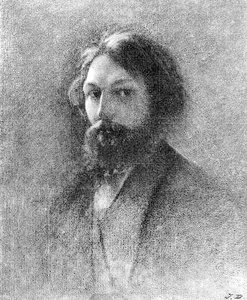
Jules Dupré (1811–1889) stands as a cornerstone figure within the Barbizon School, an artistic movement that championed raw observation and emotional resonance in landscape painting. Unlike his contemporaries like Corot who often sought lyrical beauty and tranquil stillness, Dupré wrestled with the darker, more tempestuous side of nature. He possessed a unique ability to capture the fury of storms, the melancholic grandeur of twilight, and the relentless energy of the elements, conveying these experiences with unparalleled intensity. Born in Nantes, France, Dupré’s artistic journey began amidst a burgeoning fascination for the natural world and its capacity to evoke profound, often turbulent, human feelings.
His early life provided a foundation of meticulous attention to detail and an appreciation for craftsmanship, qualities honed by his father’s porcelain manufacturing business. This formative experience would later translate into his own artistic endeavors, particularly evident in his early works exploring the intricacies of ceramic decoration. As an apprentice porcelain decorator, he learned the discipline of fine lines and textures, a skill set that would eventually evolve into his masterful handling of atmospheric depth and organic forms.
A Vision Shaped by Storm and Sky
The trajectory of Dupré’s career was irrevocably shaped by his encounter with the groundbreaking canvases of John Constable. This exposure to English landscape traditions ignited a desire to capture the essence of nature’s dynamism—the relentless push and pull of wind-driven foliage and the dramatic interplay of light and shadow during the most volatile hours of the day. Traveling to Great Britain in 1831, Dupré made profound studies of these English masters, returning to France with a portfolio of imagery that would redefine his approach to the landscape.
He found particular inspiration in the coastal districts around Southampton and Plymouth. These vast expanses of water, reflecting turbulent skies, provided him with the perfect laboratory to study the tempestuous motion of storm clouds and the movement of seas. His paintings from this period are not merely depictions of scenery; they are visceral expressions of mood and feeling, imbued with a palpable sense of drama and even sorrow. By embracing the Barbizon aesthetic, Dupré prioritized expressive color palettes and bold brushstrokes over idealized or polished representations, allowing the texture of the paint itself to mirror the ruggedness of the earth.
Legacy of the Barbizon Master
As a key figure in the Barbizon group, Dupré developed close ties with other legendary painters, including Théodore Rousseau. His rise within the French art establishment was marked by significant milestones, such as his acceptance into the Salon and receiving official recognition through medals for his landscapes. His work became synonymous with a certain sonorous and resonant color harmony, where the light of a setting sun or the gloom of an approaching gale could be felt by the viewer as much as seen.
Today, Jules Dupré is remembered as one of the most influential 19th-century French landscape artists. His contribution to art lies in his ability to bridge the gap between pure observation and romantic emotion. Through works such as La Petite Charrette, Cows Crossing a Ford, and his evocative depictions of river landscapes, he taught generations of artists that nature is not just a subject to be painted, but a powerful force to be experienced. His legacy remains etched in the heavy, atmospheric textures and the dramatic, breathing skies that continue to captivate the modern imagination.
jules dupré
1811 - 1889 , France
Quick Facts
- Artistic Movement Or Style: Barbizon School
- Artists Or Movements Influenced By This Artist: ['Romantic Painting']
- Artists Who Influenced This Artist: ['Constable']
- Date Of Birth: Nantes, France (1811)
- Date Of Death: October 6, 1889
- Full Name: Jules Dupré
- Nationality: French
- Notable Artworks:
- Morning and Evening at the Louvre
- Crossing the Bridge in the Wallace Collection
- Place Of Birth: France
Related Articles
The Barbizon School: Pioneering Realism & the Pastoral Vision in 19th-Century French Painting
Explore the Barbizon School's pivotal role in 19th-century French painting. Discover how these artists revolutionized landscape art with their commitment to Realism and a profound connection to nature. Learn about key figures like Rousseau, Millet & Corot.

Beyond the Horizon: 10 Landscape Masterpieces for Your Home Decor
Journey through 10 breathtaking landscape paintings by Monet, Van Gogh & more! Explore iconic artworks, artistic techniques & find inspiration for your home decor. Museum-quality reproductions at ArtsDot.com. Discover all masterpieces on ArtsDot.com
Evoking Nature's Sublime: A Comprehensive Exploration of 19th-Century Landscape Painting
Explore the captivating world of 19th-century landscape painting! Discover renowned artists like Friedrich & Monet, key movements, and find the perfect artwork to bring nature's serenity into your home. Expert insights at ArtsDot.
Idyllic Visions: Exploring the Pastoral Scene in Art History – From Arcadia to Modern Interpretations
Explore the captivating history of pastoral art from classical Arcadia to modern masterpieces. Discover key artists like Millet & Cole at ArtsDot. Find serene landscape paintings for your home.
Idyllic Visions: Exploring the Pastoral Tradition in Western Art – Themes, Techniques & Enduring Appeal
Explore the rich history of pastoral art from classical Arcadia to contemporary interpretations. Discover key artists, themes & collecting tips at ArtsDot.