 Preview
 Send
Send Share
Share
 Details

 Download
 Similars
 X-Ray
X-Ray Diaporama
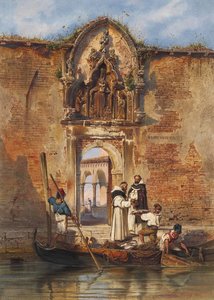
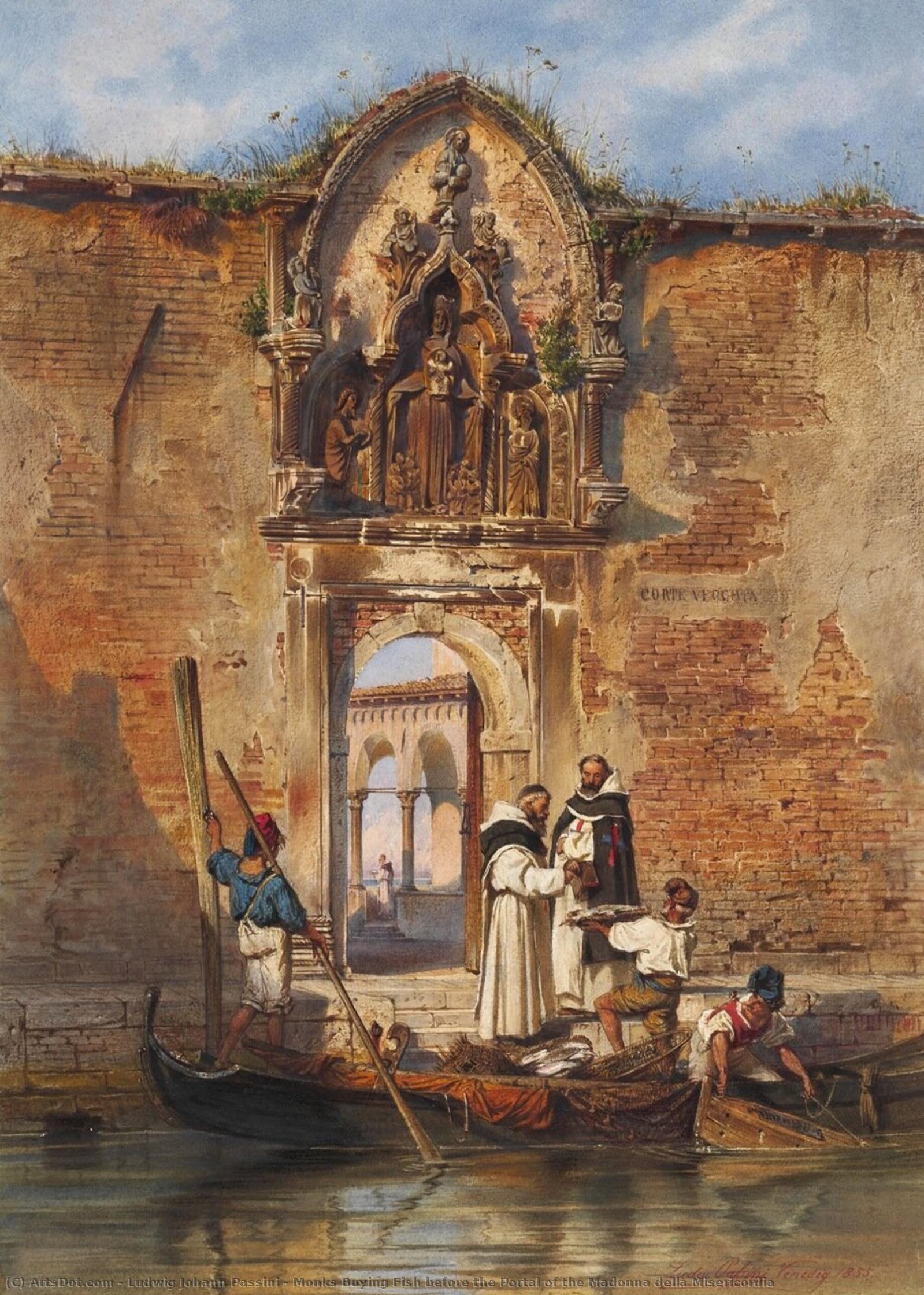
Monks Buying Fish before the Portal of the Madonna della Misericordia
 Acrylic On Canvas
- WallArt
- Genre Painting
 1855
1855 47.0 x 33.0 cm
 National Gallery of Art
 Read More
Giclée / Art Print
Museum-quality giclée or canvas print with fast production and flexible finish options. ( Buy Hand Made Painting Buy Image)




P118B $10

P118H $10

P118W $10

P438Z $10

P508JH $12

P508YH $12

P805H $10

P805Z $10

P919BZ $10

P919G $10

P919XJ $10

P959ZH $10

P968JZ $12

W106C $8

W218G $10

W218JH $8

W218Y $10

W307PJ $10

W316G $10

W316PJ $8

W316Y $10

W398PJ $8

W4111J $10

W500HY $15

W500JH $15

W692G $12

W849H $8

W940BG $15

W953PJ $8




Pick from our preset sizes that match the artwork's original proportions.

You may enter your own dimensions to fit a specific frame or space. If your selected size does not match the original image's proportions, we will either crop the artwork or extend the image with a mirrored or solid-fill edge. A digital mockup will be sent for your approval before production begins.
Please note that the on-screen preview does not reflect the actual cropping or extension. Only the mockup will accurately show the final composition.
While custom sizes are available, we recommend selecting a dimension from the predefined list to preserve the original proportions.
Worldwide Delivery () in 2 weeks instead of standard 4/5 weeks. (2 September)

Free Worldwide Express Shipping

High-Quality Linen Canvas

Full Shipping Insurance

Customs Tax Refund Guarantee

True Color Matching Guarantee

60-Day Return Policy (Defects Only)

100% Money-Back Guarantee

Bulk Discount Offer
 Glass option is only available in size under 110 CM

Monks Buying Fish before the Portal of the Madonna della Misericordia
Giclée / Art Print
Reproduction Size
-


Total Price
$ 63
A Moment of Grace: Ludwig Passini’s Venetian Chronicle
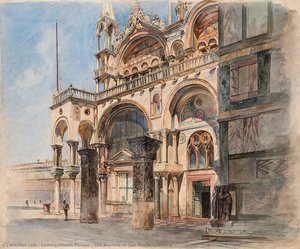
Ludwig Johann Passini's “Monks Buying Fish before the Portal of the Madonna della Misericordia,” painted in 1855, isn’t merely a depiction of a marketplace scene; it’s a carefully constructed tableau brimming with quiet spirituality and the everyday rhythms of Venetian life. The painting transports us to a sun-drenched corner of the city, where the mundane act of purchasing fish becomes imbued with a profound sense of reverence. Passini, a master of genre painting, skillfully captures not just the visual details – the worn brickwork of the church façade, the vibrant colors of the fish, the simple robes of the monks – but also the palpable atmosphere of community and faith.
The composition is remarkably balanced, drawing our eye to the central figures engaged in their transaction. Two men, likely merchants and monks respectively, stand close together, their gestures suggesting a comfortable familiarity. Around them, other individuals bustle about, creating a sense of lively activity that contrasts subtly with the solemnity of the religious portal looming behind. Notice how Passini uses light – dappled sunlight filtering through the buildings – to create depth and highlight key elements within the scene. The artist’s meticulous attention to detail, from the texture of the fish scales to the folds in the monks' garments, speaks volumes about his dedication to realism and his ability to capture the essence of a particular moment in time.
The Madonna della Misericordia: A Focal Point of Devotion
Understanding the context surrounding this painting is crucial to appreciating its deeper meaning. The “Madonna della Misericordia” (Our Lady of Mercy) was a significant devotional image within Venice, and Passini’s choice to depict monks purchasing fish before its portal immediately connects the scene to religious practice. The Madonna della Misericordia was associated with charity and compassion – themes central to Venetian society at the time. The act of buying fish, therefore, isn't simply about acquiring sustenance; it represents a contribution to the community, an embodiment of mercy and generosity.
Furthermore, the portal itself acts as a visual anchor, framing the scene with its architectural grandeur. The weathered brickwork and arched doorway suggest centuries of devotion, grounding the contemporary transaction in a rich historical tradition. The painting subtly invites us to contemplate the intersection between faith, commerce, and daily life – a theme that resonated deeply within the Venetian culture of the 19th century.
Technique and Style: A Masterful Blend
Passini’s technique is characterized by a remarkable blend of realism and sensitivity. He employed watercolor and gouache on paper, creating a luminous quality that perfectly captures the light and atmosphere of Venice. The artist's use of layering and glazing techniques allows him to build up color gradually, achieving subtle variations in tone and texture. Observe how he renders the reflections on the wet fish – a testament to his keen eye for detail and his ability to capture fleeting moments of beauty.
The painting’s style is firmly rooted in the academic tradition, yet it possesses a distinctly Venetian sensibility. Passini was influenced by artists like Carlo Watts, but he developed a unique voice through his focus on everyday subjects and his masterful use of light and color. His work reflects a deep appreciation for the beauty of ordinary life – a quality that makes “Monks Buying Fish” such a compelling and enduring image.
A Legacy of Venetian Charm
Ludwig Passini’s “Monks Buying Fish before the Portal of the Madonna della Misericordia” is more than just a painting; it's a window into the soul of Venice. It offers a glimpse into the daily lives, beliefs, and artistic sensibilities of a vibrant city at the cusp of modernity. Reproductions of this captivating work continue to resonate with viewers today, evoking a sense of nostalgia for a bygone era and reminding us of the enduring power of art to capture the essence of human experience.
Related Artworks


Artist Biography
The Venetian Soul: The Life and Art of Ludwig Johann Passini
In the golden light of the nineteenth century, few artists captured the rhythmic pulse of Mediterranean life with as much tenderness and precision as Ludwig Johann Passini. Born in Vienna on July 9, 1832, Passini was a man of dual heritage, an Austrian by birth whose artistic soul became irrevocably entwined with the canals and cobblestones of Italy. His journey began under the watchful eye of his father, Johann Nepomuk Passini, a skilled engraver who provided the young artist with a foundational mastery of line and visual craftsmanship. This early exposure to the meticulous world of printmaking would later manifest in the exquisite detail and narrative clarity that define his most celebrated works.
The trajectory of Passini’s life was shaped by movement and cosmopolitan discovery. Following his family's relocation to Trieste in 1850, he was exposed to a melting pot of cultures that would broaden his artistic horizons far beyond the borders of his native Austria. His formal training at the prestigious Vienna Academy of Art brought him into the orbit of masters such as Joseph von Führich and Leopold Kupelwieser, where he refined a classical sensibility. Yet, it was the encouragement of Führich that propelled him toward Leipzig and eventually to the heart of Italy, setting the stage for a career defined by the pursuit of light, atmosphere, and the human condition.
A Mastery of Genre and the Venetian Spirit
Passini’s artistic evolution is a testament to his ability to adapt his technique to the spirit of his surroundings. During his years in Rome between 1853 and 1870, his work took on a profound narrative quality. He focused intensely on the human figure, placing characters within rich architectural settings and interior spaces that whispered stories of daily existence. It was during this period that he mastered the art of the genre scene—paintings that do not merely depict a moment, but breathe life into the social fabric of the era.
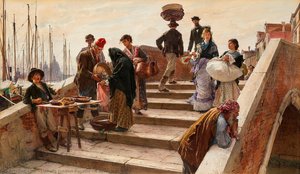
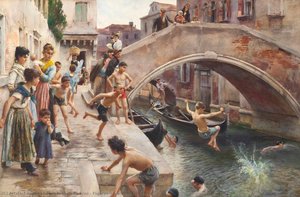
< p>However, it was his permanent move to Venice in 1873 that unlocked his most enduring creative period. Settling for three decades in the magnificent Palazzo Vendramin Calergi, Passini became a cornerstone of an illustrious artist colony. Alongside contemporaries such as Henry Woods and August von Pettenkofen, he participated in a vibrant intellectual exchange that pushed the boundaries of realism. His Venetian oeuvre is a breathtaking collection of watercolors and oils that serve as a visual chronicle of the city. Whether capturing the bustling activity on a bridge or the quiet, spiritual reverence of monks purchasing fish near a cathedral portal, Passini possessed a rare ability to find the extraordinary within the ordinary.Technique, Legacy, and Artistic Significance
The brilliance of Passini’s work lies in his seamless blend of realism and poetic atmosphere. His technique was characterized by a meticulous attention to detail—the texture of sun-drenched brickwork, the subtle shimmer of water, and the intricate folds of period clothing—all rendered with a sensitivity that avoids the coldness of mere documentation. In his watercolors, he achieved a luminous quality that captured the fleeting effects of light, while his oil paintings, such as the evocative A Bridge in Venice, utilized masterful composition to draw the viewer into the heart of the scene.
Beyond his technical prowess, Passini’s historical significance rests in his role as a bridge between classical tradition and the burgeoning interest in modern, everyday life. He did not seek the grandiosity of historical epics; instead, he sought the truth in a child's play or a merchant's trade. His legacy is preserved in the way he immortalized a vanishing way of life, providing future generations with a window into the vibrant, social tapestry of 19th-century Italy. Today, his works remain cherished for their ability to evoke nostalgia and a profound sense of human connection, ensuring that the name Ludwig Johann Passini remains synonymous with the timeless beauty of the Venetian spirit.

ludwig johann passini
1832 - 1903
Quick Facts
- Artistic Movement Or Style: Realist
- Artists Or Movements Influenced By This Artist: ['Henry Woods']
- Artists Who Influenced This Artist:
- Joseph von Führich
- Leopold Kupelwieser
- Date Of Birth: 1832
- Date Of Death: 1903
- Full Name: Ludwig Johann Passini
- Nationality: Austrian
- Notable Artworks:
- A Shared Confidence
- Roman Children at Play
- Princess Rospigliosi and Baroness Baude
- Place Of Birth: Vienna, Austria
Related Articles

Watercolor Wonders: 10 Masterpieces That Redefined Art History | ArtsDot
Journey through 10 legendary watercolor masterpieces by Sargent, Turner & Homer! Explore iconic landscapes, portraits & floral art that redefined history. Find museum-quality reproductions and curated decor ideas at ArtsDot.com.

Ephemeral Visions: Exploring the Artistic Legacy & Contemporary Practice of Watercolor Painting
Explore the captivating world of watercolor painting! Discover its rich history, essential techniques, influential artists & collecting tips. A comprehensive guide for art enthusiasts from ArtsDot.

Ephemeral Visions: Exploring the History & Emotional Resonance of Watercolor Painting
Explore the captivating history of watercolor painting, from ancient techniques to modern masters like Kandinsky & Blake. Discover essential artists, collecting tips & the emotional power of this luminous medium. Expert insights for art enthusiasts.
Ephemeral Visions: Exploring the Artistic Legacy & Nuances of Watercolor Painting
Explore the captivating world of watercolor painting! Discover its rich history, essential techniques, influential artists & collecting tips from art experts. A comprehensive guide for enthusiasts.
The Enduring Appeal of Watercolor: History, Techniques & Contemporary Practice
Explore the captivating world of watercolor painting! Discover its rich history, essential techniques, influential artists, and collecting tips. A comprehensive guide for art enthusiasts.