 Preview
 Send
Send Share
Share
 Details

 Download
 Similars
 X-Ray
X-Ray Diaporama
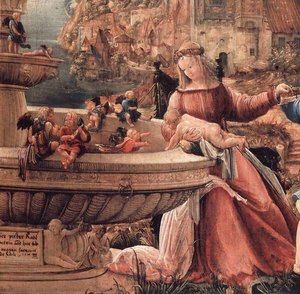
LA FUITE EN EGYPTE


 Read More
Hand Made Oil Reproduction
Hand-painted oil on canvas in your size and frame, made to order by our artists. ( Buy Print Buy Image)




P118B $10

P118H $10

P118W $10

P438Z $10

P508JH $12

P508YH $12

P805H $10

P805Z $10

P919BZ $10

P919G $10

P919XJ $10

P959ZH $10

P968JZ $12

W106C $8

W218G $10

W218JH $8

W218Y $10

W307PJ $10

W316G $10

W316PJ $8

W316Y $10

W398PJ $8

W4111J $10

W500HY $15

W500JH $15

W692G $12

W849H $8

W940BG $15

W953PJ $8




Pick from our preset sizes that match the artwork's original proportions.

You may enter your own dimensions to fit a specific frame or space. If your selected size does not match the original image's proportions, we will either crop the artwork or extend the painting with additional hand-painted elements. A digital mockup will be sent for your approval before production begins.
Please note that the on-screen preview does not reflect the actual cropping or extension. Only the mockup will accurately show the final composition.
While custom sizes are available, we recommend selecting a dimension from the predefined list to preserve the original proportions.
After order, ArtsDot.com team will email client for instructions and provide a mockup preview
Worldwide Delivery () in 3/4 weeks instead of standard 5 weeks. (17 August). No compromise on quality.

Free Worldwide Express Shipping

High-Quality Linen Canvas

Full Shipping Insurance

Customs Tax Refund Guarantee

True Color Matching Guarantee

60-Day Return Policy (Defects Only)

100% Money-Back Guarantee

Bulk Discount Offer
 Glass option is only available in size under 110 CM

LA FUITE EN EGYPTE
Reproduction Medium
Reproduction Size
-


Total Price
$ 313
Artwork Description
A Journey Etched in Canvas: The Flight into Egypt
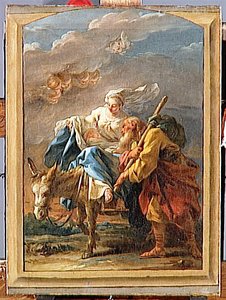
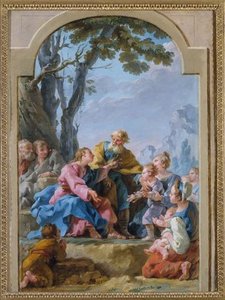
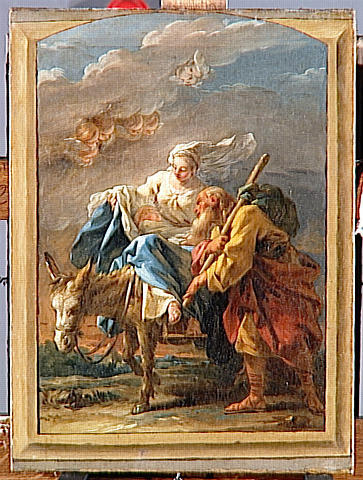
To gaze upon this depiction of La Fuite en Egypte is to be transported across the dusty, sacred paths of antiquity. This painting captures one of Christianity's most profound narratives—the perilous journey of Mary, Joseph, and the infant Jesus fleeing persecution. The composition itself guides the eye upward and forward, mirroring the desperate yet divinely guided movement of the Holy Family. It is a scene steeped in quiet drama, where the weight of history meets the promise of faith. The artist masterfully arranges the figures into a stable, almost pyramidal grouping, lending an immediate sense of both vulnerability and enduring strength to the central tableau.
Echoes of 18th-Century Grandeur
The style speaks eloquently of the late Baroque transitioning into Neoclassicism, hallmarks of the era when Noël Hallé was at his zenith. While the subject matter is deeply religious, the execution possesses a certain polished grace characteristic of 18th-century European painting. One can observe the influence of classical ideals—the idealized forms of the figures and the dramatic yet controlled use of drapery. The artist employs soft, flowing lines to define the garments, making the fabric seem less like painted pigment and more like living material caught in a gentle breeze. This technical finesse suggests an academic mastery, where every fold and gesture contributes to the overall narrative flow.
Color, Light, and Emotional Resonance
The palette is a study in muted warmth contrasted by celestial blues. Earthy browns and ochres dominate the landscape and the travelers' robes, grounding the scene in reality, while Mary’s vibrant blue robe serves as a luminous focal point—a beacon of purity amidst the journey's hardship. The lighting is exquisitely diffused; there are no harsh spotlights, only a gentle, pervasive glow that seems to emanate from the divine presence overhead. This soft illumination bathes the figures in an aura of serenity, transforming what could be a scene of terror into one of profound, enduring devotion. The hovering angels above serve not merely as decoration, but as visible manifestations of divine protection.
Symbolism and Interior Harmony
For the collector or designer, this piece offers more than mere ornamentation; it provides an emotional anchor for any space. Symbolically, the journey represents perseverance—the steadfast commitment to faith despite overwhelming adversity. The inclusion of the donkey adds a touch of humble realism to the divine narrative. When considering its placement, one must appreciate how its vertical orientation draws the eye upward, lending height and spiritual aspiration to a room. Its aged patina, captured in the reproduction, invites contemplation, suggesting that the stories depicted are timeless, echoing through centuries.
Related Artworks
Artist Biography
A Legacy of Grandeur: The Life and Art of Noël Hallé
In the luminous landscape of 18th-century French painting, few names evoke the intersection of classical reverence and royal splendor quite like Noël Hallé. Born in Paris in 1711 into a family steeped in the traditions of the brush, Hallé was destined for a life defined by the pursuit of aesthetic perfection. As the son of the painter Claude-Guy Hallé, his early years were an immersion in the nuances of color and composition, providing him with a foundational mastery that would later allow him to navigate the complex demands of the French court. His journey was not merely one of inherited skill, but of profound intellectual expansion, driven by a desire to capture the monumental weight of history through the delicate lens of the Baroque style.
The defining chapter of Hallé’s artistic development began with his triumph in 1736, when he secured the prestigious Prix de Rome. This achievement served as his gateway to the eternal city, where from 1737 until 1744, he resided within the hallowed halls of the Académie Royale Française. It was in Rome that Hallé’s artistic soul truly encountered its greatest inspirations. The sheer scale of Roman architecture and the dramatic tension found in classical sculpture left an indelible mark upon his psyche. Under the guidance of masters like Jean-François de Troy, he learned to synthesize the rigorous discipline of classical technique with a burgeoning sense of theatricality. His works from this period reflect a deep fascination with mythological narratives and historical epochs, rendered with a meticulous attention to detail that breathes life into ancient stone and legend.
Mastery of Technique and Royal Patronage
Upon his return to France, Hallé’s reputation preceded him, leading to an illustrious career characterized by high-stakes commissions and royal recognition. During the reign of Louis XV, he became a sought-after talent for the most prestigious institutions in Europe. His ability to weave complex historical narratives into visually arresting compositions made him an ideal choice for the Gobelins Manufactory and the opulent halls of Versailles. Hallé possessed a rare gift for portraying the grandeur of aristocratic life, capturing the quiet dignity of the elite amidst settings of unparalleled luxury. Whether decorating the Grand Trianon or the Petit Trianon, his brushwork served to reinforce the prestige of the French monarchy, blending the monumental with the intimate.
The technical brilliance of Hallé’s oeuvre lies in his sophisticated use of light and color. He did not merely paint scenes; he constructed atmospheres. His palettes were often vibrant yet controlled, capable of conveying both the intellectual rigor required by academic standards and the emotional intensity necessary to engage the viewer's heart. In his historical paintings, one can observe a seamless integration of:
- Classical Precision: A dedication to anatomical accuracy and architectural integrity derived from his Roman studies.
- Baroque Drama: The use of chiaroscuro and dynamic movement to elevate historical events into epic spectacles.
- Narrative Depth: An ability to imbue even the smallest figure with a sense of purpose and emotional resonance.
Historical Significance and Enduring Impression
As the 18th century progressed, Hallé’s work stood as a testament to the enduring power of classical ideals in an era of shifting tastes. While the art world began to move toward new sensibilities, his commitment to the grandeur of the past provided a sense of continuity and cultural stability for the French state. His contributions to the decorative arts and historical painting helped define the visual identity of the Louis XV era, leaving behind a legacy that celebrates the marriage of scholarly knowledge and artistic intuition.
Today, the works of Noël Hallé remain vital windows into a lost world of elegance and epic storytelling. He remains a pivotal figure for scholars and art enthusiasts alike, representing a moment in history when the brush was used to bridge the gap between the ancient glories of Rome and the contemporary splendor of Paris. His life, spanning from his birth in 1711 to his passing in 1781, serves as a complete arc of an artist who mastered the art of making history live again on canvas.
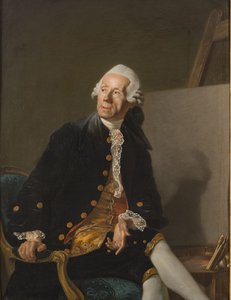
noël hallé
1711 - 1781 , France
Quick Facts
- Artistic Movement Or Style: Baroque
- Artists Or Movements Influenced By This Artist: ['Classical Paintings']
- Artists Who Influenced This Artist: ['Jean-François de Troy']
- Date Of Birth: September 2, 1711
- Full Name: Noël Hallé
- Nationality: French
- Notable Artworks:
- The Death of Seneca
- Cornelia, Mother of the Gracchi
- Justice of Trajan
- Place Of Birth: Paris, France
Related Articles

The Enduring Legacy of Oil on Canvas: Technique, History & Aesthetic Impact
Explore the rich history & techniques of oil painting – from Renaissance masters to Impressionism. Discover pigments, layering methods, and why this timeless medium endures. Expert insights for artists & art enthusiasts.

Oil on Canvas: A Historical & Technical Exploration of a Timeless Artistic Medium
Explore the rich history & enduring techniques of oil painting on canvas. Discover the science behind its longevity, conservation practices, and contemporary relevance. Expert insights for art enthusiasts.

The Enduring Power of Painting: A Historical & Contemporary Exploration of Form and Emotion
Explore the rich history & enduring techniques of oil painting with ArtsDot. Discover masterpieces, learn about art collecting, and find authentic handmade reproductions crafted by skilled artists.

The Enduring Legacy of Oil on Canvas: Technique, History & Contemporary Practice
Explore the rich history & enduring techniques of oil painting on canvas. Discover the science behind its longevity, conservation practices, and contemporary relevance. Expert insights for art enthusiasts.
18th Century Masters: 10 Artworks That Define an Era | ArtsDot
Journey through 18th century art! Explore 10 iconic paintings – from Rococo elegance to Neoclassical grandeur. Discover Fragonard, David & more. Find museum-quality reproductions and elevate your home decor on ArtsDot.com.