 Preview
 Send
Send Share
Share
 Details

 Download
 Similars
 X-Ray
X-Ray Diaporama
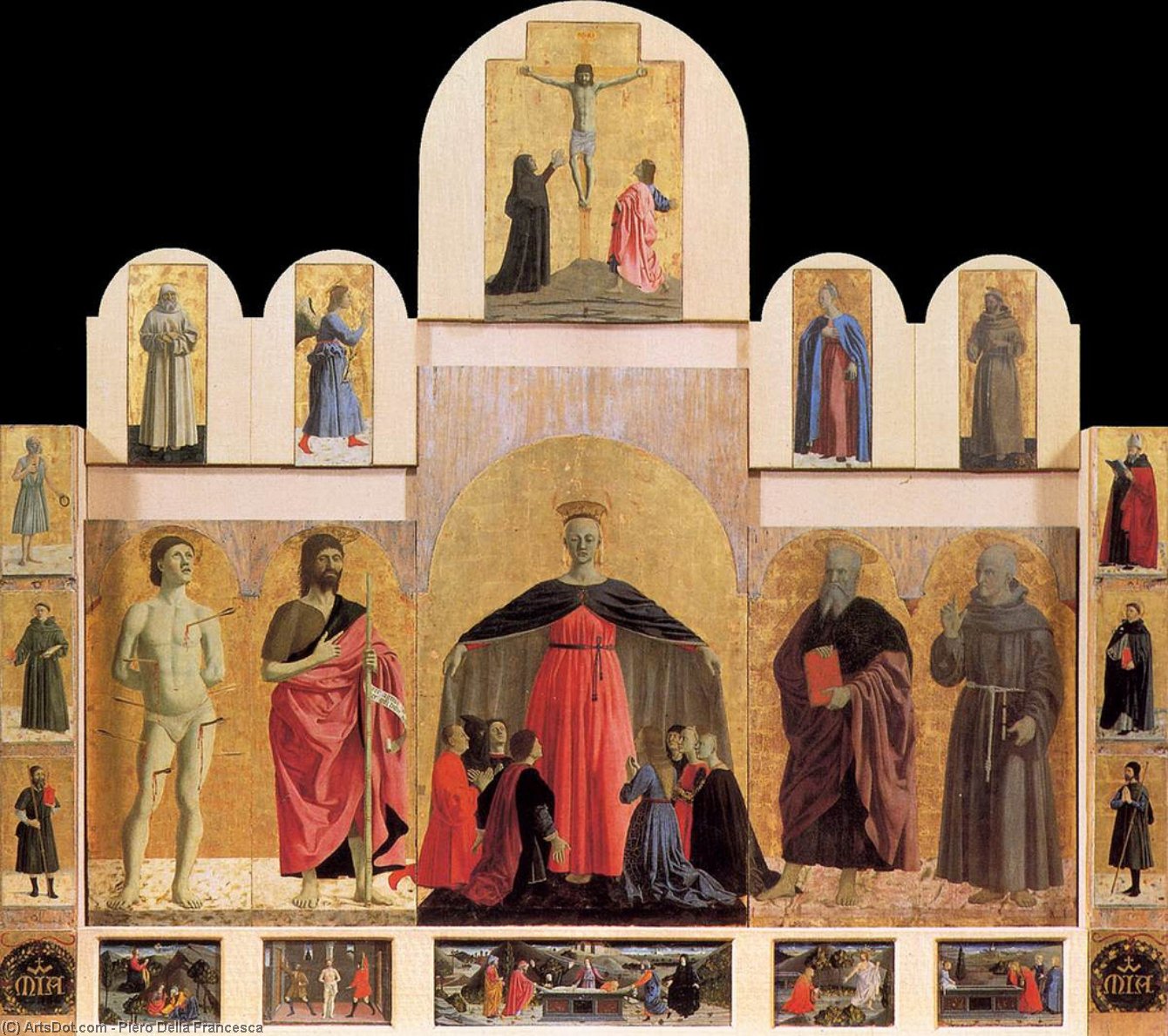
Polyptych of the Misericordia
 Oil On Panel
- Early Renaissance
 1445
1445- Renaissance
 330.0 x 273.0 cm
 Pinacoteca Comunale
 Read More
Hand Made Oil Reproduction
Hand-painted oil on canvas in your size and frame, made to order by our artists. ( Buy Print Buy Image)




P118B $10

P118H $10

P118W $10

P438Z $10

P508JH $12

P508YH $12

P805H $10

P805Z $10

P919BZ $10

P919G $10

P919XJ $10

P959ZH $10

P968JZ $12

W106C $8

W218G $10

W218JH $8

W218Y $10

W307PJ $10

W316G $10

W316PJ $8

W316Y $10

W398PJ $8

W4111J $10

W500HY $15

W500JH $15

W692G $12

W849H $8

W940BG $15

W953PJ $8




Pick from our preset sizes that match the artwork's original proportions.

You may enter your own dimensions to fit a specific frame or space. If your selected size does not match the original image's proportions, we will either crop the artwork or extend the painting with additional hand-painted elements. A digital mockup will be sent for your approval before production begins.
Please note that the on-screen preview does not reflect the actual cropping or extension. Only the mockup will accurately show the final composition.
While custom sizes are available, we recommend selecting a dimension from the predefined list to preserve the original proportions.
After order, ArtsDot.com team will email client for instructions and provide a mockup preview
Worldwide Delivery () in 3/4 weeks instead of standard 5 weeks. (22 August). No compromise on quality.

Free Worldwide Express Shipping

High-Quality Linen Canvas

Full Shipping Insurance

Customs Tax Refund Guarantee

True Color Matching Guarantee

60-Day Return Policy (Defects Only)

100% Money-Back Guarantee

Bulk Discount Offer
 Glass option is only available in size under 110 CM

Polyptych of the Misericordia
Reproduction Medium
Reproduction Size
-


Total Price
$ 263
Artwork Description
A Vision of Mercy and Divine Presence
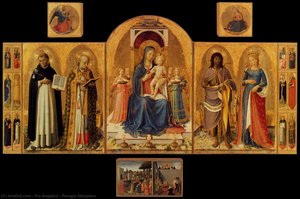
Piero della Francesca’s Polyptych of the Misericordia, a monumental work housed within the Museo Civico di Sansepolcro in Tuscany, isn't merely a painting; it’s an immersive experience. Commissioned in 1445 by the Compagnia della Misericordia, a confraternity dedicated to charitable works, this polyptych represents a pivotal moment in the artist’s career and a profound exploration of space, perspective, and human emotion. More than just a devotional image, it's a carefully constructed tableau designed to evoke a sense of awe and connection with both the divine and the earthly realms.
The polyptych unfolds as a series of panels, each contributing to a unified narrative. The central panel immediately draws the eye – a breathtaking depiction of the Virgin Mary, enveloped in her mantle, offering protection and solace to the kneeling members of the confraternity below. This gesture, known as *Madonna della Misericordia* (Our Lady of Mercy), is not simply an act of charity but a visual embodiment of divine grace. Piero masterfully manipulates space; the figures appear to be suspended within the voluminous folds of her cloak, creating a startlingly realistic three-dimensional effect that defies the limitations of the panel format. This innovative use of perspective, influenced by Brunelleschi’s architectural theories, was revolutionary for its time and established Piero as a pioneer in Renaissance art.
The Geometry of Faith: Composition and Technique
Piero della Francesca's genius lies not only in his ability to render human form with remarkable accuracy but also in his rigorous application of mathematical principles. The polyptych is a testament to this intellectual approach – a carefully calculated composition based on geometric ratios and proportions. The arrangement of figures, the placement of architectural elements, even the distribution of light and shadow, all adhere to precise mathematical relationships, creating a sense of harmony and balance. This meticulous attention to detail extends to the use of color; Piero employed a restrained palette of earthy tones – ochres, siennas, and umbers – that contribute to the painting’s solemn and contemplative mood.
The technique itself is equally noteworthy. Piero utilized oil on panel, a relatively new medium at the time, which allowed him to achieve subtle gradations of tone and create a luminous quality rarely seen in earlier works. The layering of glazes builds up depth and richness, while the careful modeling of forms gives them a tangible presence. Notice particularly the rendering of St. Sebastian’s body – a study in anatomical precision that echoes Masaccio's groundbreaking work in Florence. The influence of this Florentine master is evident throughout the polyptych, demonstrating Piero’s engagement with the artistic currents of his time.
Symbolism and Context: A Reflection of Sansepolcro
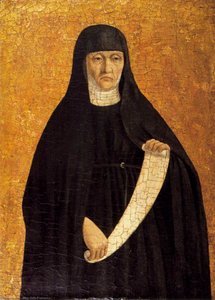
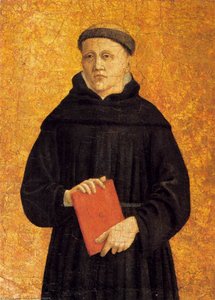
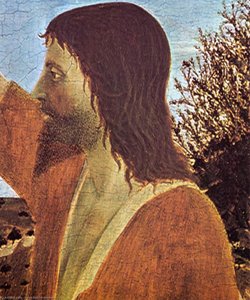
Beyond its formal qualities, the Polyptych of the Misericordia is rich in symbolism. The choice of subject matter – the Virgin Mary offering mercy – reflects the core values of the Compagnia della Misericordia, a charitable organization dedicated to providing assistance to the poor and sick. The inclusion of various saints—St. Sebastian, St. John the Baptist, St. Benedict, St. Francis—represents the diverse spiritual influences within the community. The predella panels depicting scenes from Jesus’s life further reinforce this devotional theme.
Furthermore, the polyptych is deeply rooted in the local context of Sansepolcro. The town's name, meaning "Holy Sepulchre," alludes to the importance of pilgrimage and devotion to sacred sites. The painting can be seen as a visual representation of Sansepolcro’s identity—a community committed to both earthly concerns and spiritual aspirations. It is a powerful testament to the intersection of art, faith, and civic pride.
Bringing Piero della Francesca Home: Reproductions for Your Space
ArtsDot offers meticulously crafted hand-painted reproductions of the Polyptych of the Misericordia, allowing you to experience the beauty and power of this Renaissance masterpiece in your own home. Our skilled artists faithfully recreate Piero’s intricate details, vibrant colors, and masterful use of perspective, ensuring that your reproduction captures the essence of this iconic work. Whether you are an art enthusiast, a collector, or simply seeking to add a touch of timeless elegance to your interior design, our reproductions provide a stunning way to connect with one of the most significant works in Italian Renaissance art.
Related Artworks
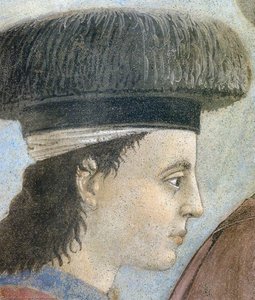
Artist Biography
A Tuscan Visionary: The Life and Art of Piero della Francesca
Born around 1415 in the quiet Umbrian town of Sansepolcro, Piero di Benedetto de’ Franceschi – known to history as Piero della Francesca – emerged from a relatively obscure background to become one of the most intellectually rigorous and profoundly influential painters of the Early Renaissance. Unlike many of his contemporaries whose lives are richly documented, Piero remains somewhat enigmatic; details about his family and early training are scarce. What *is* certain is that he possessed an extraordinary mind, equally captivated by the emerging artistic currents of Florence and the precise languages of mathematics and geometry. His father was a shoemaker and tanner, providing Piero with a stable if unostentatious upbringing, and it’s believed his initial artistic education occurred locally, absorbing the traditions of central Italian painting before the seismic shifts initiated by Masaccio and Brunelleschi. This early grounding would prove crucial in shaping his unique synthesis of Gothic grace and Renaissance innovation.
Florence and the Dawn of a New Aesthetic
Around 1439, Piero journeyed to Florence, a city then pulsating with artistic energy. This period proved transformative. He collaborated with Domenico Veneziano on frescoes for the church of Sant’Egidio, an experience that exposed him directly to the burgeoning Florentine style. More importantly, he immersed himself in the study of Masaccio's groundbreaking frescoes in the Brancacci Chapel – a revelation in naturalism and spatial illusion. The influence of Brunelleschi’s architectural innovations, particularly his mastery of linear perspective, also deeply impacted Piero’s artistic development. He didn’t merely adopt these techniques; he *analyzed* them, dissecting their underlying mathematical principles. This analytical approach would become the hallmark of his work, setting him apart from many of his peers. He absorbed the Florentine emphasis on realism and anatomy but filtered it through a distinctly personal lens, one characterized by stillness, clarity, and an almost austere beauty. Upon returning to Sansepolcro in the 1440s, Piero began establishing himself as a leading artist, though he continued to travel and work throughout Italy for decades.
Masterpieces of Light and Geometry
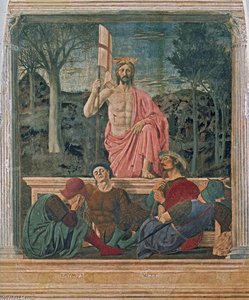
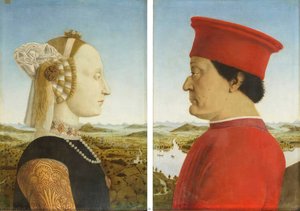
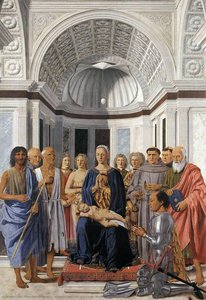
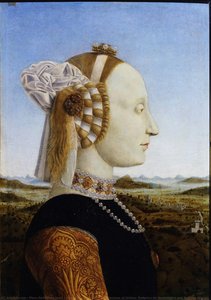
Piero della Francesca’s artistic legacy rests on a relatively small but exceptionally powerful body of work. Perhaps his most celebrated achievement is the fresco cycle *The History of the True Cross* in the church of San Francesco, Arezzo. This monumental narrative unfolds with remarkable clarity and serenity, depicting scenes from the legend of the wood of the cross with an unprecedented sense of spatial depth and psychological insight. The figures are not merely representations of biblical characters; they are imbued with a quiet dignity and contemplative stillness that elevates them to archetypal forms. The *Montefeltro Altarpiece*, now in Milan’s Brera Gallery, showcases his mastery of oil painting and refined portraiture, featuring striking depictions of Federico da Montefeltro and Battista Sforza – portraits celebrated for their psychological acuity and meticulous detail. The *Baptism of Christ* in the National Gallery, London, is another testament to his skill; its elegant composition, luminous colors, and subtle exploration of light create an atmosphere of profound spiritual resonance. His style consistently demonstrates a commitment to geometric precision, balanced compositions, and a restrained palette, utilizing light and shadow not merely for aesthetic effect but as tools for defining form and creating a sense of palpable volume.
Beyond the Brush: A Mathematician’s Vision
What truly distinguishes Piero della Francesca is his unique intellectual breadth. He was not simply an artist; he was also a mathematician, geometer, and author. His treatise *De Prospectiva Pingendi* (On Perspective Painting) stands as one of the earliest formal treatises on perspective, demonstrating his profound understanding of mathematical principles and their application to art. This work wasn’t merely theoretical; it informed every aspect of his painting. He meticulously calculated spatial relationships, employed geometric constructions to organize compositions, and used light not just to illuminate but to define form with scientific precision. His interest in optics further enhanced his ability to create illusions of depth and realism. This fusion of artistic sensibility and mathematical rigor is what gives Piero’s work its enduring power and intellectual weight. He believed that beauty resided in order and proportion, and he sought to translate these principles into visual form.
A Lasting Legacy
Piero della Francesca died in 1492, leaving behind a legacy that would not be fully appreciated for centuries. Though not as prolific as some of his contemporaries like Leonardo da Vinci or Michelangelo, his surviving works exerted a subtle but profound influence on generations of artists. Leonardo himself studied Piero’s techniques and admired his mastery of light and shadow. Raphael, too, drew inspiration from his compositions and spatial arrangements. In the 20th century, art historians rediscovered Piero's work, recognizing him as a pivotal figure in the development of Renaissance art – a bridge between the International Gothic style and the High Renaissance. His emphasis on mathematical perspective, realistic representation, and serene humanism continues to resonate with artists and viewers alike, solidifying his place as one of the most important and enduring masters of the Italian Renaissance. His paintings are not merely beautiful objects; they are windows into a world where art, science, and spirituality converge in harmonious balance.
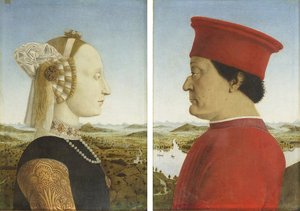
Piero della Francesca
1415 - 1492 , Italy
Quick Facts
- Artistic Movement Or Style: Early Renaissance
- Artists Or Movements Influenced By This Artist:
- Leonardo da Vinci
- Raphael
- Artists Who Influenced This Artist:
- Masaccio
- Domenico Veneziano
- Date Of Birth: c. 1415
- Date Of Death: 1492
- Full Name: Piero della Francesca
- Nationality: Italian
- Notable Artworks:
- The Resurrection
- Montefeltro Altarpiece
- Baptism of Christ
- True Cross frescoes
- Place Of Birth: Sansepolcro, Italy
Related Articles

The Fresco as Family Legacy: Preserving Heritage Through Wall Art
Explore the rich history & enduring legacy of fresco painting. Discover how to preserve family heritage through stunning wall art. Expert insights & restoration guidance.
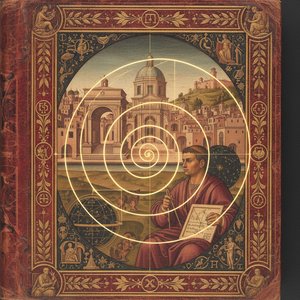
Piero della Francesca: Renaissance Perspective, Divine Proportion & the Pursuit of Ideal Form
Explore the revolutionary art of Piero della Francesca – master of perspective, divine proportion & Renaissance humanism. Discover his iconic paintings & lasting influence on art history.

The Enduring Legacy of Fresco Painting: Techniques, History & Contemporary Relevance
Explore the rich history & enduring artistry of fresco painting – from Giotto to Michelangelo! Discover techniques, conservation efforts, & modern applications. Learn how ArtsDot brings this timeless art form to your home.

The Enduring Legacy of Fresco: Technique, History & Artistic Expression Across Cultures
Explore the rich history & enduring legacy of fresco painting! Discover ancient techniques, Giotto's masterpieces, and modern applications. Expert insights for art lovers & professionals.
The Enduring Legacy of Fresco: Technique, History & Artistic Expression
Explore the rich history & enduring artistry of fresco painting. Discover techniques from Giotto to Michelangelo, conservation efforts, & modern applications. Learn how ArtsDot brings this timeless art form to your home.